
Toyota
Toyota · Automotive · Filed May 4, 2026 · USPTO published Nov 19, 2026 · This week's release
Toyota Files Patent to Stop Cars From Draining While Plugged In
Your EV can show a lower battery after a night on the charger, because the car itself used more power than a weak charger delivered. Toyota's patent application has the car check first and skip charging when the numbers fall short.
- Publication number
- US 2026/0365064 A1(US20260365064A1)
- Applicant
- TOYOTA JIDOSHA KABUSHIKI KAISHA
- Filed · Published
- May 4, 2026 · Nov 19, 2026
- Inventors
- Shun SATO
- Status when we published
- Waiting for an examiner
- Document
- 14 claims
- US classification
- 320/109
What Toyota's weak-charger cutoff actually does
You plug your EV into a weak outlet in the garage before bed. In the morning you check the app and the battery is lower than when you started. The car was "charging" all night, but it spent more power running its own computers than the cable could deliver.
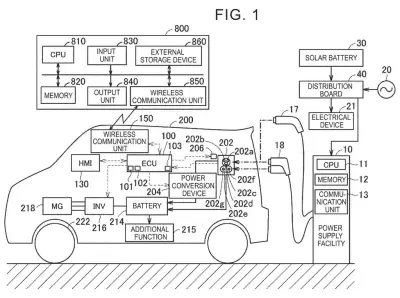
Toyota's patent application adds a check before charging begins. The car works out the most power the charger can supply, then compares that to what the car itself needs just to stay awake. That includes its main computer, plus extras like an air conditioner or a drive recorder. If the charger has power to spare, charging starts.
If the charger falls short, the car doesn't start charging and puts a message on its screen saying so. The filing also allows for wear and tear: wiring loses a little more power as a car gets older, and the math accounts for that.
… determine a first value that allows a determination of maximum power of power output from the power supply facility to the vehicle, charge the battery in a case where the first value is greater than a predetermined second value, and refrain from charging the battery in a case where the first value is less than the second value.
Translation: The car checks how much power the outlet can provide and refuses to charge if the available power is too low.
How the car compares charger output to its own use
The core claim is a gatekeeper. A processor in the vehicle (in the examples, the ECU, or electronic control unit, the car's main computer) determines a first value that reveals the maximum power the charger can send. It compares that to a preset second value. Above it, the car charges. Below it, the car refrains.
The description fills in how the numbers come about:
- Charger can talk to the car: the car asks for the maximum current. In a home with solar panels, that can be the leftover power after the house's own appliances.
- Charger can't talk: the car guesses from stored charging history at that location, using either the highest or the average past maximum.
- The car's own draw: the computer alone uses tens to hundreds of watts. Extras such as an air conditioner or drive recorder add more. The filing also allows a fixed stand-in current such as 1 A or 6 A, and claim 4 covers a threshold above 0 A and up to 1 A.
- Aging wiring: resistance in the car's power line rises over the years, so the car estimates efficiency from years since manufacture.
A fuller version uses two thresholds: a lower bar for the computer alone and a higher bar when the extras are running. If charging is refused, the car's touch screen says it has not started.
Why Toyota's plug-in check matters for slow chargers
The practical payoff is avoiding a confusing moment: a car that says it's charging while the battery shrinks. The filing says this can leave a driver uneasy when the charge level falls during charging. Weak sources are where it would show up, such as a slow home circuit or a solar setup whose leftover power is small. The filing describes plug-in hybrids and battery-electric cars alike.
The patent's answer is to refuse charging when the supply can't cover the car's own needs, and to tell you. It doesn't speed anything up or find extra power. For you, the benefit would be an honest "not charging" message in place of a battery that looks like it's charging but isn't.
Toyota's ninth filing we've tracked since November in our Toyota coverage follows patents like the side mirror camera display and the update-during-parking fix.
Source: US 2026/0365064 A1 at the USPTO (PDF). Full patent text and figures are in the official publication.
Get our take in your Top Stories
Liked this breakdown? Add Patentlyze as a preferred source on Google, and our plain-English take shows up more often in your Top Stories the next time Toyota patent news breaks.
Add Patentlyze on Google
One click.
There are more where this came from
We read the new patents from Big Tech, carmakers and more and send you the ones worth knowing. Plain English, free, every week.
The drawings · 6 sheets
6 drawing sheets from US 2026/0365064 A1 · click any drawing to enlarge


More from Toyota
All 16 Toyota patents →
More in Automotive
All 432 Automotive patents →
Waymo (Google)
Waymo Files Patent for Suggesting Nearby Pickup Spots When Your Pin Won't Work
Hyundai & Kia
Kia Files Patent for Evening Out EV Battery Temperatures Before Charging
Hyundai & Kia
Kia Patents a Charging Plug Hidden in the Center of Your Car's Wheel
BMW
No comments yet