
Toyota
Toyota · Energy · Filed Apr 14, 2026 · USPTO published Nov 19, 2026 · This week's release
Toyota Files Patent for Giving Used Car Batteries a Ready-Made AI Brain
When a car battery retires, it can go on to power a house or a store. Toyota's new patent is about how to keep an AI watching its health without starting from scratch.
- Publication number
- US 2026/0367157 A1(US20260367157A1)
- Applicant
- TOYOTA JIDOSHA KABUSHIKI KAISHA
- Filed · Published
- Apr 14, 2026 · Nov 19, 2026
- Inventors
- Daiki YOKOYAMA, Kouichi YOKOYAMA
- Status when we published
- Waiting for an examiner
- Document
- 7 claims
- US classification
- 324/426
What Toyota's used-battery model matching does
A car battery has spent eight years in a taxi, running hard every day. Now it is being pulled out and wired up to a store's backup power system, where life is very different.
The trouble is knowing how healthy that battery really is. Software can estimate this, but it has to be trained, and training usually takes a mountain of data that a freshly reused battery does not have yet.
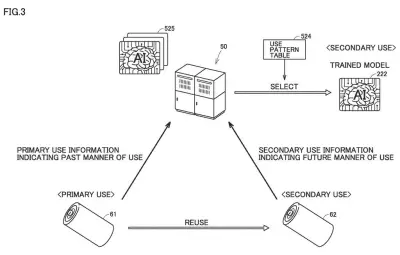
Toyota's patent gets around this by keeping a library of already-trained models. It looks at how the battery was used before (commuting, taxi, car rental) and how it will be used next (a household, a factory, a store), then picks the model that fits that pairing. That means a reused battery can get decent monitoring on day one.
… a model selection unit that selects, from among a plurality of trained models trained to estimate a battery parameter indicating a state of the battery during the primary use, a trained model for estimating the battery parameter during the secondary use, based on the primary use information and the secondary use information.
Translation: The system picks the best AI brain for a used battery by comparing how it was driven before and after.
How Toyota pairs a battery's past with its future
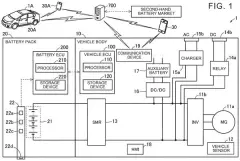
The system has three main parts: a unit that collects primary use information (how the battery was used in its first life), a unit that collects secondary use information (how it is being used in its second life), and a model selection unit that chooses one trained model from a stored set.
The filing gives a concrete example. A vehicle battery's first life is sorted into one of five patterns: commuting, shopping, taxi, ridesharing, or car rental. Its second life as a stationary battery is sorted into one of five more: single-earner household, dual-earner household, daytime factory, three-shift factory, or store. Five times five makes 25 combinations, and each one is tied, along with the battery type, to its own trained model in a lookup table.
Once chosen, the model can be fine-tuned using transfer learning (reusing part of an already-trained neural network and retraining only the last layers on new data). That takes far less data and computing time than building a model from scratch.
The models estimate values such as state of charge (how full the battery is), state of health (how much capacity it has left), self-discharge, and abnormalities like swelling or leaks. The filing also describes topping up under-trained models with data from secondary use.
The battery management system includes a primary use information acquisition unit that acquires primary use information indicating a manner of use of a battery during primary use of the battery …
Translation: It tracks how the battery was used in its first life to understand its condition.
Why Toyota's battery reuse filing matters at home
If you ever buy solar storage or use a business that runs on reused EV batteries, the payoff is trust. Knowing how much charge and life a used battery really has decides how safely and how long it can be run.
For Toyota and other carmakers, the filing speaks to a practical problem: millions of EV batteries will leave cars while still holding useful capacity. A way to monitor them accurately from the first day makes reuse cheaper and easier to offer. The filing also notes that the system can respond to the estimates, for example by lowering charge and discharge power.
Toyota's fifth filing we've tracked since November in our Toyota coverage follows patents on pricing used EV batteries and faster car summoning.
Source: US 2026/0367157 A1 at the USPTO (PDF). Full patent text and figures are in the official publication.
Get our take in your Top Stories
Liked this breakdown? Add Patentlyze as a preferred source on Google, and our plain-English take shows up more often in your Top Stories the next time Toyota patent news breaks.
Add Patentlyze on Google
One click.
There are more where this came from
We read the new patents from Big Tech, carmakers and more and send you the ones worth knowing. Plain English, free, every week.
The drawings · 13 sheets
13 drawing sheets from US 2026/0367157 A1 · click any drawing to enlarge


Show the other 5 sheets


More from Toyota
All 16 Toyota patents →
More in Energy
All 147 Energy patents →
Honda
Honda Patents a Battery-Swap Station That Keeps Spare Batteries Partly Charged
Honda
Honda Patents a Heating and Cooling System That Reuses Energy for Carbon Removal
Apple
Apple Patents a Magnetic Rubber Layer That Helps Trackpads Click With Less Power
Apple
No comments yet