
IBM Patents an AI That Checks Its Own Confidence Before Answering Without a Full Team
Most AI systems fail silently when part of their infrastructure goes offline. IBM's new patent describes a way for an AI to notice it's working with incomplete information and only answer when it's confident enough to be trusted.
How IBM's partial-ensemble AI avoids blind guesses
A hospital's AI diagnosis tool runs on five models working together. One night, two of those models go offline for maintenance. The remaining three keep running, but nobody warned them to be more careful about the answers they give.
That gap is what this IBM patent tries to close. The system keeps a running check on how confident the available models actually are before it delivers any answer to you. If the group that showed up for work can still meet a minimum quality bar, the answer goes out. If they can't, it stays put.
Think of it like a group of doctors voting on a diagnosis. If two out of five are absent, the remaining three still vote, but only report their conclusion if they agree strongly enough. IBM's system does the same thing automatically, in real time, without waiting for a human to notice something is wrong.
… generating an aggregated prediction in response to the inference request, wherein the aggregated prediction aggregates individual predictions generated by machine learning models of the ensemble identified as available to generate a prediction …
Translation: The system combines guesses from whichever models are currently working to form a single answer.
How the confidence check gates the final prediction
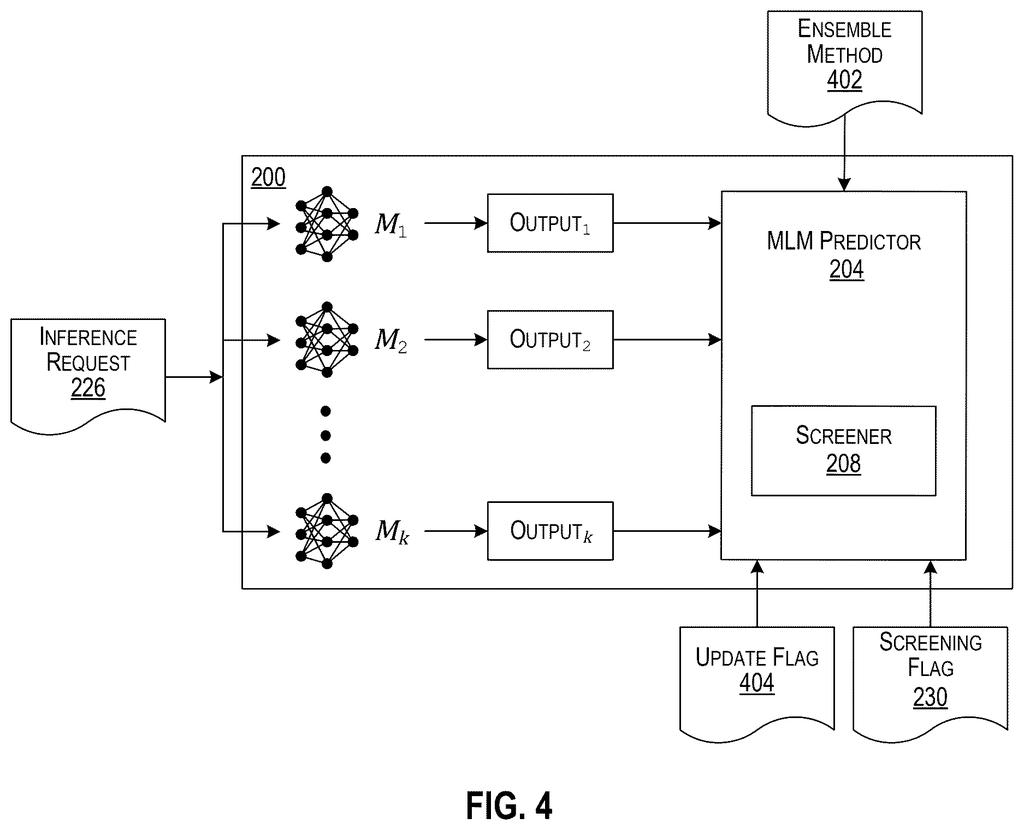
The patent describes an ensemble inference system (a setup where multiple AI models vote on an answer, then combine their votes into one prediction). The core idea is that the system is built to handle the case where some models in that ensemble are temporarily unavailable.
When a prediction request comes in, the system first checks which models are online and ready. It then collects predictions from whatever subset is available and combines them into an aggregated prediction (a single blended answer drawn from the available votes).
- Performance guarantee: Before outputting anything, the system calculates a confidence score based on only the available models. This is essentially a mathematical promise about how much the partial group's answer can be trusted.
- Threshold check: That confidence score is compared against a preset minimum bar. If the score clears the bar, the answer is released. If it doesn't, the system can withhold the output rather than send a potentially unreliable result.
- Graceful degradation: The design explicitly accounts for less-than-full availability as a normal operating condition, not an exception to be patched.
The patent frames this as useful for scenarios where models are being updated, swapped out, or retrained on a rolling basis, which is common in production AI deployments where you can't take the entire system offline for maintenance.
Responsive to determining that less than all of the ensemble of machine learning models are available, a performance guarantee based on the individual predictions is generated.
Translation: When some parts of the AI are missing, it calculates a score to measure its own reliability.
What self-validating AI means for high-stakes deployments
AI reliability is one of the least-glamorous and most expensive problems in production deployments. When a company runs AI in a hospital, a bank, or a factory floor, a silent wrong answer can be more dangerous than no answer at all. IBM's approach tries to build quality control directly into the prediction pipeline, so the system itself decides whether it's ready to speak rather than leaving that judgment to whoever happens to be monitoring it at the time.
For engineering teams running large-scale AI infrastructure, this kind of self-validating design reduces the operational burden of rolling updates. You don't have to wait for every model in an ensemble to be ready before you can serve predictions. The filing sits within a broader wave of AI reliability and ML-ops patents that Big Tech patent news has been tracking as companies race to make production AI behave predictably under real-world conditions.
IBM's 13th filing we've tracked since May on AI models working in teams adds to a thread that includes AI grading its own code and AI calling in human experts.
AI systems that keep running while secretly broken are one of the worst problems in business software. They sound confident, give wrong answers, and nobody notices until real damage is done.
IBM's new approach fixes this by teaching the system to check its own work. If too many parts of it have gone quiet mid-task, it stops and says so, rather than shipping a corrupted answer as if nothing were wrong.
That matters because the old danger was never a dramatic crash. It was a system failing in slow motion, decision by decision, while every dashboard showed green.
There are more where this came from
We read every patent application Big Tech publishes and send you the ones worth knowing. Plain English, free, every week.
The drawings
9 drawing sheets from US 2026/0244996 A1 · click any drawing to enlarge


Want this weekly breakdown for a company we don't cover? Patentlyze Pro →
Be the first to weigh in