
Intel Patents a System That Shifts AI Processing Strategies Mid-Task
Running AI on a chip is rarely one steady operation, it's a series of phases that each have different demands. Intel has filed a patent for hardware that automatically picks the best execution style for each phase, rather than committing to one approach for the whole job.
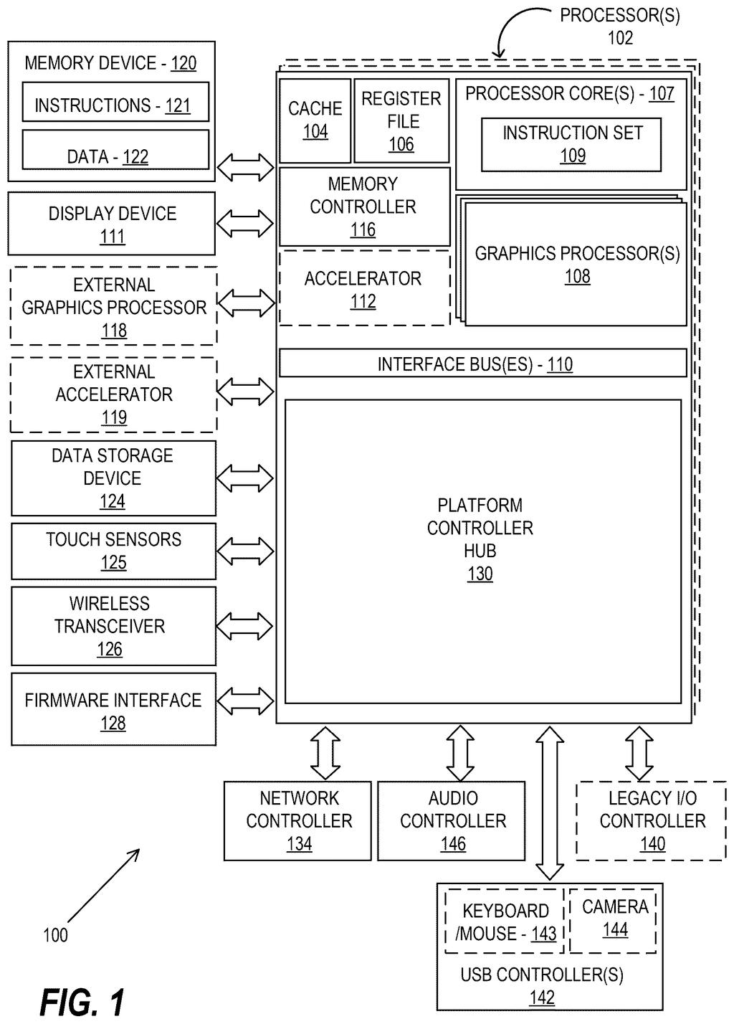
How Intel's mid-task mode switching actually works
Ever wondered why your phone gets hot running AI features, even on a small task? A big part of the answer is that AI work is uneven: some steps need every processor core doing the exact same thing in lockstep, while others need each core to wander off and follow its own thread of logic.
Intel's patent describes a chip component that acts like a traffic director. Instead of forcing all the AI work through one fixed lane, it reads what type of work is coming next and routes it to the right mode. If the next chunk is regular and repetitive, it goes one way. If it's irregular and branchy, it goes another.
The goal is to stop the chip from wasting energy and time running in a mode that's a bad fit for the moment. That matters because even a small mismatch between the workload and the hardware mode adds up across millions of operations in an AI model.
… dispatching hardware logic to determine whether a current phase of an inferencing routine is to be executed in the SIMD mode or the SIMT mode, and to dispatch instructions of the current phase for execution by the execution circuitry of a CU in accordance with the SIMD mode or the SIMT mode, respectively.
Translation: Specialized hardware decides how to run each step of an AI task on the fly.
How the dispatcher picks SIMD vs. SIMT per inference phase
The patent centers on a piece of dispatching hardware logic sitting in front of a set of compute units (the processing cores that do the actual AI math).
Each compute unit is built to run in two distinct modes:
- SIMD (Single Instruction, Multiple Data): Every core executes the exact same instruction at the same time, just on different chunks of data. Think of a drill team moving in perfect unison. This is efficient for regular, predictable operations like multiplying large arrays of numbers.
- SIMT (Single Instruction, Multiple Thread): Cores can diverge, each following its own execution path even within the same instruction cycle. This handles irregular work where different data points send the computation down different branches.
The dispatcher watches the current phase of an inference routine (a single AI model run is broken into multiple phases, not one monolithic pass). For each phase it determines which mode fits, then sends the instructions in the matching format.
The key claim is that this decision happens in hardware, not in software that runs before the chip starts. That means the switch can happen dynamically as the model progresses through its phases, without a programmer having to hand-annotate every step.
What this means for AI chip efficiency at scale
AI inference, the moment when a trained model actually answers your question or generates an image, is increasingly the most expensive operation data centers run. Chips that waste cycles by staying in the wrong execution mode for even a fraction of a model's phases pay a real efficiency penalty, multiplied across billions of requests.
Intel's steady investment in AI chip architecture shows up in filings like this one, which target the granular scheduling decisions that compound into serious performance gaps. For end users, more efficient inference means faster responses, lower costs passed down through cloud services, and potentially longer battery life on devices that run AI locally.
That makes this Intel's 38th filing we've tracked since May in our AI chip wars watchlist, following one on running software efficiently and one on car screen chip picks.
The problem this patent addresses is real and the scale of it is large. AI inference workloads are genuinely mixed: the attention layers in a transformer model behave very differently from the feed-forward layers that follow, and forcing both through the same hardware mode is a known source of inefficiency.
The solution here is tidy but not surprising. SIMD and SIMT are established ideas in chip design, and the insight that an AI model has distinct phases with different parallelism profiles has been in the research literature for years. The patent's claim is that Intel has built dispatching hardware to act on that insight automatically, which is incremental progress rather than a conceptual leap.
The honest read is that this is solid chip engineering housekeeping, the kind of optimization that accumulates into a measurable edge in a benchmark but won't change what AI can do. If you care about the long efficiency race between chip vendors, filings like this are worth understanding. If you're waiting for a step-change in AI capability, this isn't it.
There are more where this came from
We read every patent application Big Tech publishes and send you the ones worth knowing. Plain English, free, every week.
The drawings
47 drawing sheets from US 2026/0267655 A1 · click any drawing to enlarge


Want this weekly breakdown for a company we don't cover? Patentlyze Pro →