
Apple
Apple · AR / VR · Filed Apr 23, 2026 · USPTO published Nov 12, 2026 · This week's release
Apple Files Patent for a Headset That Stops Talking When You Tilt Your Head
Apple describes a headset that stops talking the moment your body language says you're about to speak, before you've said a word.
- Publication number
- US 2026/0359001 A1(US20260359001A1)
- Applicant
- Apple Inc.
- Filed · Published
- Apr 23, 2026 · Nov 12, 2026
- Inventors
- Thomas G. SALTER, Devin W. CHALMERS, Anna L. BREWER
- Status when we published
- Waiting for an examiner
- Document
- 20 claims
- US classification
- 715/727
- Parent application
- Claims priority from a provisional application 63804555 (filed May 12, 2025)
What Apple's pause-when-you-speak patent does
Ever tried to cut in on a voice that just keeps going? You're in the kitchen with your hands full, a recorded instruction is halfway through a long sentence, and you suddenly need to ask something.
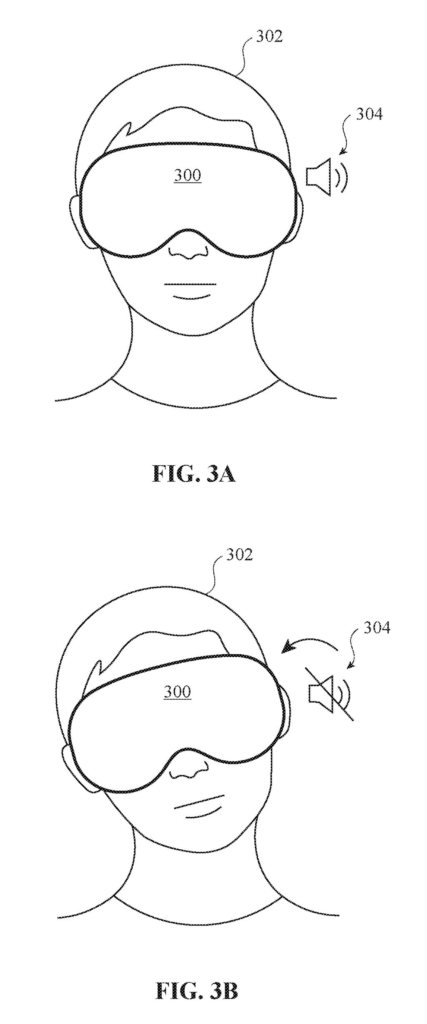
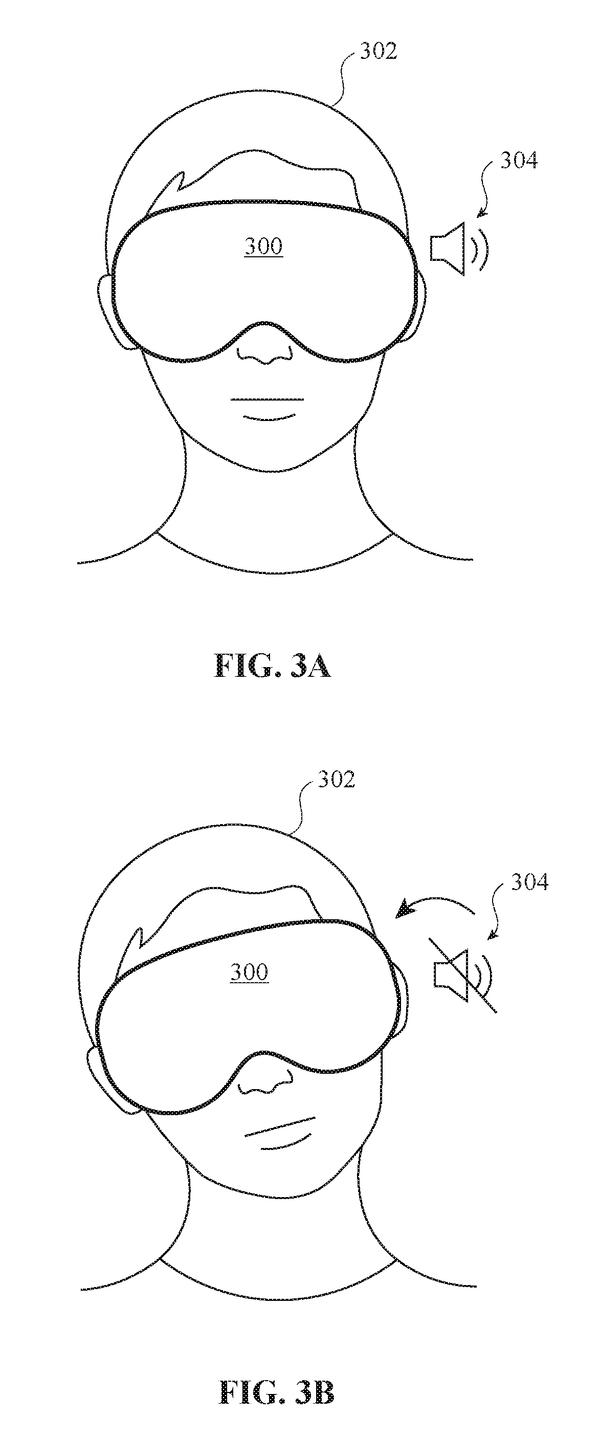
Apple's patent describes a wearable, such as a headset, that handles this by watching how you move. A head tilt, an open mouth or a half-raised hand can tell it you're about to talk, so it pauses its audio right away. It also considers when you moved: a tilt at the start of a sentence is a likelier interruption than one near the end.
If it guesses wrong, it recovers. When you don't follow up within a couple of seconds, it picks up where it left off.
detecting, via the one or more input devices, a first movement of a first portion of a user of the first computer system; determining a first user intention based on the first movement of the first portion of the user …
Translation: The headset watches how you move your body to figure out what you are trying to do.
How the headset scores a stray head tilt
The system watches your body through sensors a headset already has: a motion sensor (an inertial measurement unit, which feels tilts and shakes), cameras that face your eyes and face, and cameras that face outward. While audio is playing, it reads a movement, such as a head tilt, and guesses your intention. Claim 1 says that when the guess is that you want to speak, the device stops the audio. A different guess triggers a different action.
To make the guess, the movement can be fed into a model (a trained program that rates how likely each intention is), including one tuned to your own past habits. The device also checks the state of the audio. In the filing's example, a tilt near the start of a sentence scores 85% likely to be an interruption, while the same tilt late in a sentence scores 10%, against a 75% cutoff.
The filing also describes other responses:
- Resuming the audio if you don't follow up within a short window (2 seconds in one example).
- Playing fresh audio instead of resuming when you had already heard most of the first message.
- Explaining an object when you look at it and make a gesture.
- Cutting in to steer you back when your gaze drifts to the wrong item.
A second device with its own camera can also spot your movement and send the headset a signal.
in accordance with a determination that the first user intention corresponds to a first intention, performing a first action; and in accordance with a determination that the first user intention corresponds to a second intention, different from the first intention, performing a second action …
Translation: It triggers different responses depending on whether you want to talk or do something else.
What this means for hands-free Apple headsets
The practical payoff is talking to an audio guide the way you'd talk to a person. Cooking, fixing something or following directions often leaves your hands busy. A head tilt or an open mouth that silences the voice means you can cut in without reaching for anything.
The hard part is accuracy. A device that goes silent whenever you scratch your head would be annoying, which is why the filing leans on timing, a score and a quick auto-resume. The description also notes that gestures differ between people and cultures, so the device learns your own habits over time. Cameras watching your face and eyes also raise obvious privacy questions.
Apple's 52nd filing we've tracked since May in our eye and hand controls watchlist builds on a see-through zoom display and tracking eyes through display lenses.
Source: US 2026/0359001 A1 at the USPTO (PDF). Full patent text and figures are in the official publication.
Get our take in your Top Stories
Liked this breakdown? Add Patentlyze as a preferred source on Google, and our plain-English take shows up more often in your Top Stories the next time Apple patent news breaks.
Add Patentlyze on Google
One click.
There are more where this came from
We read every patent application Big Tech publishes and send you the ones worth knowing. Plain English, free, every week.
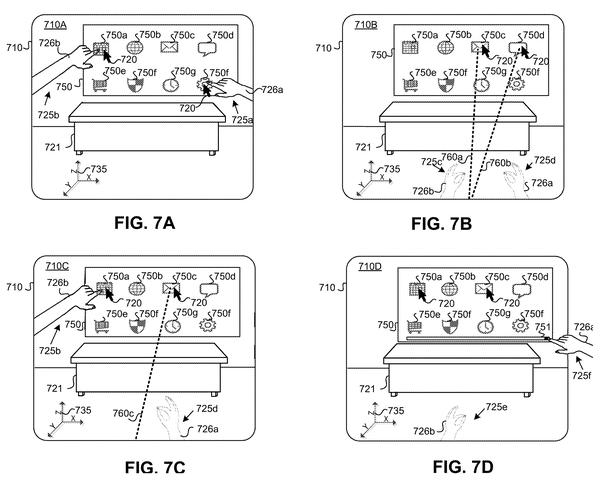
The drawings · 27 sheets
27 drawing sheets from US 2026/0359001 A1 · click any drawing to enlarge


Show the other 19 sheets


More from Apple
All 672 Apple patents →
More in AR / VR
All 690 AR / VR patents →
Google
Google Patents Earbud Tips That Can Feel You Chew and Yawn
Nvidia
Nvidia Files Patent for Games That Watch Your Face and Adjust the Difficulty
IBM
IBM Patents a Dimpled Chip Surface That Helps Sensors Spot Proteins in Blood
Samsung
No comments yet