

Microsoft
Microsoft · Memory & storage · Filed May 7, 2025 · USPTO published Nov 12, 2026 · This week's release
Microsoft Files Patent for Squeezing More Data Into Glass Storage Plates
A hard drive might last 5 to 10 years, while data etched in glass could last thousands. Microsoft's new patent application tries to cram more information into each tiny etched spot by changing its shape.
- Publication number
- US 2026/0358673 A1(US20260358673A1)
- Applicant
- Microsoft Technology Licensing, LLC
- Filed · Published
- May 7, 2025 · Nov 12, 2026
- Inventors
- Joona Juhana KOPONEN, Simo Kaarlo TAMMELA, Esa Tapani RAIKKONEN
- Status when we published
- Waiting for an examiner
- Document
- 20 claims
- US classification
- 359/305
- Examiner
- CHOI, WILLIAM C (Art Unit 2872)
What Microsoft's glass-storage patent does
You're backing up a lifetime of photos, and the hard drive you're trusting will probably last 5 to 10 years. Data written into glass plates, by contrast, is described in this filing as lasting thousands of years. The catch is getting enough information into each tiny spot.
Glass storage works by zapping a plate with a laser. Each altered spot (called a voxel) holds one or more bits of data. Today every spot has the same shape, and the laser's strength is what encodes the data, which leaves very little room for error.
This patent application changes the shape of the spot instead. Switch between two shapes and each spot holds one extra bit; add more shapes and you get more bits. The trick is steering the laser beam down one of two paths that reshape it, quickly enough to keep writing fast.
… the modulator is controllable to cause a deflection of an input light beam from a first optical path to a second optical path through the one or more waveguides …
Translation: The system uses a controller to steer a laser beam along different routes through glass channels.
How a laser beam gets two different shapes
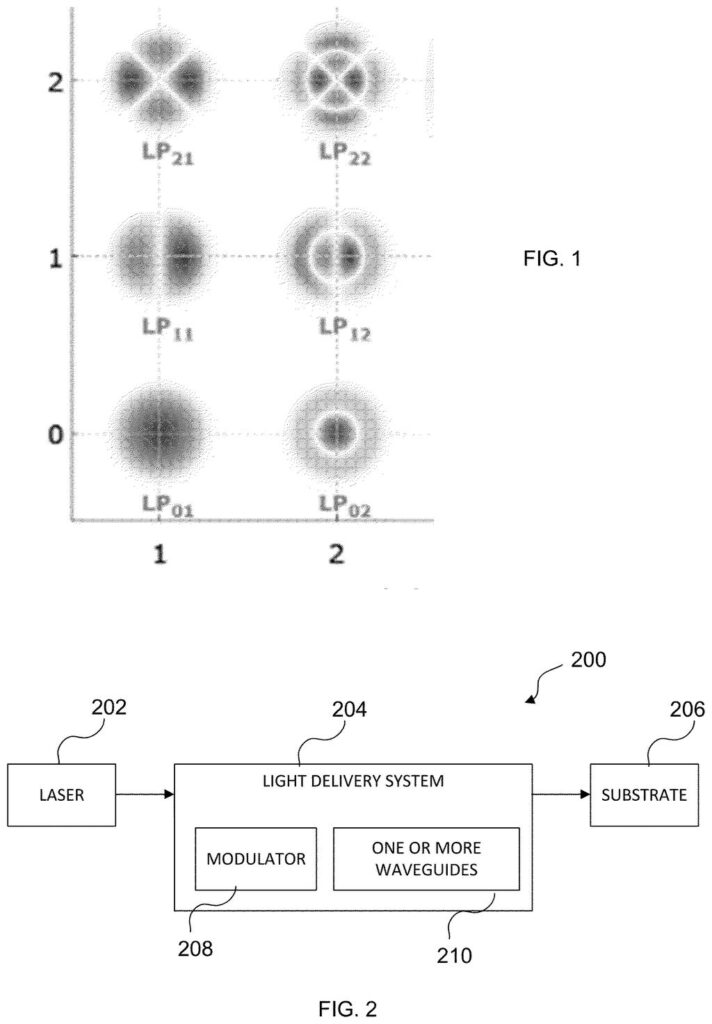
The filing describes a light delivery system that sits between a laser and the glass. It has a fast modulator (a device that steers or switches a light beam on command) and one or more waveguides (thin channels, usually optical fibers, that carry light). On a control signal, the modulator sends the beam down one of two paths. Because the paths treat light differently, the beam comes out with a different brightness pattern and burns a different-shaped spot.
The filing lays out several ways to build those two paths:
- One fiber that supports several modes (patterns light can take inside a fiber): a plain circular one on one path and a more complex, non-circular one on the other.
- Two fibers, where one converts the light to the complex pattern with a long period grating (a series of tiny marks in the fiber) or a slight sideways offset at a joint.
- Two fibers with different core shapes, circular and elliptical.
- Two identical fibers, with a non-circular lens on one output.
The modulator can be an acousto-optic type (sound waves bend the beam, and it handles more laser power) or an electro-optic type (it switches the light's polarization, runs faster, and pairs with a polarization splitter). A second modulator can first adjust beam strength, so shape and strength both carry data. Many such systems could run in parallel to write several spots at once.
… resulting in a different spatial distribution of an output light beam output from the light delivery system …
Translation: This shifting changes how the laser light spreads out when it exits the system to store data.
Why more data per spot matters for archives
The appeal is simple: more data per spot means more data per plate. Glass storage is pitched as a compact, long-lived home for information you rarely touch but can't afford to lose, such as old family photos or company records. The filing puts the life of magnetic storage at perhaps 5 to 10 years, against thousands for glass.
The approach is also built to keep writing speed up, since the shape change comes from switching a beam path rather than slowing the laser down. It can be combined with the existing method of varying laser strength, so the gains could stack. For now, this is a patent application describing optics, not a product.
Microsoft's fifth filing in the Memory & storage patents we cover since May follows earlier work on power tracking per VM and NVMe command batching.
Source: US 2026/0358673 A1 at the USPTO (PDF). Full patent text and figures are in the official publication.
Get our take in your Top Stories
Liked this breakdown? Add Patentlyze as a preferred source on Google, and our plain-English take shows up more often in your Top Stories the next time Microsoft patent news breaks.
Add Patentlyze on Google
One click.
There are more where this came from
We read every patent application Big Tech publishes and send you the ones worth knowing. Plain English, free, every week.
The drawings · 7 sheets
7 drawing sheets from US 2026/0358673 A1 · click any drawing to enlarge


More from Microsoft
All 646 Microsoft patents →

More in Hardware
All 2,316 Hardware patents →
Nvidia
Nvidia Patents a Cloud-Assisted Rollback System for Cluster Storage Recovery

Samsung
Samsung Patents a Pre-Read Trick That Beats Cache Lookup Latency

Samsung
Samsung Patents a Strain-Gradient Memory Cell to Boost DRAM Performance
Samsung
No comments yet