Latest AI simulation patents, Page 14
World models and digital twins: AI that predicts physics, builds 3D scenes, and rehearses reality before acting in it. Early, strange, and worth tracking.
- in the Nov 19 release
- 7
- in November so far
- 17
- filings tracked
- 193
- last 90 days
- 75
Recent filings
Newest first · 193 total-
Google · Published May 28
Google Patents a 3D-Aware Feature Matching System for Object Recognition
Matching a photo of an object taken from the front to one taken from the side is surprisingly hard — and Google's new patent tackles it by teaching an AI to think in 3D while looking at 2D images.
-
Nvidia · Published May 28
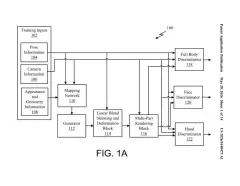
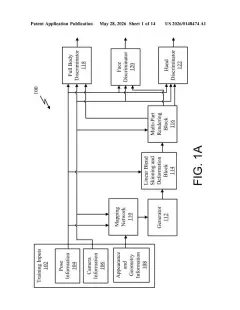
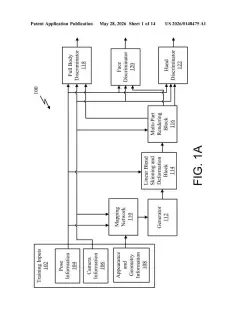
Nvidia Patents a Foundation Model for Generating Full-Body 3D Digital Humans
Nvidia is working on a single AI model that can generate a complete, photorealistic 3D human — face, hands, full body — trained almost entirely on ordinary 2D photos scraped from the internet, no 3D studio required.
-
Nvidia · Published May 28
Nvidia Patents a 3D Digital Human Foundation Model Built From 2D Photos
Nvidia is working on a system that can take ordinary, uncontrolled 2D photos — the kind scraped from the internet — and use them to train a generative model capable of producing detailed, poseable 3D digital humans, complete with face and hand detail.
-
Nvidia · Published May 28
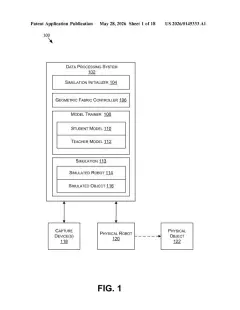
Nvidia Patents a Teacher-Student AI Loop for Dexterous Robot Grasping
Teaching a robot hand to reliably pick up an arbitrary object is one of the hardest unsolved problems in robotics. Nvidia's latest patent tries to crack it by pairing a physics-math trick called 'geometric fabrics' with a two-stage AI training system that goes from simulation to the real world using nothing but depth-camera images.
-
Nvidia · Published May 28
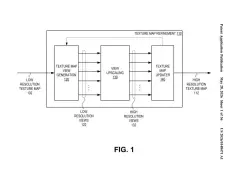
Nvidia Patents a Neural Network System for Upscaling 3D Texture Maps
Nvidia wants to let neural networks do the heavy lifting of generating high-resolution textures — starting from a cheaper, low-res version and letting AI fill in the details. It's DLSS logic, but applied to texture maps instead of final frame pixels.
-
Nvidia · Published May 28
Nvidia Patents a Pipeline for Building 3D Digital Humans From Everyday 2D Photos
Training a 3D digital human model normally requires expensive, controlled capture setups — but Nvidia's new patent describes a way to do it from the messy, inconsistent photos you'd find anywhere on the internet.
-
Nvidia · Published May 28
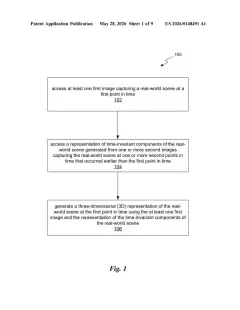
Nvidia Patents a Memory-Driven 3D Scene Reconstruction System for Self-Driving Cars
What if your self-driving car could remember what a street looked like last Tuesday — and use that memory to fill in the parts of today's view that a parked truck is blocking? That's the core idea in Nvidia's latest patent filing.
-
Adobe · Published May 28
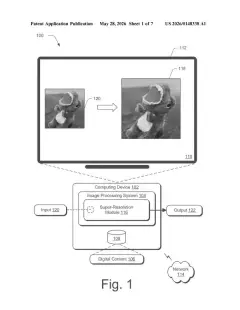
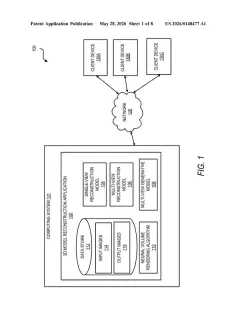
Adobe Patents a Generative Video Pipeline for 3D Model Super-Resolution
Adobe has filed a patent for a clever workaround to a persistent problem in 3D graphics: instead of trying to upscale a 3D model directly, it converts the model into a video first, uses a generative AI video upsampler to sharpen it, and then reconstructs the 3D object from the higher-resolution footage.
-
Adobe · Published May 28
Adobe Patents a Pipeline That Builds 3D Models From One Photo
Take one photo of an object, and Adobe's patented system reconstructs a full 3D model of it — no turntable, no depth camera, no multi-angle shoot required.
-
Sony · Published May 28
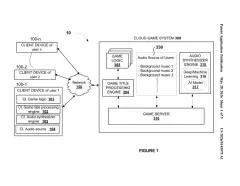
Sony Patents an AI Engine That Remixes Your Music to Match Video Game Moments
Imagine playing a tense boss fight — but instead of the game's original score, your own playlist is dynamically remixed in real-time to match that exact moment's energy. That's exactly what Sony is trying to build.
-
Samsung · Published May 21
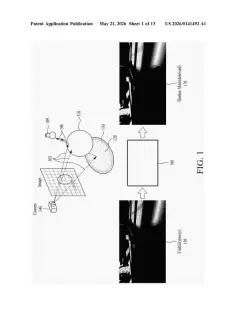
Samsung Patents a Neural Network System for Cleaner Real-Time Shadows
Noisy, grainy shadows are one of the most stubborn visual artifacts in real-time 3D rendering — and Samsung thinks a neural network sorting lights by type is the right fix.
-
Adobe · Published May 21
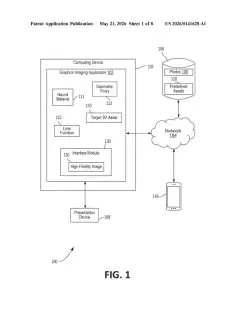
Adobe Patents a Neural Material Encoding System for Lightweight 3D Assets
Adobe wants to let you take a richly detailed 3D object — complex curves, intricate surface materials — and compress its visual fidelity into a lightweight package that runs comfortably on a phone or in a browser tab.