
Adobe
Adobe · Software · Filed May 12, 2025 · USPTO published Nov 12, 2026 · This week's release
Adobe Patents a Tool That Converts Dollars and Miles Per Gallon Inside Your Documents
Adobe's filing describes a one-click button that rewrites the rent in your lease from dollars to yen, and it leaves the math to lookup tables instead of an AI. The AI's only job is to understand what the document is about.
- Publication number
- US 2026/0359550 A1(US20260359550A1)
- Applicant
- Adobe Inc.
- Filed · Published
- May 12, 2025 · Nov 12, 2026
- Inventors
- Raghav Kapoor, Nedim Lipka, Eunyee Koh
- Status when we published
- Waiting for an examiner
- Document
- 20 claims
- US classification
- 704/9
- Examiner
- DORVIL, RICHEMOND (Art Unit 2658)
What Adobe's unit-converting document tool does
A lease agreement sits open on a screen, with the monthly rent listed in US dollars. The person reading it lives in Japan and wants to see the yen amount, right there in the document.
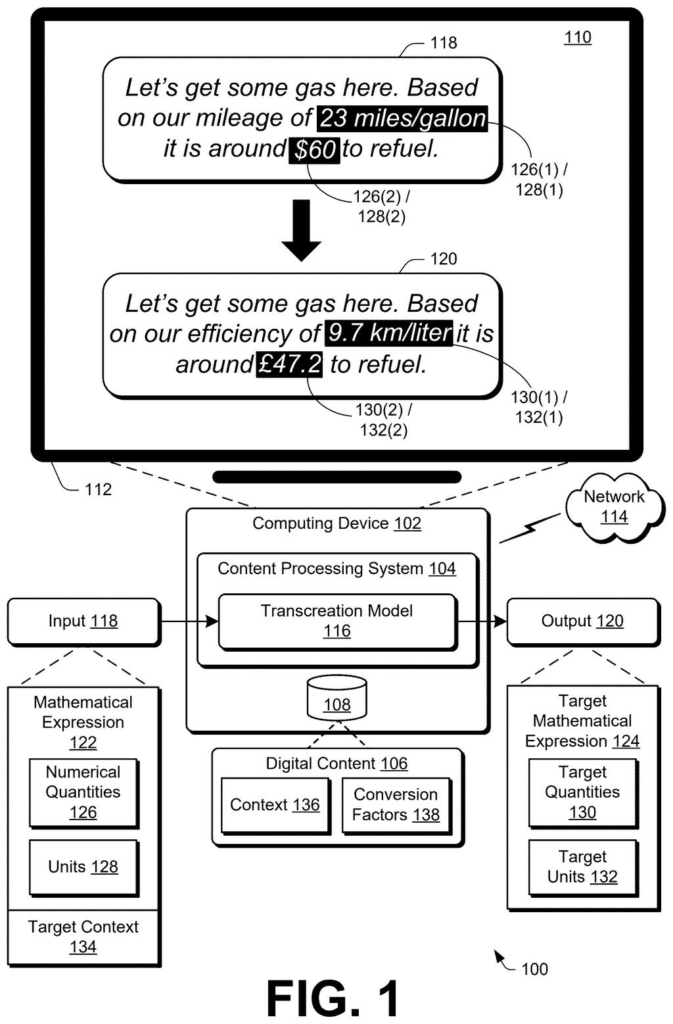
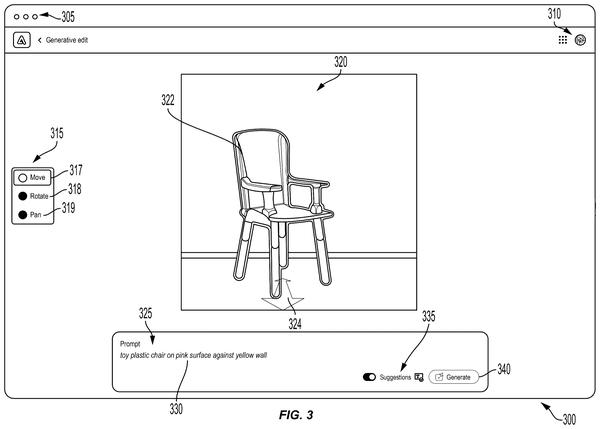
Adobe's patent application describes a tool for exactly that. You highlight the rent, pick Japan as the target (by typing it or even saying it out loud), and click a button labeled "Replace Expression." The amount and the currency swap in place. The same idea covers a sentence like "23 miles/gallon," which becomes about 9.7 kilometers per liter.
The twist is how the work is split. An AI reads the document to figure out what it is about and to spot the numbers. The actual arithmetic is handed to fixed tables and rules, because chatbots are known to fumble numbers.
… determining, by the processing device, a target quantity and a target unit for the numerical quantity and the unit based on the target context using a mapping, the mapping defining a unit-to-context relationship with the context of the digital document …
Translation: It calculates the new numbers and units needed for the selected context.
How Adobe's tool chains conversions together
The filing describes a three-part pipeline:
- Understand the document. A large language model (the same kind of AI behind chatbots) writes a short summary of the document and uses it to work out the context, such as region or topic. It also pulls out each number and its unit, then double-checks by searching the original text for them. If something doesn't match, it tries again.
- Match the units. You supply a target context, like Japan or metric. A lookup table the filing calls a context unit dictionary finds the equivalent unit for that setting. Cooking might use milliliters, while driving uses kilometers per liter.
- Do the math. Conversion rates live in a graph: each unit is a dot, and each line between two dots is a known rate. To get from miles to centimeters, the system walks miles to kilometers to meters to centimeters and multiplies the rates along the way. A breadth first search (a method that checks the nearest options first) finds the shortest route. Changing one line, like a currency rate, updates every conversion that uses it.
A final step, a unit-aware shunting yard function (a classic method for evaluating math in the right order), treats units as operators. That lets it handle mixed expressions like "$100+£100" and compound units without any AI guessing.
Techniques related to generative mathematical transcreation are described. In an example, a processing device is operable to receive a mathematical expression having a numerical quantity and a unit that is extracted from a digital document, and initiate a machine-learning model to generate a context of the digital document.
Translation: The software reads math inside a document and figures out what the text is about using machine learning.
What this means for contracts and recipes
If this ever shows up in an editing app, the payoff is simple: you pick a country, click a button, and the prices, distances and temperatures in your document change to match. The filing's own examples include a US lease converted to yen, a recipe moved from milliliters to teaspoons, and even a chart whose axes are redrawn in new units. For anyone who writes for readers abroad, that replaces a lot of copy-and-calculate work.
The filing also covers messier cases, like mixed currencies in one sum and traditional local units such as Japan's kan and shaku. It is a patent application, and nothing in it says a product is coming. Still, it shows one direction for AI features in document tools: less rewriting of words, more adjusting the numbers that sit next to them.
Adobe's 264th filing in our Adobe coverage since May follows patents like training AI on fake requests and rebuilding marketing flows across apps.
Source: US 2026/0359550 A1 at the USPTO (PDF). Full patent text and figures are in the official publication.
Get our take in your Top Stories
Liked this breakdown? Add Patentlyze as a preferred source on Google, and our plain-English take shows up more often in your Top Stories the next time Adobe patent news breaks.
Add Patentlyze on Google
One click.
There are more where this came from
We read every patent application Big Tech publishes and send you the ones worth knowing. Plain English, free, every week.
The drawings · 17 sheets
17 drawing sheets from US 2026/0359550 A1 · click any drawing to enlarge


Show the other 9 sheets


More from Adobe
All 264 Adobe patents →
More in Software
All 753 Software patents →
Samsung
Samsung Patents a Way to Search Images Inside Documents as If They Were Text
Apple
Apple Files Patent for Group Chats That Open Shared Documents Without Exposing Your Identity

Sony
Sony Files Patent for Tying Player Comments to Specific In-Game Play Units
Google
No comments yet