
Adobe
Adobe · AI / ML · Filed May 19, 2025 · USPTO published Nov 19, 2026 · This week's release
Adobe Files Patent for AI Images That Keep Your Face and Your Outfit Intact
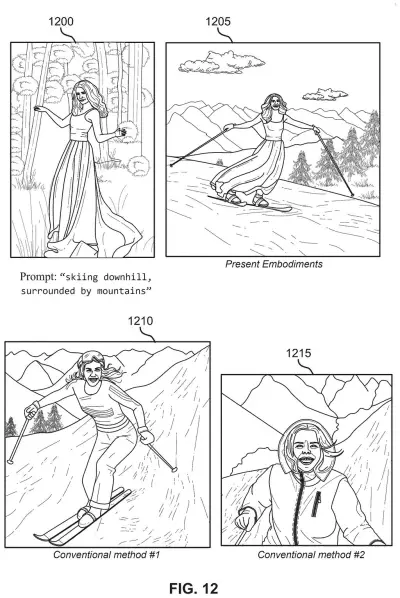
Ask an AI image tool to put you on a ski slope and you often get someone who looks a bit like you, in different clothes. Adobe's patent application splits your photo into face, torso, legs and shoes so each piece stays recognizable.
- Publication number
- US 2026/0368963 A1(US20260368963A1)
- Applicant
- ADOBE INC.
- Filed · Published
- May 19, 2025 · Nov 19, 2026
- Inventors
- Jisu Nam, Zhan Xu, Jing Shi, Difan Liu, Feng Liu, Yang Zhou
- Status when we published
- Waiting for an examiner
- Document
- 20 claims
- US classification
- 345/636
- Examiner
- COBB, MICHAEL J (Art Unit 2615)
What Adobe's body-part photo encoding does
Every time you ask an AI image tool to drop a photo of yourself onto a ski slope, you roll the dice. The face might come back close, but your floral dress turns into a shirt and pants, and a hat you never wore appears. The filing says many tools boil a person down to a small summary, and that blends the details together.
Adobe's patent application takes a different route. It cuts your photo into pieces: the whole body, face, torso, legs and shoes. Each piece is studied on its own, then the pieces are combined into one detailed record of how you look.
Your text, such as skiing downhill, surrounded by mountains, sets the scene. The image generator follows both, so the words choose the setting while the body record keeps your face, clothing and accessories in place.
… generating, using a body-partitioned transformer of an image generation model, a plurality of body part identity embeddings corresponding to body parts of the subject …
Translation: The system uses a special AI tool to break down and map out different sections of a person's body.
How the five-region split keeps details apart
The system takes two inputs: a photo of a person and a short text description of a scene. It first splits the photo into regions. In the main example there are five: the full body, face, torso, legs and shoes. Each crop goes through an image encoder (software that turns a picture into lists of numbers a computer can work with) on its own, so details from one region do not bleed into another.
Next comes what the filing calls a body-partitioned transformer, a type of neural network that weighs which pieces of information matter most. It turns each region's numbers into body part identity embeddings, which are dense lists of numbers recording clothing patterns, textures, colors and accessories. It does this by linking its own starting placeholders to each region's features (cross-attention), then letting the features compare notes with each other (self-attention), and repeating the cycle several times. The results are stacked into one combined description of the whole person.
The picture itself comes from a diffusion model, which starts with random static and removes the noise step by step until an image appears. At each step it consults two sources: one block reads your scene text, and another reads the body description. A weighting value balances the two.
During training, only the body-partitioned transformer and the body-part block are updated while the other models stay frozen, which the filing says preserves the base model's general image skills. The claims also cover adding a second person's photo to the same image.
The body part identity embeddings encode full-body spatial details as well as fine-level details.
Translation: These digital body maps capture everything from overall body shape down to tiny physical traits.
Why AI portraits might stop changing your outfit
If you have ever asked an AI tool to put you in a new setting, you know the letdown: the face is close, but the outfit is wrong. This patent application aims at that gap, with images that keep your clothing, accessories and face consistent across new poses, places and styles such as cartoon or anime.
The filing describes working from one input photo plus a text prompt, rather than the per-person retraining that some older approaches require. For creative software, that points toward personalized images that look like the real person without a long setup. It remains an application, so nothing here says when or whether it ships.
That makes this Adobe's 48th filing we've tracked since May in our controllable AI image generation work, joining earlier applications like one on layering depth choices and one on decorative text wrapping.
Source: US 2026/0368963 A1 at the USPTO (PDF). Full patent text and figures are in the official publication.
Get our take in your Top Stories
Liked this breakdown? Add Patentlyze as a preferred source on Google, and our plain-English take shows up more often in your Top Stories the next time Adobe patent news breaks.
Add Patentlyze on Google
One click.
There are more where this came from
We read every patent application Big Tech publishes and send you the ones worth knowing. Plain English, free, every week.
The drawings · 15 sheets
15 drawing sheets from US 2026/0368963 A1 · click any drawing to enlarge


Show the other 7 sheets


More from Adobe
All 270 Adobe patents →
More in AI vision
All 351 AI vision patents →
Adobe
Adobe Files Patent for an AI That Learns Your Dog From a Few Photos
Adobe
Adobe Files Patent to Paste Objects Into Photos With Matching Light and Shadows
Adobe
Adobe Files Patent for AI Video That Follows a Path You Mark With a Box
Adobe
No comments yet