
Adobe
Adobe · AI / ML · Filed May 12, 2025 · USPTO published Nov 19, 2026 · This week's release
Adobe Patents an AI Tool That Dresses Up Letters Without Warping Them
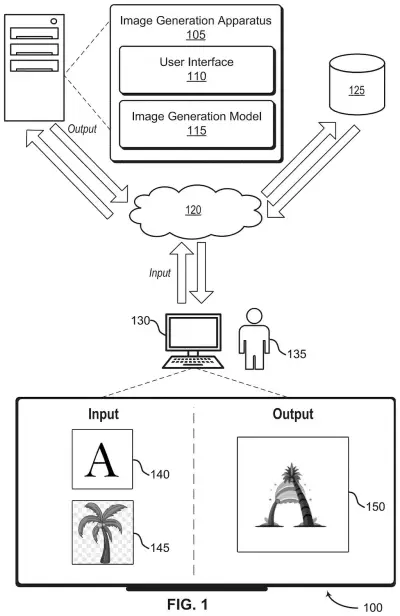
Adobe has filed a patent application for an AI that can turn the letter S into a slithering snake, or an A into a palm tree, while keeping it readable as the letter it started as.
- Publication number
- US 2026/0368962 A1(US20260368962A1)
- Applicant
- ADOBE INC.
- Filed · Published
- May 12, 2025 · Nov 19, 2026
- Inventors
- Nippun Sharma, Kshitiz Kaushik, Vineet Batra
- Status when we published
- Examiner raised objections; the company can respond
- Document
- 20 claims
- US classification
- 345/619
- Examiner
- MCCULLEY, RYAN D (Art Unit 2611)
What Adobe's letter-to-snake AI tool actually does
Imagine you're making a poster for a jazz night and you want the letter J to look like a saxophone. Today that means hand-tweaking curves for hours, or asking an AI image tool and getting back something that no longer reads as a J.
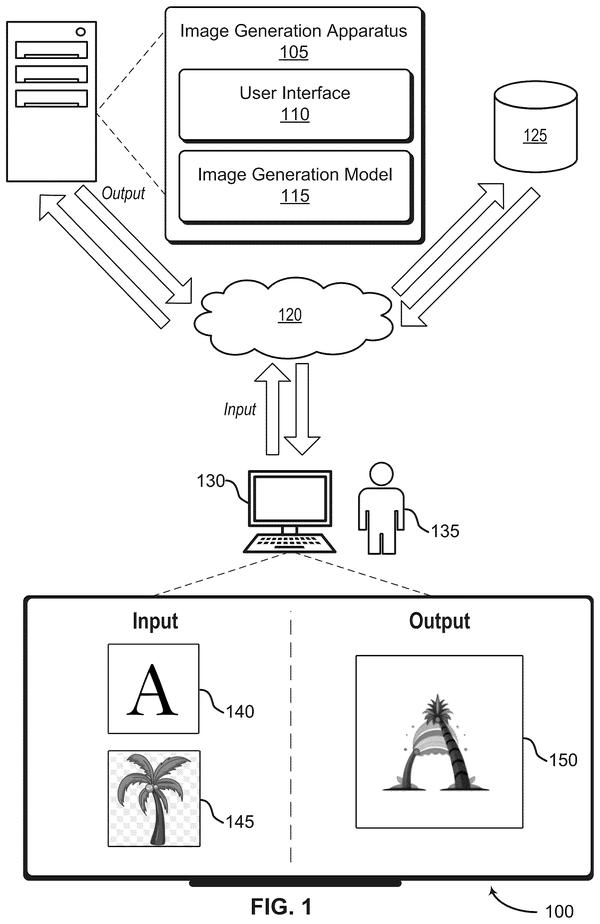
Adobe's patent application describes a way to do this automatically. You hand the system a picture of the letter plus a prompt, either a few words like a sleeping cat, cute or a reference photo. It reshapes the letter so the outline stays recognizable but picks up the look of whatever you asked for.
You also get a control over how strictly the result sticks to the original letter. Turn it one way and you get a more faithful letter. Turn it the other way and you get more of the snake, the cat or the saxophone.
… generating a latent code based on the glyph image and the guidance prompt using a perceptual loss, wherein the latent code represents the target structure and the target semantic concept …
Translation: The AI combines the letter's shape with the text prompt while making sure the letter stays recognizable.
How the letter's shape stays locked in place
The system takes two inputs: a glyph image (a picture of a letter in some typeface) and a guidance prompt, which can be a few words of text or a reference image describing the look you want.
First, the letter is converted into a latent code (a compressed numeric version of the image that an AI model works with internally), and noise is added to it. The code is then adjusted over many small steps using two scores. A denoising loss (a measure of how far the result is from a clean, believable image that matches the prompt) pulls it toward the prompt. A perceptual loss (a measure of how much the shape has drifted from the original letter) pulls it back toward the letter.
The description fills in several details:
- The prompt-side score uses a method called score distillation sampling.
- The shape-side score combines two checks, one on the color channels and one on the remaining channels of the code.
- A user control sets how much the shape score counts, trading letter fidelity against prompt detail.
- The adjustment steps are picked with a time-prioritized method mixed with random steps, which the filing says brings out more detail.
Because the tuning happens while the image is being made, any ordinary diffusion model (an AI that builds images by gradually removing noise) can be used with no special letter training. The filing says an older approach produced jagged edges and black and white only, while this one can output color, and the result can also be converted into scalable vector artwork.
… generating a synthetic image based on the latent code, where the synthetic image depicts the target structure and the target semantic concept …
Translation: The system then outputs the final decorated letter that matches both the shape and the requested style.
Why designers who tweak lettering by hand care
For anyone who makes posters, logos or social graphics, matching a letter to an illustration is slow work. A tool built on this idea would let you type a phrase, keep a recognizable letter, and get a styled version to refine from. Because it runs on an ordinary image model instead of one trained only on lettering, it should be easier to bolt onto existing design software.
The filing is still an application. The examiner's first review rejected the claims as filed, which is a routine step that usually leads to amendments, so the final scope may end up narrower than what was published.
This is the 49th Adobe patent we've tracked since May on controllable AI images, building on earlier applications like keeping face and outfit intact and choosing what sits in front.
Source: US 2026/0368962 A1 at the USPTO (PDF). Full patent text and figures are in the official publication.
Get our take in your Top Stories
Liked this breakdown? Add Patentlyze as a preferred source on Google, and our plain-English take shows up more often in your Top Stories the next time Adobe patent news breaks.
Add Patentlyze on Google
One click.
There are more where this came from
We read every patent application Big Tech publishes and send you the ones worth knowing. Plain English, free, every week.
The drawings · 19 sheets
19 drawing sheets from US 2026/0368962 A1 · click any drawing to enlarge


Show the other 11 sheets


More from Adobe
All 270 Adobe patents →
More in AI / ML
All 2,738 AI / ML patents →
Disney
Disney Files Patent for Game Worlds That Change With Live Events
Google
A New Google Patent Turns Your Browsing History Into a Podcast for Your Commute
Microsoft
Microsoft Files Patent to Help AI Skip the Still Parts of a Video
IBM
No comments yet