
Apple
Apple · Software · Filed May 19, 2026 · USPTO published Nov 19, 2026 · This week's release
Apple Files Patent for a Phone That Pinpoints the Exact Store You're In Using Wi-Fi
Your phone's GPS often can't tell which shop in a mall you're standing in. Apple's patent application describes a way for the phone to work that out by itself, using the Wi-Fi networks it can hear.
- Publication number
- US 2026/0371035 A1(US20260371035A1)
- Applicant
- Apple Inc.
- Filed · Published
- May 19, 2026 · Nov 19, 2026
- Inventors
- Richard B. Warren, Adam J. Leonard, Emmanouil Alimpertis, Long Gao, Ricky Wing Kei Tai, Todd R. Grooms
- Status when we published
- Waiting for an examiner
- Document
- 20 claims
- US classification
- 455/456.1
- Parent application
- Claims priority from a provisional application 63808459 (filed May 19, 2025)
What Apple's on-device location profile does
Ever watched the blue dot on your map app drift across three different stores while you stood perfectly still? GPS is weak indoors, so your phone usually knows roughly where you are but not which place you're in.
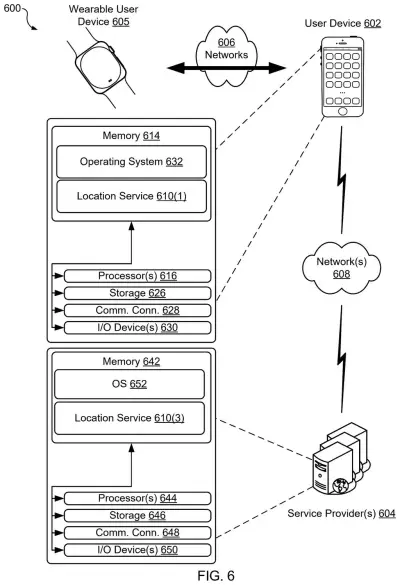
Apple's patent application describes a fix that runs on the phone. It grabs a small map of your area, listens to the Wi-Fi networks around you (and can add how you're moving), and matches that pattern to one specific place, like a restaurant or a park. It then hands apps a location profile: the place's name, address, hours and type.
Because the matching happens on your device, it doesn't have to keep telling a server where you are. Apps could then do things like nudge you toward a yoga session when you arrive at the park where you usually do yoga.
obtaining, by a location service implemented on a user device, a map representative of a geographic area corresponding to a position of the user device, wherein the map includes one or more locations in the geographic area …
Translation: The phone downloads a digital map of the immediate area around you.
How your iPhone matches Wi-Fi to a map tile
The filing describes a location service that runs on the phone itself. It starts with an ordinary GPS position, then pulls up a map tile covering that area (the example given is roughly five miles by five miles) that lists the places inside it, such as stores, parks and buildings. The tile comes from a server the first time and can be saved in a cache (a local stash) for later.
Next, the service collects sensor data, mainly Wi-Fi signal strengths. The claims describe a wireless signal fingerprint, meaning a pattern built from the names of nearby networks (their SSIDs) and how strong each one is. Matching that pattern against the map produces a location identifier, a unique ID for one specific place. The filing also allows Bluetooth, cellular and ultra-wideband signals, motion data from the phone's inertial sensors (the chips that notice walking or sitting), and a machine learning model to do the matching.
What comes out the other end:
- A location profile: the place's name, address, hours, type and boundary, handed to apps.
- A confidence score saying how sure the guess is, which can decide whether a paired watch gets the update.
- A history of recent visits with timestamps that other apps can ask for.
- Pre-fetched maps for neighboring areas or places you're predicted to visit, ideally while charging on Wi-Fi.
… determining a location profile based at least in part on the one or more locations of the map and the sensor data …
Translation: It figures out where you are by combining the map data with readings from the phone sensors.
Why your watch and apps could get place-aware
The practical payoff is apps that react to the exact place you're in. A maps app could show a restaurant's hours and menu the moment you walk in, or a list of places you've been this week. A workout app could offer a yoga reminder at your usual park but stay quiet at a different one. A paired watch could get the same place information from your phone and show a calorie-goal reminder.
Apple's own pitch in the filing is about cost and privacy. Doing the matching on the phone means fewer requests to a server, less battery and data use, and less of your position sent off the device. The phone still downloads maps and place details from a server when it hasn't saved them, so it doesn't cut the cord entirely.
This is the 678th Apple patent application in our Apple coverage since May, adding to filings like the luggage tag beeper and the screen-share verifier.
Source: US 2026/0371035 A1 at the USPTO (PDF). Full patent text and figures are in the official publication.
Get our take in your Top Stories
Liked this breakdown? Add Patentlyze as a preferred source on Google, and our plain-English take shows up more often in your Top Stories the next time Apple patent news breaks.
Add Patentlyze on Google
One click.
There are more where this came from
We read every patent application Big Tech publishes and send you the ones worth knowing. Plain English, free, every week.
The drawings · 11 sheets
11 drawing sheets from US 2026/0371035 A1 · click any drawing to enlarge


Show the other 3 sheets


More from Apple
All 748 Apple patents →
More in Software
All 814 Software patents →
Google
Google Patents a Way to Turn Location Searches Into Interactive 3D Walkthroughs
IBM
New IBM Patent Pinpoints Whether Bugs Live in Code or Tests
Google
Google Files Patent to Deliver Targeted Ads While Protecting User Privacy
Microsoft
No comments yet