
Apple
Apple · Cell phone · Filed Aug 19, 2025 · USPTO published Nov 19, 2026 · This week's release
Apple Patents a Wireless Charger That Tunes Out Routine Standby Signals Between Data Bursts
Your phone and its wireless charger keep talking through the charging coil even when they have nothing to say, and decoding that filler costs the charger energy. Apple's filing adds a tiny always-on listener so the heavy decoding only runs when a real message arrives.
- Publication number
- US 2026/0370036 A1(US20260370036A1)
- Applicant
- Apple Inc.
- Filed · Published
- Aug 19, 2025 · Nov 19, 2026
- Inventors
- Sriram Narayanan, Arash Mehrabi, Stephen C Terry
- Status when we published
- Waiting for an examiner
- Document
- 20 claims
- US classification
- 375/141
- Examiner
- CORRIELUS, JEAN B (Art Unit 2633)
- Parent application
- Claims priority from a provisional application 63806905 (filed May 16, 2025)
What Apple's wireless charger listener does
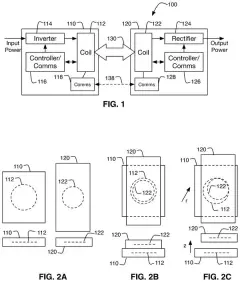
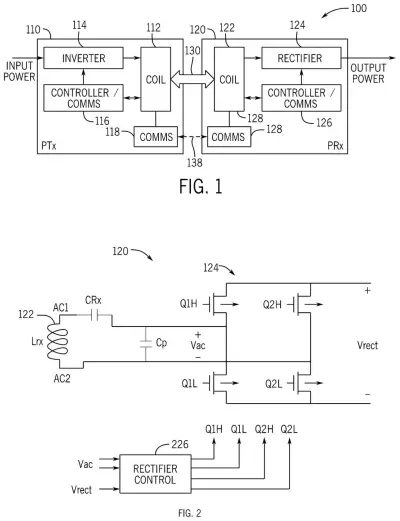
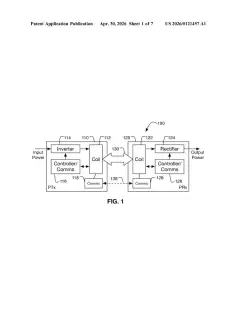
Set your phone on a wireless charger and the two devices start chatting through the charging coil itself. Even when nothing useful is being said, your phone keeps sending a stream of filler, and the charger keeps decoding every bit of it, burning a little energy and giving off a little heat.
Apple's patent filing describes a fix. The charger gets a tiny, low-power listener that stays on all the time and checks only for the filler pattern. As long as it hears the pattern, the main decoder stays asleep. The moment the pattern stops, which means a real message is starting, the listener wakes the full decoder.
Why send filler at all? The filing says it makes charging quieter and more stable. This patent is about keeping those benefits without the power bill on the charger side.
… control and communication circuitry coupled to the wireless power transfer coil including an always-on decoder responsive to the idle pattern that selectively activates further decoder circuitry responsive to an end of the idle pattern to decode the data packets.
Translation: A low power sensor watches for background standby signals and only wakes up the main decoder when actual data arrives.
How the always-on decoder spots a real message
Your phone talks to the charger by briefly changing how much power it draws. That is called amplitude shift keying (ASK): tiny ups and downs in the charging signal act like a code the charger can read through its own coil. Between real messages, the phone sends an idle pattern, a run of 1 bits.
Instead of running its full decoder all the time, the charger runs an always-on decoder that watches for that pattern. A run of 1s shows up as one clean tone, so the listener measures the energy at that frequency. When a real packet begins, the mix of 1s and 0s makes that energy drop, and the listener switches on the full decoder.
The listener is built from a few simple pieces:
- Envelope detector: traces the outline of the charging signal's peaks.
- Decimator: throws away a share of the samples to cut noise and computing work.
- Correlator: compares what is left to the idle pattern, acting as a filter tuned to that one frequency.
- Threshold detector: wakes the full decoder when the energy falls below a set level.
A second version runs four listeners side by side, at 40, 200, 400 and 800 kHz, so the charger can handle different data rates without being told which one is in use. Dependent claims also cover spread spectrum, where each bit is replaced by a longer sequence of high and low chips. The filing notes the full decoder may need buffered data to catch up after it wakes.
Why charger idle chatter costs you power
Wireless charging is built into phones, tablets and accessories like headphones and styluses, and the filing names all of them as likely users. A charger that skips decoding filler wastes less power and gives off less heat, which adds up for a charger that sits powered on for hours.
The filler itself has benefits the filing lists: less random noise outside messages, a more stable power output and less audible noise. This patent keeps those gains and trims the cost on the charger side. You are unlikely to notice it directly. At most you might get a charger that runs a bit cooler and wastes a little less electricity.
This is the 59th Apple filing in our cell phone coverage we've tracked since May, adding to ideas like a snap-together phone and a tracker that rests at home.
Source: US 2026/0370036 A1 at the USPTO (PDF). Full patent text and figures are in the official publication.
Get our take in your Top Stories
Liked this breakdown? Add Patentlyze as a preferred source on Google, and our plain-English take shows up more often in your Top Stories the next time Apple patent news breaks.
Add Patentlyze on Google
One click.
There are more where this came from
We read every patent application Big Tech publishes and send you the ones worth knowing. Plain English, free, every week.
The drawings · 5 sheets
5 drawing sheets from US 2026/0370036 A1 · click any drawing to enlarge


More from Apple
All 748 Apple patents →
More in Cell phone
All 494 Cell phone patents →
Sony
Sony Patents a Tiny Laser Whose Light Waves All Line Up the Same Way
Microsoft
Microsoft Patents a Phone Screen That Hides Its Antenna in the Glass
Qualcomm
Qualcomm Files Patent for Sharper Phone Video When Your Subject Won't Hold Still
Google
No comments yet