
Apple
Apple · Software · Filed Mar 13, 2026 · USPTO published Nov 19, 2026 · This week's release
Apple Files Patent for Live Translation That Switches Between Phone and Earbud Mics
Apple's filing goes after a familiar annoyance of live translation: your phone is muffled in a pocket while your earbuds hear everything. The fix is a software switch that decides which microphone the translation app listens to, and sometimes none at all.
- Publication number
- US 2026/0367865 A1(US20260367865A1)
- Applicant
- Apple Inc.
- Filed · Published
- Mar 13, 2026 · Nov 19, 2026
- Inventors
- Ashok MASILAMANI
- Status when we published
- Waiting for an examiner
- Document
- 20 claims
- US classification
- 704/3
- Parent application
- Claims priority from a provisional application 63806596 (filed May 15, 2025)
What Apple's translation mic switch actually does
A traveler in a Madrid café has her phone zipped inside her bag while the waiter asks what she'd like. Her earbuds are in and a translation app is running. A phone buried in a bag hears the waiter badly, so the translation comes out garbled or not at all.
Apple's filing describes a way for the phone to decide which microphone to listen with. It can use the phone's own mic when the phone is out in the open, or the earbuds' mics when the phone is muffled. It can also choose based on which one hears the waiter more clearly.
It also notices when you start talking. In the main version, it pauses the translation so the app isn't chattering in your ear while you speak. If the sound is too poor, the phone can show a note telling you to move it closer to the other person.
… controlling, by the first device based on the first microphone signal and the second microphone signal, an audio input to a translator application at the first device, the translator application configured to generate an audio translation, from a first language to a second language, of voice content in the audio input.
Translation: The phone manages which microphone feeds the translation software based on the incoming audio signals.
How the phone picks between phone and earbud mics
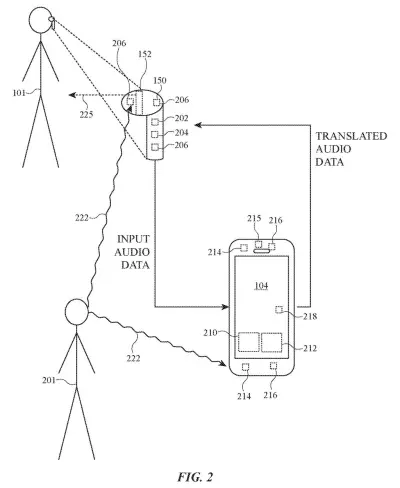
The patent covers a piece of software called an input controller that sits in front of a translation app on a phone. Its job is to decide, moment to moment, what audio the app receives: the phone's own microphone, the microphone from a second device such as earbuds, headphones or smart glasses, or nothing at all.
To decide, it weighs several clues. It measures the signal-to-noise ratio (how loud the speech is compared with background noise) in each microphone signal. It uses voice activity detectors (small programs that spot when someone is talking) to tell your voice from the other person's. It also checks whether the phone is obstructed, using a proximity sensor and motion sensors to guess if it's in a pocket or in a hand.
The filing also describes some extras:
- Earbuds can send two streams at once, one tuned for your voice and one for the other person, so translation of the other person can continue while you talk.
- Translated speech can be played so it seems to come from where the person is standing, and can be matched to a computer voice that sounds similar to theirs.
- Echo cancellation (removing the phone's own speaker sound from its microphone) keeps the app from re-translating its own output when it also translates your speech aloud.
- If the signals are poor, the phone can prompt you to move it closer.
An input controller at an electronic device may control which, if any, of multiple microphone signals from multiple microphones is provided to a translator application for translation of speech represented in the microphone signals.
Translation: The device decides which microphone to use for translation based on signal quality and speech content.
Why translating with earbuds could get less clumsy
If you've tried a translation app in a loud restaurant or with your phone in your bag, you know the failure: the app hears mush and guesses. This patent aims at that moment, so you don't have to pull out your phone and hold it up like a microphone. The pause while you talk matters too, because a translated voice that keeps speaking over you ruins the back-and-forth of a real conversation. The filing also says pausing saves processing and battery power.
For Apple, it ties a phone and the devices on your head into one shared set of microphones. The filing names earbuds, headphones and smart glasses as possible second devices. It remains a patent application, and nothing in it says whether or when a feature like this would ship.
This is the 722nd Apple filing in our Apple coverage since May, adding to work like the callback reminder patent and the on-device AI format patent.
Source: US 2026/0367865 A1 at the USPTO (PDF). Full patent text and figures are in the official publication.
Get our take in your Top Stories
Liked this breakdown? Add Patentlyze as a preferred source on Google, and our plain-English take shows up more often in your Top Stories the next time Apple patent news breaks.
Add Patentlyze on Google
One click.
There are more where this came from
We read every patent application Big Tech publishes and send you the ones worth knowing. Plain English, free, every week.
The drawings · 15 sheets
15 drawing sheets from US 2026/0367865 A1 · click any drawing to enlarge


Show the other 7 sheets


More from Apple
All 748 Apple patents →
More in Software
All 814 Software patents →
Google
Google Files Patent for Video Call Alerts That Show a Translation Is Still Playing
Samsung
Samsung Patents an In-App Translation Tool That Expands the Screen to Fit Both Languages
Samsung
Samsung Files Patent for One Volume Button That Handles a Call and Its Translation
Samsung
No comments yet