
Google
Google · AR / VR · Filed May 15, 2026 · USPTO published Nov 19, 2026 · This week's release
Google Files Patent for Smart Glasses That Take a Closer Look at Small Print
Ask your smart glasses to read a tiny ingredient list, and this Google patent has them send a blurry photo first, then zoom in only if they need to.
- Publication number
- US 2026/0369050 A1(US20260369050A1)
- Applicant
- GOOGLE LLC
- Filed · Published
- May 15, 2026 · Nov 19, 2026
- Inventors
- Achin Kulshrestha, Jilin Tu, Omar Estrada Diaz, Aveek Purohit, Alistair Michael Muldal, Ruihan Zhang, Benedict Odai
- Status when we published
- Waiting for an examiner
- Document
- 23 claims
- US classification
- 382/103
- Parent application
- Claims priority from a provisional application 63808449 (filed May 19, 2025)
What Google's zoom-in glasses patent describes
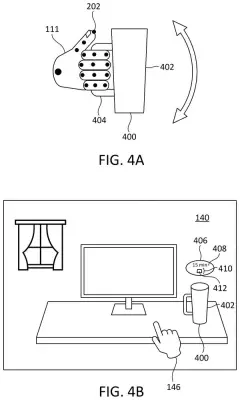
A shopper wearing smart glasses stands in a grocery aisle, staring at a bag of snacks. She asks, "Does this contain peanuts?" The ingredient list is printed so small that a quick, low-quality snapshot can't make it out.
This Google patent application describes a fix. Your glasses first send a shrunken, low-detail photo along with your question. A server works out which part of the picture matters (here, the ingredient list) and, if it can't answer with confidence, asks the glasses for a sharper close-up of just that spot.
The glasses keep a few seconds of full-quality frames in memory, so they can cut out the requested piece and send only that. You get a reliable answer, and your battery and data aren't spent streaming sharp video all day.
… receiving the second image, the second image having more detail than the portion of the first image; and determining a response based on the request and the second image.
Translation: The glasses grab a sharper second picture to figure out an answer.
How the glasses crop a sharper look on request
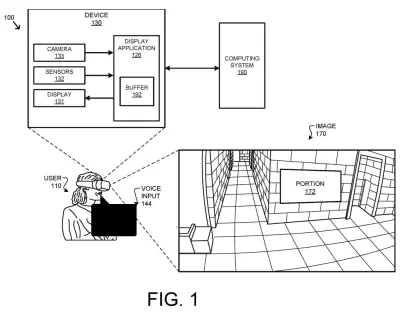
The system answers a visual question in two passes. The glasses capture a full-quality frame (the filing gives 3840 x 2160 pixels as an example) and hold it in a short-term memory. They send the server a shrunken copy along with your spoken or gestured request.
The server runs a vision-language model (AI software that reads both pictures and words) to find the part of the image your request refers to. It can use cues like "this sign," where you are looking, or a pointing gesture. It can try an answer on the blurry copy first, and zoom in only when its confidence score (the model's own estimate of how likely it is to be right) falls below a set threshold. A crowded scene is another trigger the filing lists.
Then the server asks the glasses for a closer look. That request can include:
- Coordinates for a box around the area of interest
- A timestamp, so the glasses pull the right frame from a three-to-five-second sliding window
The glasses crop that box from the original and send back only those pixels. The model reads the text in them to answer, or translate it. If the whole scene matters, it asks for a sharper full frame. If even the close-up fails, the reply can say so and suggest moving closer or holding still.
The method can include receiving the second image, wherein the second image includes more detail than the portion of the first image.
Translation: The device takes a closer, higher resolution look at the target area.
Why smart glasses need to zoom before answering
If a voice assistant has ever guessed wrong about small print, you know the problem. Medicine labels, ingredient lists and street signs are exactly what people ask about, and they are the first things a low-quality image loses. This approach keeps the first answer fast and cheap, and pays for sharpness only when a question needs it.
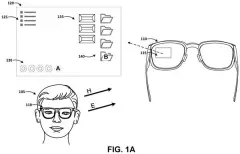
The filing describes glasses as a hands-free helper that sees what you see, which makes battery life and bandwidth hard limits. Sending one small crop instead of constant sharp video speaks to both. It also describes the assistant admitting when it can't read something, such as asking you to rotate a bottle, instead of making up the missing words.
That makes this Google's 60th filing we've tracked since May on smart glasses display work, following one on sizing objects by hand position and one on lens fit for more wearers.
Source: US 2026/0369050 A1 at the USPTO (PDF). Full patent text and figures are in the official publication.
Get our take in your Top Stories
Liked this breakdown? Add Patentlyze as a preferred source on Google, and our plain-English take shows up more often in your Top Stories the next time Google patent news breaks.
Add Patentlyze on Google
One click.
There are more where this came from
We read every patent application Big Tech publishes and send you the ones worth knowing. Plain English, free, every week.
The drawings · 7 sheets
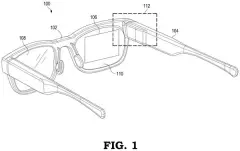
7 drawing sheets from US 2026/0369050 A1 · click any drawing to enlarge


More from Google
All 1,127 Google patents →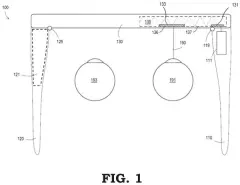
More in AR / VR
All 713 AR / VR patents →
Google
Google Files Patent to Stop Smart Glasses Displays From Wasting Light
Google
Google Files Patent to Make Smart Glasses Displays Look Evenly Bright
Google
New AR Glasses Patent Fixes Distortion From Bent Frames
Google
No comments yet