
IBM
IBM · Security · Filed May 19, 2025 · USPTO published Nov 19, 2026 · This week's release
IBM Files Patent for a System That Writes Its Own Fixes for Chatbot Hacks
IBM's filing describes software that reads about a new chatbot hack online, checks whether it would work on your company's AI setup, and writes the fix itself.
- Publication number
- US 2026/0368317 A1(US20260368317A1)
- Applicant
- International Business Machines Corporation
- Filed · Published
- May 19, 2025 · Nov 19, 2026
- Inventors
- Nicholas Sauriol, Arn Hyndman, John Christopher Lynk
- Status when we published
- Examiner raised objections; the company can respond
- Document
- 20 claims
- US classification
- 726/1
- Examiner
- MAI, KEVIN S (Art Unit 2499)
What IBM's chatbot-hack watchdog actually does
Right now, when someone finds a new way to trick a chatbot into misbehaving, a human administrator usually has to hear about it, work out whether it applies to their own system, and write a fix by hand. Multiply that by every AI model a company runs, and things get missed.
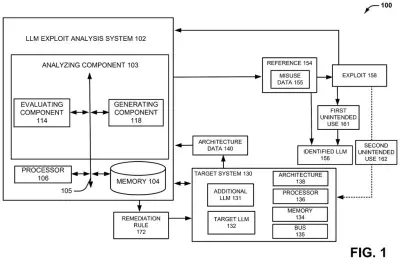
IBM's filing describes software that does this legwork. It searches the internet and private databases on a regular schedule for write-ups of chatbot misuse, pulls out the exact steps, and checks them against a description of how your company's AI is wired up. If the trick could work on your setup, it writes a rule that blocks it, rewrites the offending text, or strips it out before the chatbot ever sees it.
If a rule fails its test, a person gets a notification. Humans step in only when the automation can't cope.
an evaluating component that evaluates misuse data defining a first unintended use of a first large learning model (LLM) against architecture data defining architecture of a computer system comprising a target LLM; and a generating component that, based on the evaluating, generates a remediation rule that addresses a second unintended use of the target LLM.
Translation: The system checks how one chatbot was hacked and writes a custom rule to prevent similar attacks on another chatbot.
How IBM checks a hack against your setup
The system has two main parts. An evaluating component takes a record of misuse of one AI model (the "first" model) and compares it with architecture data, a description of the protected company's system: which AI models it runs, how requests are routed among them, and which databases they can reach. A generating component then writes a remediation rule (a rule that shuts down the misuse) for the target model.
The filing also describes an identifying component that searches public and private databases at a set frequency. It stores what it finds as vector embeddings (numeric fingerprints of meaning, so reports of the same trick group together even when worded differently). The evaluating component can also produce a risk factor, a score for how well the trick applies to your model. It sorts exploits into pattern-based ones (special tokens or sequences) and meaning-based ones (an instruction hidden in the wording).
The rules take three forms:
- Blocking an input, or transforming it.
- Redaction, which removes short matching patterns.
- Filtering, which removes longer matching patterns before the model reads the text.
One description example swaps a prompt telling the AI it has "no morals or concern for the law" for a wholesome version. Each rule is tested against a known exploit, and a failed test triggers a notification to an administrator.
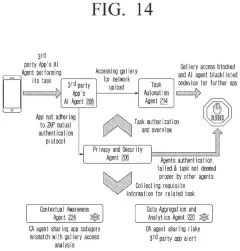
The architecture data can define routing paths among one or more of the target LLM, one or more additional LLMs of the computer system, or an information database of the computer system.
Translation: It maps out how different AI models and databases are connected inside the computer network.
Why IBM's patent targets chatbot security chores
If your bank, airline or employer runs a chatbot, someone has to keep it safe from new tricks, and today that is largely manual work. This patent application describes a way to automate the watching, the checking and the first draft of the fix, so protection against a hack found on someone else's chatbot could reach yours sooner.
The idea also covers more than a single chatbot. It looks at how several AI models and databases connect, since a trick that hits one can reach the others. The examiner's first review rejected the claims as filed, which is routine at this stage and usually followed by amendments, so nothing here is approved.
That makes this IBM's 82nd filing we've tracked since May in the AI guardrails race, following one on testing chatbots with hostile rewrites and one on training AI on fake business problems.
Source: US 2026/0368317 A1 at the USPTO (PDF). Full patent text and figures are in the official publication.
Get our take in your Top Stories
Liked this breakdown? Add Patentlyze as a preferred source on Google, and our plain-English take shows up more often in your Top Stories the next time IBM patent news breaks.
Add Patentlyze on Google
One click.
There are more where this came from
We read every patent application Big Tech publishes and send you the ones worth knowing. Plain English, free, every week.
The drawings · 10 sheets
10 drawing sheets from US 2026/0368317 A1 · click any drawing to enlarge


Show the other 2 sheets


More from IBM
All 481 IBM patents →
More in Security
All 353 Security patents →
Nvidia
Nvidia Patents a Risk Score for AI Models Downloaded From Untrusted Sources
OpenAI
OpenAI Patents an AI Bug Hunter That Tests Its Own Findings Before Reporting Them
Microsoft
Microsoft Patent: AI Chatbots That Automatically Rewrite Security Rules Against Manipulation
Samsung
No comments yet