
Hyundai & Kia
Hyundai & Kia · Automotive · Filed Nov 25, 2025 · USPTO published Nov 19, 2026 · This week's release
Kia Patents a Hydrogen Car Timer for Your Plugged-In Gear
Plugging a coffee maker or a space heater into a hydrogen car is easy. Telling you how long it can keep running is the hard part, and Kia has filed a patent on a fix.
- Publication number
- US 2026/0365048 A1(US20260365048A1)
- Applicant
- Kia Corporation
- Filed · Published
- Nov 25, 2025 · Nov 19, 2026
- Inventors
- Hyung Seok Choi, Jae Ok Ha, Dae Jong Kim, Jae Ho Han
- Status when we published
- Waiting for an examiner
- Document
- 20 claims
- US classification
- 307/9.1
- Examiner
- LAM, ALEX W (Art Unit 2836)
What Kia's hydrogen car power countdown does
Every time you plug something into your car's outlet, whether it's a camp stove, a laptop or a lamp during a blackout, you want one answer: how long until the power runs out?
On a hydrogen fuel cell car, that answer is tricky. Power comes from two places, a battery and a hydrogen tank, and the car has to read both gauges and combine them. The gauges report at different speeds and in different levels of detail, so the countdown on your dash can jump around or simply be wrong.
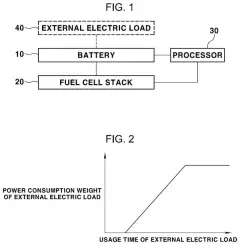
Kia's filing describes a calmer approach. When you plug in, the car works out how much total energy it has and then subtracts what you actually use as time goes on. It estimates the time left from your average usage rather than a single moment's spike. The result is a countdown that should wobble less and mislead you less.
… a processor configured to determine a currently available total power amount based on a state of charge (SoC) of the battery and a state of fuel (SoF) of the fuel cell stack …
Translation: It calculates total available power from both the battery charge and the remaining hydrogen fuel.
How Kia turns battery and fuel into minutes
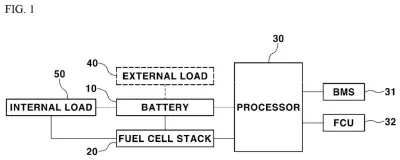
The system is built around a processor that talks to two existing car computers: the battery management system (the unit that tracks how full the battery is) and the fuel cell control unit (the unit that tracks how much hydrogen is left in the tank). It converts both readings into a single energy figure in kilowatt-hours.
Once an outside device is connected, the processor does not keep re-reading both gauges. Instead it follows these steps:
- It saves the hydrogen level at the moment of the first calculation as a reference point.
- It adds up all the power used by outside devices and by the car's own systems, such as the radiator, air conditioner and fuel cell heater.
- It subtracts that running total from the starting energy figure to get what's left.
- It divides what's left by the average power use, which gives the remaining time.
If the hydrogen level drops by a set amount (the filing gives 5% as an example), the processor redoes the full calculation to correct any drift. It also skips the calculation while the battery is being charged by the fuel cell.
The update speed changes too. For the first hour, the estimate refreshes every 5 seconds, since the average is still based on little data. After that it refreshes every 30 seconds, which keeps the number from jumping. The result appears on the car's display.
… to determine a remaining time during which power is allowed to be supplied to an internal load and an external load of the vehicle …
Translation: It figures out how long plugged-in gear and car systems can run before power runs out.
Why a steady countdown matters when you camp
If you use your car as a power source for camping, tailgating or an outage, a countdown you can trust decides whether you keep the fridge running or head for a refill. A number that swings from two hours to forty minutes and back is worse than no number, because you stop believing it.
The filing is also a reminder that fuel cell cars have an extra layer of complexity compared with plain battery cars: two energy sources, measured in different ways. Kia says the hydrogen reading in particular has a limit on how accurate it can be, since it is estimated from tank pressure and temperature. This patent tries to work around that limit with arithmetic rather than a new sensor.
Hyundai's ninth filing since November in our Hyundai coverage follows patents like the wheel-hidden charging plug and pre-charge battery balancing.
Source: US 2026/0365048 A1 at the USPTO (PDF). Full patent text and figures are in the official publication.
Get our take in your Top Stories
Liked this breakdown? Add Patentlyze as a preferred source on Google, and our plain-English take shows up more often in your Top Stories the next time Hyundai & Kia patent news breaks.
Add Patentlyze on Google
One click.
There are more where this came from
We read the new patents from Big Tech, carmakers and more and send you the ones worth knowing. Plain English, free, every week.
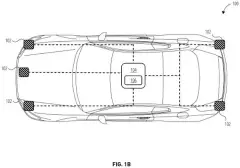
The drawings · 2 sheets
2 drawing sheets from US 2026/0365048 A1 · click any drawing to enlarge


No comments yet