
Samsung
Samsung · Display · Filed Jul 9, 2026 · USPTO published Nov 19, 2026 · This week's release
Samsung Files Patent for a Foldable Hinge That Resists Drop Damage
When a foldable hits the ground, its two halves can jolt toward or away from the hinge and tug on the screen. Samsung's filing adds small brackets and matching bumps to stop that, and a test it cites showed about 15% less movement.
- Publication number
- US 2026/0370744 A1(US20260370744A1)
- Applicant
- SAMSUNG ELECTRONICS CO., LTD.
- Filed · Published
- Jul 9, 2026 · Nov 19, 2026
- Inventors
- Sunpyo YUN
- Status when we published
- Waiting for an examiner
- Document
- 20 claims
- US classification
- 361/679.27
- Parent application
- Continuation of PCT/KR2025/002636 (filed Feb 26, 2025)(PCTKR2025002636)
What Samsung's hinge catches actually do
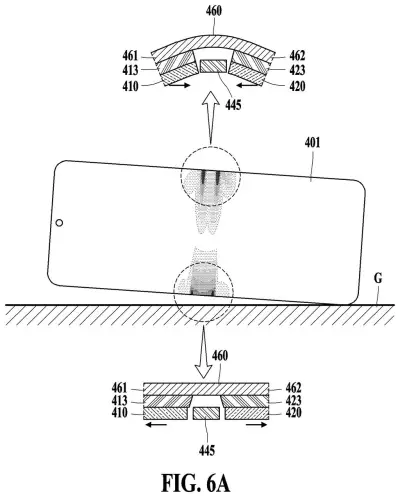
Imagine you're holding your foldable fully open, it slips from your hand, and it lands flat on the ground. For a split second, the two halves of the body can shift toward or away from the hinge in the middle, and that tug is hard on the flexible screen stretched across both.
Samsung's patent adds small brackets to each half of the body. When the device is fully open, each bracket lines up with a little bump on the hinge cover, with a tiny gap between them. Normally they never touch. If a hit pushes the halves around, the bracket meets the bump and stops them from sliding far.
When you fold the device shut, the brackets swing away from the bumps, so nothing rubs or snags while you use it.
… a hinge assembly connecting the first housing portion and the second housing portion, and configured to be operable between a folded state in which the first housing portion and the second housing portion face each other relative to a folding axis and an unfolded state in which the first housing portion and the second housing portion do not face each other …
Translation: It describes the two main parts connected by a hinge that can open up flat or close together.
How the brackets and hinge bumps line up
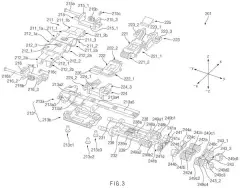
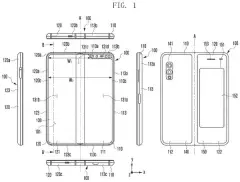
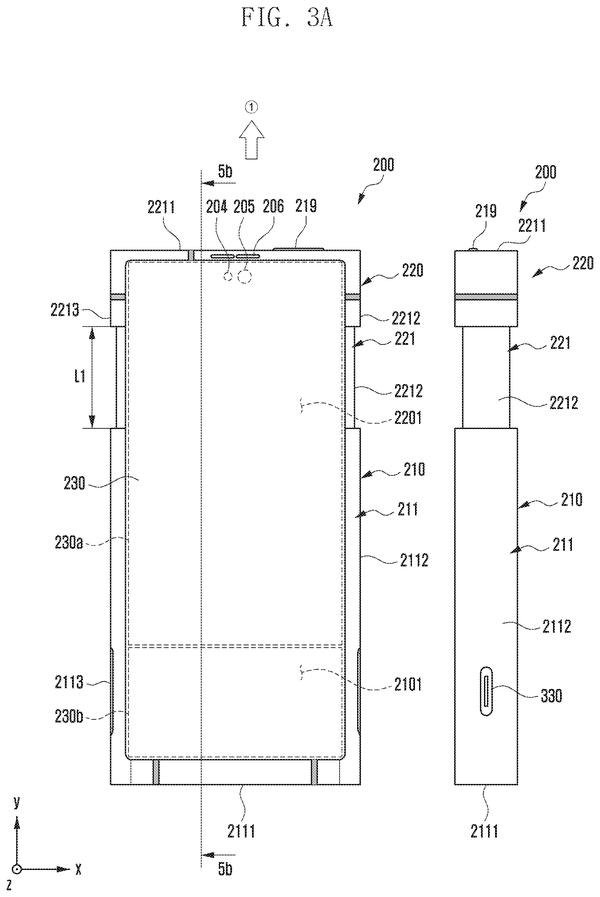
The filing describes a foldable device with two body halves joined by a hinge, and the hinge mechanism sits inside a curved cover called the hinge housing. Each half carries a connecting body, which is a small bracket. The hinge housing has matching protruding regions (bumps) that sit opposite each bracket when the device is open.
Seen along the fold line, the bracket and the bump overlap when the device is open, and they move apart as it closes. The overlap shrinks gradually during folding and disappears once the device is shut, so the parts stay out of the way of the folding motion. When open, they usually don't touch. Angled faces on each part (called offsets) keep an even gap between them, and a hit closes that gap so the parts block further movement.
The filing describes several variations:
- The bracket has a slot (an open region) that receives the bump. If the slot is as wide as the bump, it also blocks sliding along the fold line.
- An L-shaped support post on the body holds the bracket, or the bracket is molded as one piece with the body.
- The bump gets a groove that receives the bracket instead.
The brackets sit between the hinge and the flexible circuit board linking the two halves. In a drop test the filing describes, the body moved at most 0.45 mm from the hinge without the brackets and 0.38 mm with them, about 15% less.
… a connecting body disposed on at least one of the first housing portion and the second housing portion, and a hinge housing including a protruding region provided at a position facing the connecting body, in the unfolded state …
Translation: A special tab on the housing moves to lock against a protruding region when the phone is opened.
Why less hinge slack could protect your screen
The screen on a foldable is the most fragile and expensive part, and it spans a gap that has to bend every time you fold the device. Anything that keeps the two halves from yanking on it during a drop helps. The filing's own test is modest: 0.38 mm of movement versus 0.45 mm, about 15% less.
Because the brackets stay clear of the bumps while folding, you shouldn't feel any change in how the device opens and closes. The filing also says one-piece brackets can mean fewer parts and simpler assembly, which matters to any company building foldables at scale.
This is the 99th Samsung filing we've tracked since May on foldable phones, joining earlier applications like a port for expanding screens and a mirror notification screen.
Source: US 2026/0370744 A1 at the USPTO (PDF). Full patent text and figures are in the official publication.
Get our take in your Top Stories
Liked this breakdown? Add Patentlyze as a preferred source on Google, and our plain-English take shows up more often in your Top Stories the next time Samsung patent news breaks.
Add Patentlyze on Google
One click.
There are more where this came from
We read every patent application Big Tech publishes and send you the ones worth knowing. Plain English, free, every week.
The drawings · 18 sheets
18 drawing sheets from US 2026/0370744 A1 · click any drawing to enlarge


Show the other 10 sheets


More from Samsung
All 1,662 Samsung patents →
More in Display
All 741 Display patents →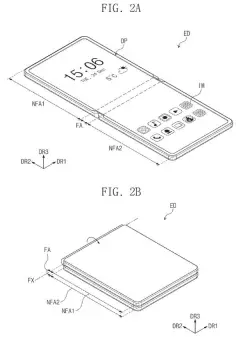
Samsung
Samsung Files Patent for Foldable Screens That Put Less Touch Wiring at the Crease
Samsung
Samsung Files Patent for a Foldable Phone That Doubles as a Smart Ring Charger
Samsung
Samsung Files Patent for a Protective Edge Coating on Foldable Phone Screens
Samsung
No comments yet