
Qualcomm
Qualcomm · Networking · Filed Apr 7, 2026 · USPTO published Nov 19, 2026 · This week's release
Qualcomm Files Patent for Store Lights That Flash to Show Where Misplaced Stock Is
Qualcomm describes a way to turn a store's ceiling lights into a stock-checking system, flashing red over a misplaced box and green over the shelf where it belongs.
- Publication number
- US 2026/0371058 A1(US20260371058A1)
- Applicant
- QUALCOMM Incorporated
- Filed · Published
- Apr 7, 2026 · Nov 19, 2026
- Inventors
- Varun Amar REDDY, Zhifei FAN, Chengjin ZHANG, Ahmed Abdelaziz Ibrahim Abdelaziz ZEWAIL, Michael MITRANI
- Status when we published
- Waiting for an examiner
- Document
- 20 claims
- US classification
- 370/329
- Parent application
- Claims priority from a provisional application 63807387 (filed May 16, 2025)
What Qualcomm's store-light tag tracking does
Every time a box gets nudged onto the wrong shelf in a store or warehouse, somebody has to notice, and that is harder than it sounds.
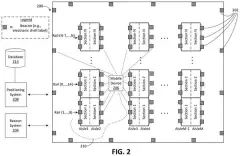
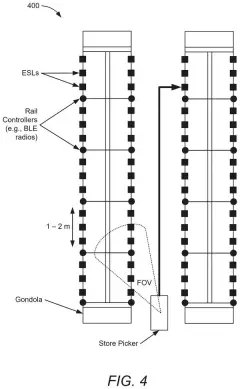
Qualcomm's patent application describes a way to let the ceiling lights do the noticing. Boxes and pallets carry small battery-free tags that send out a short radio ping. The store's wireless lights listen for those pings, work out roughly where each tag is, and then flash a signal. A green light above a shelf can mean the right box just arrived. A red flash can mean something is in the wrong place, with a green light marking where it should go.
The twist is that the system does not keep every light listening all the time. It starts wide, then narrows to the lights closest to the tag to save power.
transmit, to a set of devices, a first trigger for a scanning operation on an energy-harvesting tag in a discovery mode; receive, from the set of devices, a first set of positioning measurements of the energy-harvesting tag in the discovery mode; …
Translation: The system first tells nearby devices to search generally for the missing item's tag.
How the lights narrow down a tag's location
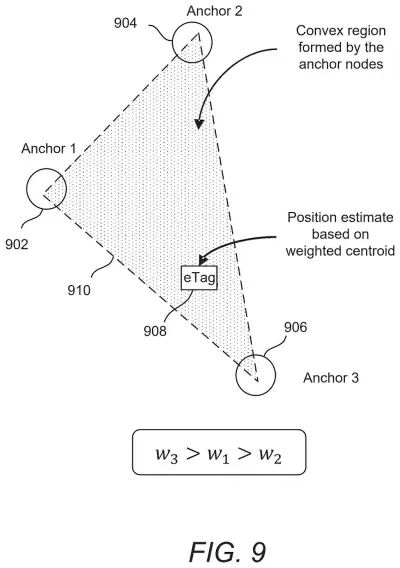
The system has a central computer, which the filing calls an edge server, in charge of a store's Bluetooth Low Energy (BLE) light radios. These are small radios built into the same kind of lighting that many stores and warehouses use to save electricity. The tags on boxes and pallets are energy-harvesting tags, meaning they run without a battery by drawing power from radio signals around them.
Finding a tag happens in two steps:
- Discovery mode: the server tells the light radios to listen for tag signals. The radios are split into clusters that take turns, so one cluster is always listening and no ping is missed. Each radio reports measurements such as signal strength, time of arrival, angle of arrival or round-trip phase (timing and signal clues that hint at distance).
- Localized mode: using those first readings, the server wakes only a subset of radios near the tag's estimated position, and optionally radios built into electronic shelf labels. They send back sharper measurements.
The filing also describes using occupancy sensors (infrared, optical or radio sensors that notice a person nearby) to help decide which radios to wake. It describes estimating a tag's position with a weighted average of nearby radio locations, giving more weight to stronger signals. The server can then command lights to show a chosen color, blink pattern or brightness.
… transmitting, to a subset within the set of devices, a second trigger for the scanning operation in a localized mode based at least in part on the first set of positioning measurements; …
Translation: It then narrows down the search by asking specific devices in the immediate area to look closer.
Why red and green ceiling lights help stockers
For store and warehouse workers, the payoff is a faster way to find what is wrong. A green light for about 5 seconds can confirm a box reached the right shelf, a red flash can flag a wrong one, and a light can point out food whose sensor readings need attention, such as ice cream rising above 0 °C. If an item is far from where it should be, one light marks where it is and another marks where it goes.
For the retailer, the bigger draw is cost. The filing builds on lighting and shelf labels a store may already have, and the two-step scan is meant to cut energy use while still pinning down a tag's position. It is a patent application, so none of this says a store will install it.
This is the 626th Qualcomm patent application in our Qualcomm coverage since May, adding to work like indoor device tracking and self-driving car memory.
Source: US 2026/0371058 A1 at the USPTO (PDF). Full patent text and figures are in the official publication.
Get our take in your Top Stories
Liked this breakdown? Add Patentlyze as a preferred source on Google, and our plain-English take shows up more often in your Top Stories the next time Qualcomm patent news breaks.
Add Patentlyze on Google
One click.
There are more where this came from
We read every patent application Big Tech publishes and send you the ones worth knowing. Plain English, free, every week.
The drawings · 17 sheets
17 drawing sheets from US 2026/0371058 A1 · click any drawing to enlarge


Show the other 9 sheets


More from Qualcomm
All 637 Qualcomm patents →
More in Networking
All 516 Networking patents →
Qualcomm
A New Qualcomm Patent Lets Cell Towers Adjust What Your Phone's AI Predicts
Qualcomm
Qualcomm Patents Wi-Fi Gear That Notices When Your Camera Turns On
Qualcomm
Qualcomm Files Patent to Stop Your Store Map Dot From Jumping Aisles
Qualcomm
No comments yet