
Samsung
Samsung · Networking · Filed Jul 9, 2025 · USPTO published Nov 19, 2026 · This week's release
Samsung Patents a 5G System That Blocks AI Apps by Location and Time
Samsung's filing describes a 5G network that can turn away your phone's AI app depending on where you are and what time it is. AI work gets sorted into types, and each type can carry its own rules.
- Publication number
- US 2026/0370568 A1(US20260370568A1)
- Applicant
- SAMSUNG ELECTRONICS CO., LTD.
- Filed · Published
- Jul 9, 2025 · Nov 19, 2026
- Inventors
- Jungshin PARK, Dongyeon KIM, Eric YIP
- Status when we published
- Examiner raised objections; the company can respond
- Document
- 15 claims
- US classification
- 709/224
- Examiner
- MIAN, MOHAMMAD YOU A (Art Unit 2457)
- Parent application
- National Stage Entry of PCT/KR2024/000459 (filed Jan 10, 2024)(PCTKR2024000459)
What Samsung's 5G AI-app gatekeeper actually does
Every time your phone connects to a 5G network, it introduces itself and says what it needs. This patent adds one more line to that introduction: a list of the AI work your installed apps do. The network checks that list against what your subscription allows, and it can turn you away.
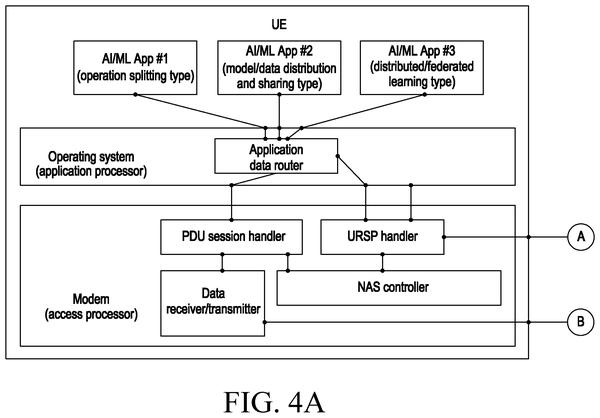
The types are spelled out. Some apps split an AI job between your phone and the network. Some download big AI models, often overnight. Others help train a shared model by learning a little on your phone and sending the results back.
Your subscription can also attach conditions, such as only in certain areas or only during set hours. If you try to use an AI app outside them, the network can refuse, and it tells your phone why: wrong service, wrong place or wrong time.
receiving a registration request message including a list of requested AI/ML operation types from a user equipment (UE); identifying a list of AI/ML operation types allowed for the UE and at least one operation condition for each AI/ML operation type …
Translation: The network checks what AI tasks your phone wants to run and what rules apply to them.
How the network checks AI requests twice
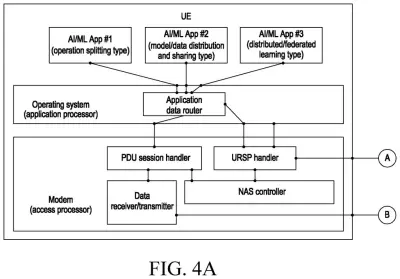
The claims cover two checkpoints inside a 5G core network (the carrier's back-end systems). First, the AMF (the part that signs phones onto the network) receives a registration request listing the AI/ML operation types your installed apps support. It asks the carrier's subscriber records, through the UDM and UDR (databases), which types you are allowed, each with an operation condition such as place or time. If a requested type is not allowed, it sends a registration reject.
Second, when an app asks for a data connection (a PDU session), the AMF checks whether your phone is inside the allowed service area, then hands off to the SMF (the part that sets up connections). The SMF re-checks your subscriber record and can reject the session.
The description names three operation types:
- Operation splitting: part of an AI job runs on your phone, part on the network.
- Model and data distribution: big AI models are stored around the network and downloaded as needed, often at night.
- Distributed learning: your phone trains a piece of a shared model and uploads the results.
Once approved, a PCF (the network's rule-setter) can set transfer policies covering how often, how large and when model or data transfers happen.
Why carriers could meter AI like data
If AI features lean on the network, a carrier needs a way to know which ones are running and to limit or price them. This design gives it that control, down to a single area or a window of hours. For you, it could mean an AI feature that works at home and refuses elsewhere, or a plan that covers some types of AI work and not others.
The filing also lets an AI app's server learn why a connection failed, so it can pause sending data or stop when your access is revoked. The examiner's first review rejected the claims as filed, which is routine at this stage and usually followed by amendments.
This is the 96th Samsung filing we've tracked since May in our 5G and network work, building on one that predicts connection trouble and AI jobs to a second tower.
Source: US 2026/0370568 A1 at the USPTO (PDF). Full patent text and figures are in the official publication.
Get our take in your Top Stories
Liked this breakdown? Add Patentlyze as a preferred source on Google, and our plain-English take shows up more often in your Top Stories the next time Samsung patent news breaks.
Add Patentlyze on Google
One click.
There are more where this came from
We read every patent application Big Tech publishes and send you the ones worth knowing. Plain English, free, every week.
The drawings · 16 sheets
16 drawing sheets from US 2026/0370568 A1 · click any drawing to enlarge


Show the other 8 sheets


More from Samsung
All 1,662 Samsung patents →
More in Networking
All 516 Networking patents →
Samsung
Samsung Files Patent for Gates That Widen Their Reach When Your Body Blocks the Signal
Samsung
Samsung Patents 5G Location Tracking That Stays Accurate Through Signal-Boosting Hardware
Samsung
Samsung Patents a System for Automatically Cleaning Up Idle 5G Network Slices
Samsung
No comments yet