
Samsung
Samsung · Networking · Filed Jul 17, 2026 · USPTO published Nov 19, 2026 · This week's release
Samsung Files Patent for a Network That Predicts Your Connection Trouble Before It Hits
Your phone and the game server on the other end usually find out about a bad signal at the same moment you do: when everything freezes. Samsung's patent describes a cell network that sees the trouble coming and tips off the app first.
- Publication number
- US 2026/0370576 A1(US20260370576A1)
- Applicant
- Samsung Electronics Co., Ltd.
- Filed · Published
- Jul 17, 2026 · Nov 19, 2026
- Inventors
- Vasanth KANAKARAJ, Shreyanshu AGARWAL, Swaraj KUMAR, Issaac KOMMINENI, Rahul Kumar SAHA, Sukhdeep SINGH
- Status when we published
- Waiting for an examiner
- Document
- 20 claims
- US classification
- 709/224
- Parent application
- Continuation of PCT/KR2025/006508 (filed May 14, 2025)(PCTKR2025006508)
How Samsung's network warns apps of lag
Ever been deep in a cloud game or a video call when the picture suddenly freezes and turns blocky? The app on the other end usually has no idea your signal is getting worse until the damage is done, because the wireless connection and the app don't share information.
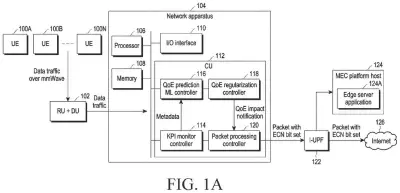
Samsung's patent describes software inside a carrier's network that watches the signal conditions of every connected phone: signal strength, delays, dropped data and interference. A machine-learning model then gives each connection a score from 0 to 1 for how likely your experience is to get worse soon.
When a score crosses a limit the carrier sets, the network tags the data headed to and from your phone with a standard warning flag. The app's server can read that flag and lower the video quality or frame rate before you notice a problem.
… determining, by the network apparatus, a QoE impact score for each UE of the plurality of UEs based on the one or more KPIs …
Translation: The system calculates a score showing how badly user devices are affected based on performance stats.
How the score flags which phones will struggle
The patent covers a method run by a network apparatus (equipment in a carrier's network) attached to the centralized unit, the part of a 5G base station setup that sees traffic from all connected phones. It receives metadata over a control interface, including traffic statistics for each session, and tracks KPIs (key performance indicators, meaning measurements such as signal strength, packet delay, dropped packets, interference, retransmissions and handover success).
A QoE prediction model (machine learning, where software learns patterns from past data) turns those readings into a QoE impact score for each phone session, tied to the subscriber's ID number (the IMSI). QoE means quality of experience. The score runs from 0 to 1 and represents the probability that the experience will get worse. The filing says the model can be re-evaluated and retrained as network conditions change.
The carrier sets a threshold. When a score passes it, a second component builds a notification listing the affected data flows, each identified by:
- Source and destination addresses
- Source and destination ports
- The protocol in use
The list can be filtered to server addresses the carrier picks, such as edge applications.
Finally, a packet processing component sets ECN bits in the packets of those flows. ECN (explicit congestion notification) is a flag already built into internet traffic that tells the receiving end the path is congested. The filing describes two setups: everything inside the central unit, or the prediction and notification pieces running as apps in an open-RAN controller.
… performing an action for moderation of the QoE based on the QoE impact notification.
Translation: The network automatically takes steps to fix the connection issues before they get worse.
Why this matters for AR, VR and cloud gaming
If this works, your AR headset, cloud game or in-car video stream could ease off before the connection stumbles, instead of freezing and recovering afterward. The filing's own examples include AR windshield overlays, 8K video for passengers in buses and taxis, cloud gaming and digital twin training tools, all of which fall apart when delay and jitter spike.
The backdrop is millimeter-wave 5G, which is very fast but easily disrupted by rain, leaves and anything blocking the line to the tower. A carrier that wants to sell reliable service for immersive apps needs some way to bridge that gap, and this filing proposes using a warning flag the internet already understands. Nothing in the filing says it is headed for a specific product, and it gives no test results.
That makes this Samsung's 95th filing we've tracked since May in our 5G and network work watchlist, building on ideas like sending AI jobs to another tower and gates that adjust for body blocking.
Source: US 2026/0370576 A1 at the USPTO (PDF). Full patent text and figures are in the official publication.
Get our take in your Top Stories
Liked this breakdown? Add Patentlyze as a preferred source on Google, and our plain-English take shows up more often in your Top Stories the next time Samsung patent news breaks.
Add Patentlyze on Google
One click.
There are more where this came from
We read every patent application Big Tech publishes and send you the ones worth knowing. Plain English, free, every week.
The drawings · 7 sheets
7 drawing sheets from US 2026/0370576 A1 · click any drawing to enlarge


More from Samsung
All 1,662 Samsung patents →
More in Networking
All 516 Networking patents →
Samsung
New Samsung Patent Targets Dynamic 5G Network Software That Reorganises Itself Under Load
Samsung
Samsung Patents a Signalling Traffic Monitoring Control System for 5G Networks
Samsung
Samsung Files Patent for Sending AI Training Jobs to a Second 5G Tower
Samsung
No comments yet