
Samsung
Samsung · Chip · Filed Apr 7, 2026 · USPTO published Aug 20, 2026 · Aug 20 release
Samsung Patents a Component That Combines Wi-Fi Antenna and Laptop Cooling Vent
Samsung is trying to solve a quiet structural headache in laptop design: fitting a good wireless antenna into a chassis that also needs to breathe. This patent describes a single carrier component that handles both jobs at once.
- Publication number
- US 2026/0246137 A1(US20260246137A1)
- Applicant
- Samsung Electronics Co., Ltd.
- Filed · Published
- Apr 7, 2026 · Aug 20, 2026
- Inventors
- Jangsun YOO, Hakjin KIM, Jihye MOON, Youngheon SONG, Myeonggil LEE, Gun LIM, Gwanghyun JO
- Status when we published
- Waiting for an examiner
- Document
- 20 claims
- US classification
- 343/702
- Parent application
- Continuation of PCT/KR2024/096429 (filed Oct 30, 2024)(PCTKR2024096429)
How Samsung fits a wireless antenna inside a laptop's vent frame
Laptop makers have always had to juggle two competing needs inside a thin chassis: cooling (which means big openings for airflow) and wireless performance (which needs antenna hardware positioned carefully near the device frame). Cramming both into a slim body forces trade-offs, and right now those trade-offs usually mean compromised placement for one or the other.
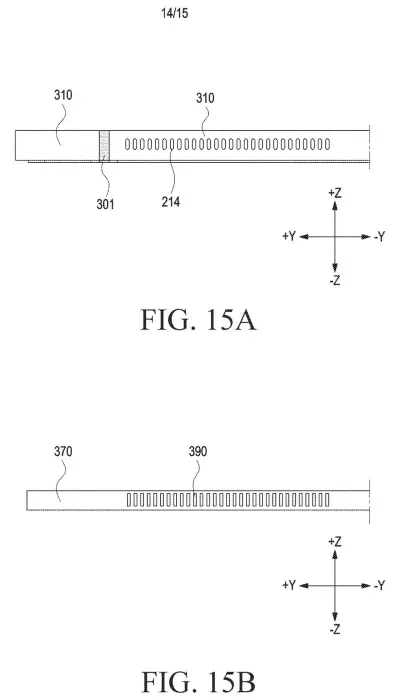
Samsung's patent describes a structural piece called an antenna carrier that sits inside the laptop housing and does both jobs. The carrier holds the antenna pattern (the actual wireless hardware) and also has vent holes cut into its sides so air from an internal fan can pass through. The conductive edges of the housing (the metal frame you can see around the laptop's sides) plug into the same system, acting as part of the antenna.
In short, instead of placing antenna hardware in whatever space is left over after cooling is sorted out, Samsung is designing a component that treats those two needs as one problem from the start.
… an antenna carrier comprising a first antenna pattern electrically connected to the first conductive portion; a fan disposed in the first housing; and a first printed circuit board disposed in the first housing …
Translation: The internal frame holds both the wireless antenna and the cooling fan right next to the main circuit board.
How the antenna carrier, fan, and vent holes connect
The patent centers on an antenna carrier, a structural bracket inside the device housing that serves as the mounting point for a first antenna pattern (the physical antenna trace, which is a precisely shaped conductive path that transmits and receives wireless signals).
What makes this design distinct is that the same carrier also includes vent holes along its side surfaces. Those holes let air pushed by an internal fan flow through the carrier itself, rather than routing airflow around a solid antenna mount. This means the antenna hardware does not have to be relocated to make room for thermal management.
The antenna connects to the rest of the electronics via a feeding portion (the point where the circuit board delivers electrical signal to the antenna) on the first antenna pattern, which links back to a first printed circuit board containing the communication module (the Wi-Fi or cellular radio chip).
The conductive portions of the housing frame, segmented strips of metal along the device's side surfaces, are also electrically tied into the antenna system. Using the metal housing edge as part of the antenna is a common approach in phones and tablets; this patent appears to apply a similar method to a device that also needs active fan cooling.
… wherein the antenna carrier further includes a first vent hole in at least a portion of the side surface of the antenna carrier, and a feeding portion disposed on the first antenna pattern …
Translation: The plastic piece holding the antenna also includes an exhaust vent for the laptop cooling system.
What this means for thin laptops and wireless signal quality
For anyone who has noticed a laptop running hot or losing Wi-Fi signal when the lid is nearly closed, this kind of design work is directly relevant. When antenna placement and cooling vents compete for the same narrow strip of real estate inside a thin laptop frame, engineers compromise on both. A carrier that physically combines those functions removes that trade-off at the component level, which can mean better airflow and better antenna positioning without making the chassis thicker.
The filing fits into a broader pattern of Samsung working out the internal geometry of thin computing devices, where millimeters matter enormously. Readers who follow Big Tech patent news around wireless antenna design will recognize this as part of an ongoing effort across the industry to treat structural components as multifunctional, especially as fanless and ultra-thin laptops push physical limits.
Samsung's 1088th filing in all Samsung filings we track since May joins earlier work on gaze-based payment scanning and automatic storage error detection.
Source: US 2026/0246137 A1 at the USPTO (PDF). Full patent text and figures are in the official publication.
Get our take in your Top Stories
Liked this breakdown? Add Patentlyze as a preferred source on Google, and our plain-English take shows up more often in your Top Stories the next time Samsung patent news breaks.
Add Patentlyze on Google
One click.
There are more where this came from
We read the new patents from Big Tech, carmakers and more and send you the ones worth knowing. Plain English, free, every week.
The drawings · 15 sheets
15 drawing sheets from US 2026/0246137 A1 · click any drawing to enlarge


Show the other 7 sheets


More from Samsung
All 1,662 Samsung patents →
More in Chip
All 651 Chip patents →
Apple
Apple Patents a Two-Sender System That Confirms Wireless Audio Delivery
Intel
Intel Patents a GPU Shortcut That Skips Redundant 3D Geometry Work

Meta
Meta Patents a Camera That Identifies Objects Before Image Data Leaves the Device
Intel