
Snap
Snap · AI / ML · Filed Jul 23, 2026 · USPTO published Nov 19, 2026 · This week's release
Snap Files Patent for AI Selfies That Put You Inside Story Scenes With Friends
Snap's filing turns your selfies into an AI character, then drops it into themed story scenes, even alongside your friends. The twist is the business model: a free first batch, then paid packs.
- Publication number
- US 2026/0368976 A1(US20260368976A1)
- Applicant
- Snap Inc.
- Filed · Published
- Jul 23, 2026 · Nov 19, 2026
- Inventors
- Ivan Babanin, Aleksandr Belskikh, Roman Golobokov, Ivan Hladush, Volodymyr Kalinichenko, Hee Hun Kim, Diana Maksimova, Alexandr Marinenko, Daniel Moreno Cuellar, Anton Pankratov, Hanna Rulevska, Pavel Savchenkov, Sergey Smetanin, Jeremy Baker Voss
- Status when we published
- Waiting for an examiner
- Document
- 20 claims
- US classification
- 345/442
- Parent application
- Continuation of 18/232,938 (filed Aug 11, 2023)(18232938)
What Snap's AI selfie story images actually do
Imagine you send a few selfies to an app, and soon you're the hero of a storybook scene, riding through an ancient myth with your best friend right beside you. That's the idea behind this Snap patent application.
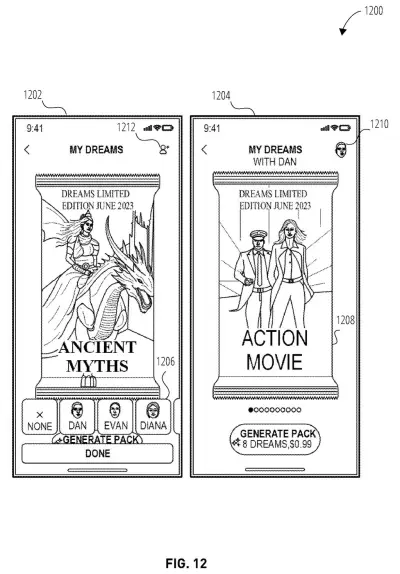
Here's how it works. The app studies your selfies and builds an AI version of you, which the filing calls an identity. Then it picks a template, a ready-made recipe that describes a scene in words and includes a rough pose guide. The AI paints you into that scene. If a friend has their own identity, the same template can put you both in the picture.
Snap also sketches out the business side. A first batch of templates is free, and the rest are grouped into packs you can buy. You can then send your finished image to a friend as a message that disappears after a set time.
… identifying a template that comprises text descriptions of a scene and conditions; and using a machine learning models to generate a personalized image based on the identity and the template.
Translation: The software matches your digital identity with a text description of a scene to create the final image.
How Snap turns a template into your story scene
The claims describe a short chain of steps. A device sends in a portrait image (a selfie) of a person or, in some versions, an animal. A machine learning model, which the description says can be a stable diffusion model (an AI image generator that builds pictures from text instructions), creates an identity to represent that subject. When you select that identity, the system finds a template linked to your account and generates a personalized image from the two.
Each template bundles two things:
- A text description of a themed story scene, split into a positive prompt (what to draw) and a negative prompt (what to avoid, such as 'blurry' or 'deformed'). The filing says the negative prompt gives steadier results with fewer glitches.
- One or more conditions, such as a pose map (a guide of key body points) or a depth map, that control the shape and position of the figure.
The filing also covers the product around it. Templates are grouped by theme into packs. In one example, 8 templates picked at random from a pack of 16 are free, and the rest can be bought. Finished images can be edited with overlays and sent as an ephemeral message (one that disappears after a set time). A template with several people can pull in friends who already have identities.
Why Snap's pack-based pricing idea stands out
If this ever reaches an app, you wouldn't write a single prompt. You'd pick a theme, tap your AI self, and get finished scenes starring you, or you and a friend, ready to edit and send. The templates carry the hard wording, so you never face a blank prompt box.
The business angle is just as clear. The filing describes a free first batch, paid packs for the rest, and a cap on how many packs a single theme can have. It also says templates bought for use with one friend must be bought again for another friend. The filing places these images inside a messaging system with disappearing messages, stories and lenses, so sharing is built in from the start.
Snap's third filing we've tracked since November in our Snap coverage follows applications on animated chat video translation and glasses with battery antennas.
Source: US 2026/0368976 A1 at the USPTO (PDF). Full patent text and figures are in the official publication.
Get our take in your Top Stories
Liked this breakdown? Add Patentlyze as a preferred source on Google, and our plain-English take shows up more often in your Top Stories the next time Snap patent news breaks.
Add Patentlyze on Google
One click.
There are more where this came from
We read the new patents from Big Tech, carmakers and more and send you the ones worth knowing. Plain English, free, every week.
The drawings · 15 sheets
15 drawing sheets from US 2026/0368976 A1 · click any drawing to enlarge


Show the other 7 sheets


More from Snap
All 5 Snap patents →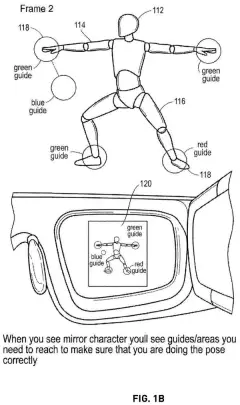
More in AI training & infrastructure
All 324 AI training & infrastructure patents →
IBM
IBM Files Patent for Training AI on Made-Up Business Planning Problems
Microsoft
Microsoft Files Patent for AI That Stops Advertisers From Overpaying for Web Ads
Qualcomm
A New Qualcomm Patent Lets Several Devices Share the Work of One AI Model
Microsoft
No comments yet