
Qualcomm
Qualcomm · AI / ML · Filed May 16, 2025 · USPTO published Nov 19, 2026 · This week's release
A New Qualcomm Patent Lets Several Devices Share the Work of One AI Model
Qualcomm has filed to split one AI model across several devices, so your phone, laptop and tablet could each carry a slice of the load.
- Publication number
- US 2026/0368485 A1(US20260368485A1)
- Applicant
- QUALCOMM Incorporated
- Filed · Published
- May 16, 2025 · Nov 19, 2026
- Inventors
- Qi XUE, Abhijit NAVALEKAR
- Status when we published
- Waiting for an examiner
- Document
- 20 claims
- US classification
- 706/15
What Qualcomm's device-sharing AI patent does
Imagine you ask an AI assistant a big question, but your phone is too small to run the whole model by itself. Normally the answer is to send the job to a data center. Qualcomm's patent application describes another route: let a few devices split the job between them.
Your phone, a laptop and a tablet would each take a slice of every step in the model. After each step, they swap results so everyone has the full picture before the next one starts. It works a bit like a few people assembling one jigsaw puzzle, each handling a section and then trading pieces.
Slice sizes vary. A stronger device gets a bigger slice, so all the devices finish at about the same time. The filing also describes a way to pick between two splitting styles depending on which is faster for a given job.
process, using a first portion of a first layer of a machine learning network, an input embedding to generate a first output corresponding to the first portion of the first layer of the machine learning network …
Translation: Your device handles just one specific slice of the AI network's first layer.
How each device handles its slice of a layer
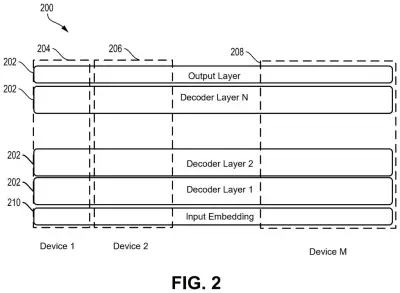
AI models are built as a stack of layers, and each layer is a huge grid of stored numbers (called weights). Running a big model means pushing your input, turned into a list of numbers called an input embedding, through every layer in turn. The patent covers cutting each layer into portions, one per device. Engineers call this tensor parallelism (splitting the number grids themselves across machines).
Here is the loop the claims describe:
- Each device runs the input through its own portion of the first layer.
- One device gathers the other devices' results and combines them into the full output of that layer.
- That combined output is sent to the other devices.
- Every device then runs its portion of the second layer on it, and the pattern repeats for the third.
Dependent claims add details. The combined result can go out one device at a time (called unicast, meaning one-to-one messages), and the order can flip on the next round. Slice sizes can follow each device's processing power, and the layer can be a self-attention layer (the part that weighs which words in a prompt matter to each other).
The description adds a second idea: use pipeline splitting (each device owns a block of whole layers) while the model reads your prompt, then tensor splitting while it writes the reply. A lookup table of speed measurements helps choose. In its example, three devices handle the first stage and two handle the second.
… determine a first combined output embedding based on a combination of the first output and a plurality of outputs corresponding to additional portions of the first layer of the machine learning network received from one or more additional devices …
Translation: The system merges your device's partial results with data sent from other nearby gadgets.
Why this matters for AI on phones and laptops
The filing starts from a familiar problem: phones, tablets and laptops have limited power, memory and battery, so AI models either get shrunk or get sent to cloud servers. Splitting one model across devices you already own offers a third option, one that could let bigger models run on gear in your own hands.
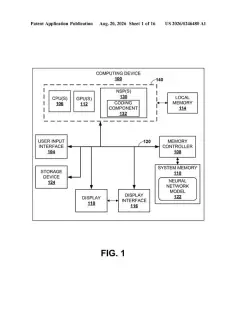
There is a catch the filing itself points to. The devices have to trade results after every layer, so a slow connection between them eats into the gains. That is why the description spends so much time on link speed, device count and a lookup table for choosing the fastest setup. The figures show a chip with a neural processing unit, 5G, Wi-Fi and Bluetooth, which fits a phone-class setting.
This is the 70th Qualcomm filing we've tracked since July in the AI chip wars, building on earlier applications like one splitting a model across devices and one for a phrase cheat sheet.
Source: US 2026/0368485 A1 at the USPTO (PDF). Full patent text and figures are in the official publication.
Get our take in your Top Stories
Liked this breakdown? Add Patentlyze as a preferred source on Google, and our plain-English take shows up more often in your Top Stories the next time Qualcomm patent news breaks.
Add Patentlyze on Google
One click.
There are more where this came from
We read every patent application Big Tech publishes and send you the ones worth knowing. Plain English, free, every week.
The drawings · 15 sheets
15 drawing sheets from US 2026/0368485 A1 · click any drawing to enlarge


Show the other 7 sheets


More from Qualcomm
All 637 Qualcomm patents →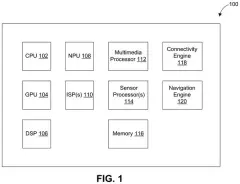
More in AI training & infrastructure
All 323 AI training & infrastructure patents →
IBM
IBM Patents a System for Splitting AI Models Across Multiple Storage Nodes
Amazon
Amazon Patents a Way to Keep AI Training Jobs Running When a Server Crashes
Google
Google Patents a Method to Store AI Model Data in Fewer Bits
Samsung
No comments yet