
Snap
Snap · AR / VR · Filed May 8, 2026 · USPTO published Nov 19, 2026 · This week's release
Snap Patents Clip-In Prescription Lenses That Click Onto AR Glasses
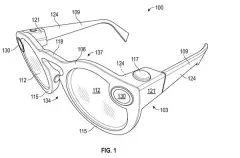
AR glasses put their display optics right where your own prescription lenses would normally go. Snap's patent shapes a lens to fit that space exactly, then holds it with a thin steel frame that clicks in.
- Publication number
- US 2026/0367408 A1(US20260367408A1)
- Applicant
- Snap Inc.
- Filed · Published
- May 8, 2026 · Nov 19, 2026
- Inventors
- Mathias Andreas Hintermann, Miller Harry Schuck III, Michael Ryner, Daniel Paul Rhodes, Robert Edward Stevens
- Status when we published
- Waiting for an examiner
- Document
- 20 claims
- US classification
- 345/630
- Parent application
- Claims priority from a provisional application 63805121 (filed May 13, 2025)
What Snap's click-on prescription lens does
Imagine you've worn glasses since middle school, and now you want to try AR glasses, the kind that float digital information in front of your eyes. Your own lenses don't fit behind the display optics. A normal lens bulges and leaves gaps around the edges, or it sits uncomfortably close to your eyes.
Snap's patent fixes the fit by shaping the front surface of your prescription lens to match the curve of the glasses' inner lens. Every prescription shares that one front curve, and the back of the lens is carved to deliver your actual correction. The whole stack stays compact.
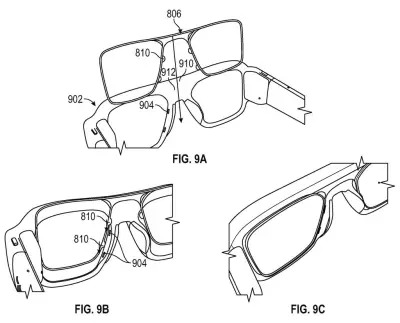
A slim frame of stamped stainless steel holds the lenses. You push it into the nose area of the glasses, then click it into place. The filing says this keeps weight down compared with attachments that use magnets.
a frame mountable to the AR headset; and at least one prescription lens supported by the frame, the at least one prescription lens having a front surface curvature that matches a curvature of an eye side lens of the AR headset.
Translation: A frame holds prescription lenses shaped to match the exact curves of the headset lenses.
How the lens matches the glasses' curve
The claims cover three related pieces: a clip-on frame, the lens itself, and the pairing of both with an AR headset. There is also a method claim for building it. Inside the headset, a waveguide (a flat piece of glass that carries the digital image to your eye) sits between a negative lens behind it and a positive lens in front. The prescription lens goes behind that stack.
The key move is that the front surface of the prescription lens has a curvature matching the back surface of the headset's eye-side lens. Because that front curve is the same for every prescription, the rear surface is aspheric (shaped in a more complex curve than a simple slice of a sphere) and tuned for each prescription. The filing says the lens keeps its optical performance when shifted off-center by up to 4 mm. It also describes making lens groups across roughly a two-diopter range (diopters measure lens strength) that share one front curve.
The frame does the holding:
- Stamped stainless steel that flexes (the filing calls it "vertical compliance"), letting the two lenses spread apart slightly to clear the nose bridge.
- Two-step install: push the frame into the nose area, then click it into place.
- Edge cuts in the lens (a groove, a "T-rim" or a "metal in line" cut) that lock it into the frame.
The filing also notes that some positive prescriptions could end up as biconvex lenses (curved outward on both sides), a shape rarely used in ordinary glasses.
Why prescription fit matters for AR glasses
If you need glasses, AR glasses have an awkward catch: the display optics sit where your own lenses would normally go. The filing says ordinary prescription lenses mate poorly with AR eyewear, leading to a thicker assembly, awkward mounting parts, and lenses so close that your eyelashes can touch them. A matched lens aims to cut all three.
For you, that could mean AR glasses that feel closer to regular specs, with your prescription clicking in instead of a bulky add-on. The 4 mm off-center tolerance matters too, since glasses never sit on your face in exactly the same spot every time. For Snap, a good vision-correction answer widens the pool of people who could comfortably wear AR glasses at all.
Snap's fourth filing we've tracked since November in our Snap coverage follows applications like AI selfies in friend scenes and self-translating animated chat videos.
Source: US 2026/0367408 A1 at the USPTO (PDF). Full patent text and figures are in the official publication.
Get our take in your Top Stories
Liked this breakdown? Add Patentlyze as a preferred source on Google, and our plain-English take shows up more often in your Top Stories the next time Snap patent news breaks.
Add Patentlyze on Google
One click.
There are more where this came from
We read the new patents from Big Tech, carmakers and more and send you the ones worth knowing. Plain English, free, every week.
The drawings · 13 sheets
13 drawing sheets from US 2026/0367408 A1 · click any drawing to enlarge


Show the other 5 sheets


More from Snap
All 5 Snap patents →

More in AR / VR
All 718 AR / VR patents →
LG
LG Patents AR Glasses That Let You Swap In Your Own Prescription Lenses
Meta
Meta Patents a Prescription Glasses Lens With an Eye-Tracking Camera Built Inside

Samsung
Samsung Files Patent So AR Content Can Adjust to Your Phone or Glasses

Qualcomm
No comments yet