
Snap
Snap · Software · Filed Jul 24, 2026 · USPTO published Nov 19, 2026 · This week's release
Snap Patents Animated Chat Videos That Translate Their Own Text
Snap describes animated chat videos whose on-screen words can change to fit the language of the person receiving them. The motion stays the same while the message is rewritten underneath.
- Publication number
- US 2026/0368989 A1(US20260368989A1)
- Applicant
- Snap Inc.
- Filed · Published
- Jul 24, 2026 · Nov 19, 2026
- Inventors
- Alexander Mashrabov, Victor Shaburov, Sofia Savinova, Dmitriy Matov, Andrew Osipov, Ivan Semenov, Roman Golobokov
- Status when we published
- Waiting for an examiner
- Document
- 20 claims
- US classification
- 345/636
- Parent application
- Continuation of 18/509,420 (filed Nov 15, 2023)(18509420)
What Snap's text-translating chat videos do
Every time you send a friend an animated greeting in a chat, the words splashed across it are stuck in whatever language you picked. If your friend reads another language, the joke can land flat.
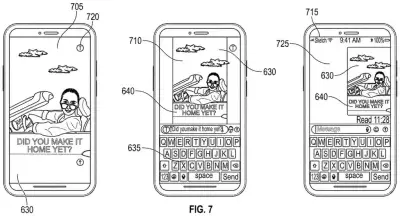
Snap's patent application describes a fix. The animated video starts as a template: a set of frames, a line of preset text, and instructions for how that text should move, glow or fly across the screen. Before the video goes out, your phone swaps in a modified version of the text based on the chat's language settings, such as a translation, and redraws the animation with the new words.
The result is a video that shows your friend the message in their language, with the same motion and effects. The filing also describes previewing the finished videos before you hit send.
… generating, by the computing device and based on localization information associated with the communication chat, a modified preset text corresponding to the preset text …
Translation: It automatically translates the text based on where the chat participants are located.
How the template's text gets rewritten and animated
The filing starts with a video template: a sequence of frame images, a line of preset text, and preset text parameters, which are instructions for how that text animates across the frames (for example, appearing letter by letter or following a curved path).
When a chat is open, the app looks at localization information for that chat (language settings, for instance) and produces a modified version of the preset text. The claims describe this as generating a translation, including one in the language of the person on the receiving end, or adding translations to a configuration file. The app then renders the video with the new words, animated by the same instructions, and sends it through the chat.
The description fills in the rendering. A configuration file records the text's scale, position, rotation, color and number of lines for every frame. Rendering then runs in steps:
- Split the text into lines if needed
- Draw each letter shape (a glyph) at a set size and font
- Pick one global scale so the text fits in every frame
- Pre-draw layers for letters, outlines and shadows
- Combine the layers, often on the phone's graphics chip
The claims also list effects such as shadows, glows, sliced or distorted text and outlines, and say users can preview the finished videos before sending. The description adds that templates can place the user's own face in the video, though the claims here center on the text.
… displaying previews of personalized videos generated with text prior to sending the personalized video …
Translation: Users can watch a preview of the animated video before sending it to friends.
Why Snap cares about words inside chat videos
If you chat with people who speak another language, you know how often a fun sticker or clip loses its point because the words on it are unreadable to the other person. A messaging app that rewrites the text inside the video for each recipient removes that gap without extra work from you.
For Snap, the appeal is simple: animated, personalized videos only spread if both sides of a chat can enjoy them. The filing describes this as part of a messenger, so the change would show up inside the chat you already use. It is a patent application, so nothing here says when or whether it ships.
Snap's second filing we've tracked since November builds on our growing our Snap coverage, which started with a battery-as-antenna idea for smart glasses.
Source: US 2026/0368989 A1 at the USPTO (PDF). Full patent text and figures are in the official publication.
Get our take in your Top Stories
Liked this breakdown? Add Patentlyze as a preferred source on Google, and our plain-English take shows up more often in your Top Stories the next time Snap patent news breaks.
Add Patentlyze on Google
One click.
There are more where this came from
We read the new patents from Big Tech, carmakers and more and send you the ones worth knowing. Plain English, free, every week.
The drawings · 10 sheets
10 drawing sheets from US 2026/0368989 A1 · click any drawing to enlarge


Show the other 2 sheets


More from Snap
All 5 Snap patents →

More in Software
All 816 Software patents →
Apple
Apple Files Patent for Phone Calls That Translate Languages as You Talk
Apple
Apple Patents a Group Chat Button That Turns Questions Into Polls
Salesforce
Salesforce Patents Limited Chat Accounts for People Outside Your Company
Samsung
No comments yet