
Sony
Sony · Automotive · Filed Oct 22, 2025 · USPTO published Nov 19, 2026 · This week's release
Sony Patents a Radar Check That Spots Interference From Oncoming Cars
When two cars with radar pass each other at night, each one's signal can fool the other. Sony's patent gives the radar a way to catch that by checking whether its own answer holds together.
- Publication number
- US 2026/0367217 A1(US20260367217A1)
- Applicant
- SONY SEMICONDUCTOR SOLUTIONS CORPORATION
- Filed · Published
- Oct 22, 2025 · Nov 19, 2026
- Inventors
- RYO SASAKI
- Status when we published
- Waiting for an examiner
- Document
- 12 claims
- US classification
- 342/134
- Parent application
- National Stage Entry of PCT/JP2024/015223 (filed Apr 17, 2024)(PCTJP2024015223)
What Sony's radar does when it gets fooled
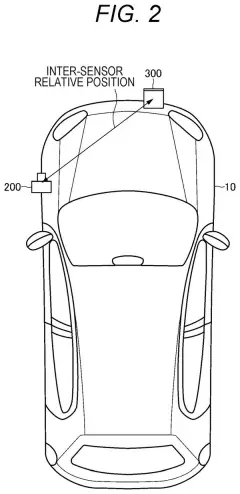
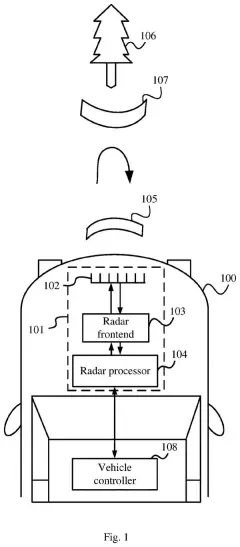
Imagine you're driving at night on a two-lane road, and an oncoming car has its own radar sending radio pulses straight at you. Your car's radar can pick up that stray signal and mistake it for a real object. Cars rely on radar for things like automatic braking and adaptive cruise control, so a confused radar is a real problem.
Sony's patent gives the radar a built-in lie detector. Instead of just reporting what it sees, the radar processes each echo under two different assumptions about how fast the object is moving. A real object only makes sense under one of them. Interference tends to look the same under both, or look wrong under both.
When the answers don't add up, the radar can flag that something is off, so the car can warn you or limit the driving features that depend on it. And it does all this without a special interference mode.
… generate a plurality of angle-of-arrival spectra on a basis of a plurality of corrected signals obtained by performing a plurality of speed folding correction processes on the first reflection chirp signal and the second reflection chirp signal …
Translation: It builds multiple directional graphs after adjusting for speed errors in the radar signals.
How the radar checks its own answer twice
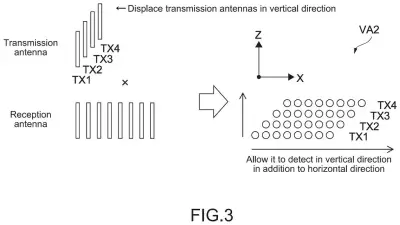
The radar sends out chirps (short radio pulses whose frequency slides smoothly upward) from two transmit antennas that take turns. Each chirp bounces off an object and returns as an echo. Because the antennas fire at slightly different moments, a moving object like an oncoming car makes the two echoes slightly out of step with each other (a phase shift).
Fixing that shift requires knowing the object's speed. Radar can only measure speed within a limited range before it folds (wraps around, like a wagon wheel that seems to spin backward on film). So the radar tries more than one correction: assume the speed wrapped zero times, then once. Each attempt becomes an angle-of-arrival spectrum (a graph of how strong the echo looks from each direction).
The device then compares those graphs:
- One clean result: only one graph has a sharp main peak, with the runner-up peak a set amount lower (the filing gives 30 dB as an example). The echo is a real target.
- Several look-alike results: the graphs barely change between guesses (the filing mentions roughly a 60% shape match). Unwanted signal.
- No clean result: no graph has a sharp peak. Also unwanted signal.
The unwanted signal can be interference from another radar, or a multipath echo (a bounce off a road surface or wall). The filing also describes a single-antenna variation and allowing more than two fold counts.
… determine whether radio wave interference is present without preparing the special mode for the radio wave interference or without increasing the noise floor even when the radio wave interference is present.
Translation: It spots outside signal interference without needing a special operating mode or raising background static.
Why this matters for driver-assist radar
If your car has automatic emergency braking or adaptive cruise control, a radar that can't tell when it is being confused is a hidden weak spot. Oncoming traffic with its own radar is the example the filing uses. The filing says that when unwanted signals are detected, the car could tell you the radar may not behave properly, or limit driving automation functions that rely on it.
For Sony, the selling point is efficiency. The check reuses the angle calculations the radar already runs, so there is no special interference mode and no higher noise floor (the extra background fuzz that coded transmission waves can add). That makes it a cheap add-on for any radar design that already works this way.
That makes this Sony's 39th filing we've tracked in self-driving sensing since July, adding to work like its ultra-fast speed camera and its two-layer chip.
Source: US 2026/0367217 A1 at the USPTO (PDF). Full patent text and figures are in the official publication.
Get our take in your Top Stories
Liked this breakdown? Add Patentlyze as a preferred source on Google, and our plain-English take shows up more often in your Top Stories the next time Sony patent news breaks.
Add Patentlyze on Google
One click.
There are more where this came from
We read every patent application Big Tech publishes and send you the ones worth knowing. Plain English, free, every week.
The drawings · 19 sheets
19 drawing sheets from US 2026/0367217 A1 · click any drawing to enlarge


Show the other 11 sheets


More from Sony
All 722 Sony patents →
More in Automotive
All 377 Automotive patents →
Nvidia
Nvidia Patents a Way to Merge Radar and Camera Feeds Into One 3D Map for Self-Driving Cars
Nvidia
Nvidia Files Patent to Help Self-Driving Radar Spot How Fast Things Move Sooner
Nvidia
Nvidia Files Patent for Teaching Cheap Car Radar to Do the Job of Costly Lasers
Mobileye (Intel)
No comments yet