Get the newsletter
Nvidia · AI / ML · Filed Feb 12, 2026 · USPTO published Nov 19, 2026 · This week's release

Nvidia Files Patent for Robots That Handle Surprises They Were Never Trained On

Instead of reacting to raw camera pixels, this Nvidia patent has a robot first write down what is true about its surroundings, then pick its next move from that list.
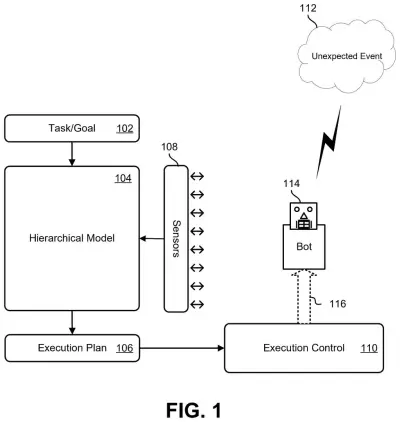
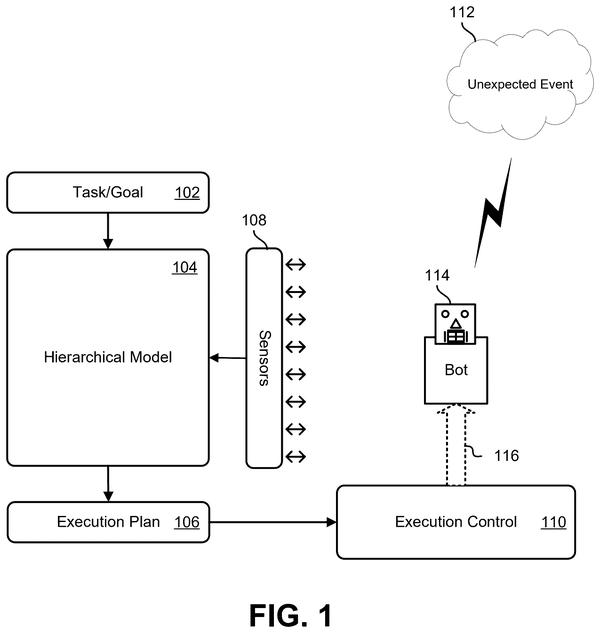
A robot senses its surroundings to adjust its plan when something unexpected happens. Drawing from patent filing US 2026/0364786 A1.
A robot senses its surroundings to adjust its plan when something unexpected happens.All 59 drawings ↓
Publication number
US 2026/0364786 A1(US20260364786A1)
Applicant
NVIDIA Corporation
Filed · Published
Feb 12, 2026 · Nov 19, 2026
Inventors
Christopher Jason Paxton, Kei Kase, Dieter Fox
Status when we published
Waiting for an examiner
Document
20 claims
US classification
701/27
Parent application
Continuation of 16/791,943 (filed Feb 14, 2020)(16791943)

What Nvidia's robot checklist planner does

Every time something in a robot's workspace shifts, a cup gets nudged or a lid gets closed, the robot has to work out what changed and what to do about it. Many robots handle this badly. They react to raw camera images, and anything they were not trained on can leave them slow or stuck.

Nvidia's patent splits the job in two. First, a neural network (software that learns from examples) looks at the camera feed and writes a short checklist of facts about the scene. Then a planner works backward from the goal to see which conditions have to be true first, and picks steps that make them true.

Because the robot rechecks the facts after every move, a surprise just changes the checklist, and the plan adjusts with it.

From the filing · CLAIM 2
… select one or more symbolic operators that, if applied to the one or more logical predicates, would cause the one or more preconditions to be satisfied; and cause the device to perform one or more actions determined based at least on the one or more symbolic operators.

Translation: The system picks the right logical steps to solve the problem and makes the robot carry them out.

How the robot works backward from its goal

The first independent claim covers a processor that starts from a goal and identifies the preconditions (things that must be true before the goal can be reached). Other claims say these are backpropagated from the goal state, meaning worked backward from the end result so each step sets up the one after it.

One or more neural networks (software trained on examples) turn sensor data, such as camera images, into logical predicates, which are symbolic statements describing the environment. The system then selects symbolic operators, named actions a robot can perform, that would satisfy the preconditions, and the device acts on them.

The description lays out a two-level design:

  • A high-level policy reads a few recent camera frames plus the robot's joint readings and infers the current logical state.
  • A low-level policy, another neural network, turns the current operator into the joint positions the robot should move to.
  • A loop repeats: check whether the goal is met, read the sensors, infer the state, pick an operator, act.

The predicates are recomputed from current sensor data, so the plan follows what the robot sees now. During training, the networks also predict depth and object-outline images as side tasks to help them learn spatial relationships.

From the filing · THE ABSTRACT
Apparatuses, systems, and techniques to facilitate robotic execution using neural networks to perform complex, multi-step tasks in situations for which a robot has not been trained.

Translation: This technology helps robots use AI to handle difficult new situations they never saw before.

What this means for robots facing surprises

If you have watched a robot freeze because something sat an inch from where it expected, you have seen the problem here. Robots that only react to camera images struggle when a situation is new, and hand-built rule trees get huge as more situations are added. A planning layer that reasons about what must be true next is a way to cope with surprises without writing a rule for each one.

For anyone hoping for robots in homes, warehouses or hospitals, multi-step jobs in messy surroundings are the hard part. The filing describes a robot arm with cameras and joint sensors, and says the aim is tasks the robot has not been trained for. It is a patent application, so it shows a direction of research, not a product on a shelf.

That makes this Nvidia's 39th filing we've tracked since May in our robot grasping and movement work, adding to earlier applications like teaching by watching hands and replanning when objects shift.

Source: US 2026/0364786 A1 at the USPTO (PDF). Full patent text and figures are in the official publication.

Get our take in your Top Stories

Liked this breakdown? Add Patentlyze as a preferred source on Google, and our plain-English take shows up more often in your Top Stories the next time Nvidia patent news breaks.

There are more where this came from

We read every patent application Big Tech publishes and send you the ones worth knowing. Plain English, free, every week.

The drawings · 59 sheets

59 drawing sheets from US 2026/0364786 A1 · click any drawing to enlarge

How a robot adapts its actions when unexpected events occur, drawing sheet 1 from US 2026/0364786 A1
Sheet 1 How a robot adapts its actions when unexpected events occur
Two tiers of planning create step by step robot routines, drawing sheet 2 from US 2026/0364786 A1
Sheet 2 Two tiers of planning create step by step robot routines
Building blocks define the rules and goals for each action, drawing sheet 3 from US 2026/0364786 A1
Sheet 3 Building blocks define the rules and goals for each action
An AI model estimates real world conditions from camera views, drawing sheet 4 from US 2026/0364786 A1
Sheet 4 An AI model estimates real world conditions from camera views
Internal parts of the AI that assesses current surroundings, drawing sheet 5 from US 2026/0364786 A1
Sheet 5 Internal parts of the AI that assesses current surroundings
Turning sensor history and tasks into the next best move, drawing sheet 6 from US 2026/0364786 A1
Sheet 6 Turning sensor history and tasks into the next best move
Inside the AI that picks precise robot arm movements, drawing sheet 7 from US 2026/0364786 A1
Sheet 7 Inside the AI that picks precise robot arm movements
Logic for updating robot actions as new situations arise, drawing sheet 8 from US 2026/0364786 A1
Sheet 8 Logic for updating robot actions as new situations arise
Show the other 51 sheets
How the robot decides its next move from sensor readings, drawing sheet 9 from US 2026/0364786 A1
Sheet 9 How the robot decides its next move from sensor readings
Chip components that calculate AI training steps and memory updates, drawing sheet 10 from US 2026/0364786 A1
Sheet 10 Chip components that calculate AI training steps and memory updates
Teaching an AI model before testing it on new tasks, drawing sheet 11 from US 2026/0364786 A1
Sheet 11 Teaching an AI model before testing it on new tasks
Server center layers that organize computing jobs and storage, drawing sheet 12 from US 2026/0364786 A1
Sheet 12 Server center layers that organize computing jobs and storage
External sensors and controls mounted around an autonomous car, drawing sheet 13 from US 2026/0364786 A1
Sheet 13 External sensors and controls mounted around an autonomous car
Overlapping coverage zones for all cameras on the car, drawing sheet 14 from US 2026/0364786 A1
Sheet 14 Overlapping coverage zones for all cameras on the car
Onboard computer chips linked to driving controls and car sensors, drawing sheet 15 from US 2026/0364786 A1
Sheet 15 Onboard computer chips linked to driving controls and car sensors
Cloud servers updating maps and AI models for cars, drawing sheet 16 from US 2026/0364786 A1
Sheet 16 Cloud servers updating maps and AI models for cars
Computer parts that coordinate processors, memory, and networking, drawing sheet 17 from US 2026/0364786 A1
Sheet 17 Computer parts that coordinate processors, memory, and networking
Connecting sensors, cameras, and audio gear to a main chip, drawing sheet 18 from US 2026/0364786 A1
Sheet 18 Connecting sensors, cameras, and audio gear to a main chip
Linking multiple AI processors together through a central switch, drawing sheet 19 from US 2026/0364786 A1
Sheet 19 Linking multiple AI processors together through a central switch
Plugging an AI accelerator into a host computer via USB, drawing sheet 20 from US 2026/0364786 A1
Sheet 20 Plugging an AI accelerator into a host computer via USB
Multiple main chips sharing tasks across graphics chips, drawing sheet 21 from US 2026/0364786 A1
Sheet 21 Multiple main chips sharing tasks across graphics chips
Sharing memory directly between processor cores and a graphics chip, drawing sheet 22 from US 2026/0364786 A1
Sheet 22 Sharing memory directly between processor cores and a graphics chip
Bringing graphics accelerator circuits directly inside the main processor, drawing sheet 23 from US 2026/0364786 A1
Sheet 23 Bringing graphics accelerator circuits directly inside the main processor
How apps send visual tasks directly to graphics hardware, drawing sheet 24 from US 2026/0364786 A1
Sheet 24 How apps send visual tasks directly to graphics hardware
Connecting graphics accelerators directly to shared system memory, drawing sheet 25 from US 2026/0364786 A1
Sheet 25 Connecting graphics accelerators directly to shared system memory
Multiple graphics chips sharing unified memory to run AI models, drawing sheet 26 from US 2026/0364786 A1
Sheet 26 Multiple graphics chips sharing unified memory to run AI models
An all-in-one chip combining graphics, video, and AI processing, drawing sheet 27 from US 2026/0364786 A1
Sheet 27 An all-in-one chip combining graphics, video, and AI processing
Specialized graphics chip layout with dedicated fragment processors, drawing sheet 28 from US 2026/0364786 A1
Sheet 28 Specialized graphics chip layout with dedicated fragment processors
General-purpose graphics chip organized into versatile shader cores, drawing sheet 29 from US 2026/0364786 A1
Sheet 29 General-purpose graphics chip organized into versatile shader cores
Inside an advanced graphics core built to run parallel calculations, drawing sheet 30 from US 2026/0364786 A1
Sheet 30 Inside an advanced graphics core built to run parallel calculations
How computer chips divide work to run tasks faster, drawing sheet 31 from US 2026/0364786 A1
Sheet 31 How computer chips divide work to run tasks faster
Computer system wiring together processors, memory, and sensors for robots, drawing sheet 32 from US 2026/0364786 A1
Sheet 32 Computer system wiring together processors, memory, and sensors for robots
How parallel chip units divide robot control jobs, drawing sheet 33 from US 2026/0364786 A1
Sheet 33 How parallel chip units divide robot control jobs
Memory routing parts inside a parallel computing block, drawing sheet 34 from US 2026/0364786 A1
Sheet 34 Memory routing parts inside a parallel computing block
Internal parts of a single processing cluster on the chip, drawing sheet 35 from US 2026/0364786 A1
Sheet 35 Internal parts of a single processing cluster on the chip
Core calculation engines running robot decision logic, drawing sheet 36 from US 2026/0364786 A1
Sheet 36 Core calculation engines running robot decision logic
Linking multiple graphics chips to speed up training, drawing sheet 37 from US 2026/0364786 A1
Sheet 37 Linking multiple graphics chips to speed up training
Specialized graphics chip blocks handling camera feeds, drawing sheet 38 from US 2026/0364786 A1
Sheet 38 Specialized graphics chip blocks handling camera feeds
Internal execution units that order and run robot tasks, drawing sheet 39 from US 2026/0364786 A1
Sheet 39 Internal execution units that order and run robot tasks
Dedicated AI processor layout for fast deep learning calculations, drawing sheet 40 from US 2026/0364786 A1
Sheet 40 Dedicated AI processor layout for fast deep learning calculations
Brain-inspired chip circuits that mimic biological neurons to run AI, drawing sheet 41 from US 2026/0364786 A1
Sheet 41 Brain-inspired chip circuits that mimic biological neurons to run AI
Central computing parts that link sensors and cameras to memory, drawing sheet 42 from US 2026/0364786 A1
Sheet 42 Central computing parts that link sensors and cameras to memory
Multiple processing cores sharing onboard memory inside a computer chip, drawing sheet 43 from US 2026/0364786 A1
Sheet 43 Multiple processing cores sharing onboard memory inside a computer chip
Graphics hardware setup that handles video displays and visual data, drawing sheet 44 from US 2026/0364786 A1
Sheet 44 Graphics hardware setup that handles video displays and visual data
Command engine that distributes rendering jobs to graphics cores, drawing sheet 45 from US 2026/0364786 A1
Sheet 45 Command engine that distributes rendering jobs to graphics cores
Clustered mini-cores that split up complex visual math tasks, drawing sheet 46 from US 2026/0364786 A1
Sheet 46 Clustered mini-cores that split up complex visual math tasks
Internal layout of execution units carrying out parallel instructions, drawing sheet 47 from US 2026/0364786 A1
Sheet 47 Internal layout of execution units carrying out parallel instructions
A single execution unit managing threads to perform rapid calculations, drawing sheet 48 from US 2026/0364786 A1
Sheet 48 A single execution unit managing threads to perform rapid calculations
Internal parts of a processor running robot tasks, drawing sheet 49 from US 2026/0364786 A1
Sheet 49 Internal parts of a processor running robot tasks
Core calculation cluster that powers real-time robot choices, drawing sheet 50 from US 2026/0364786 A1
Sheet 50 Core calculation cluster that powers real-time robot choices
Memory management unit that caches data for quick access, drawing sheet 51 from US 2026/0364786 A1
Sheet 51 Memory management unit that caches data for quick access
Multiprocessor layout that handles simultaneous robot instructions, drawing sheet 52 from US 2026/0364786 A1
Sheet 52 Multiprocessor layout that handles simultaneous robot instructions
Hospital system using hospital scans to train medical AI, drawing sheet 53 from US 2026/0364786 A1
Sheet 53 Hospital system using hospital scans to train medical AI
Software stack linking clinic image models to cloud servers, drawing sheet 54 from US 2026/0364786 A1
Sheet 54 Software stack linking clinic image models to cloud servers
Step-by-step path turning raw body scans into labeled images, drawing sheet 55 from US 2026/0364786 A1
Sheet 55 Step-by-step path turning raw body scans into labeled images
Ultrasound system processing live probe signals for screen display, drawing sheet 56 from US 2026/0364786 A1
Sheet 56 Ultrasound system processing live probe signals for screen display
How AI scans medical images and checks patient movement, drawing sheet 57 from US 2026/0364786 A1
Sheet 57 How AI scans medical images and checks patient movement
Retraining an AI model with help from human reviewers, drawing sheet 58 from US 2026/0364786 A1
Sheet 58 Retraining an AI model with help from human reviewers
Labeling raw scan data to build new training sets, drawing sheet 59 from US 2026/0364786 A1
Sheet 59 Labeling raw scan data to build new training sets
Patent filing page

More in AI training & infrastructure

All 323 AI training & infrastructure patents →

Watchlists this filing belongs to

All watchlists →
Reader comments

No comments yet

Start the discussion

Real name or a handle, either is fine. Comments are read by a person before they appear, so allow a little time. Keep it about the filing.