
Methods and Systems for Implementing a Redundant Brake System
When a self-driving truck's brakes fail, there's no driver to grab the wheel. Waymo's answer is a third independent brake controller that kicks in before the vehicle can do anything catastrophic.
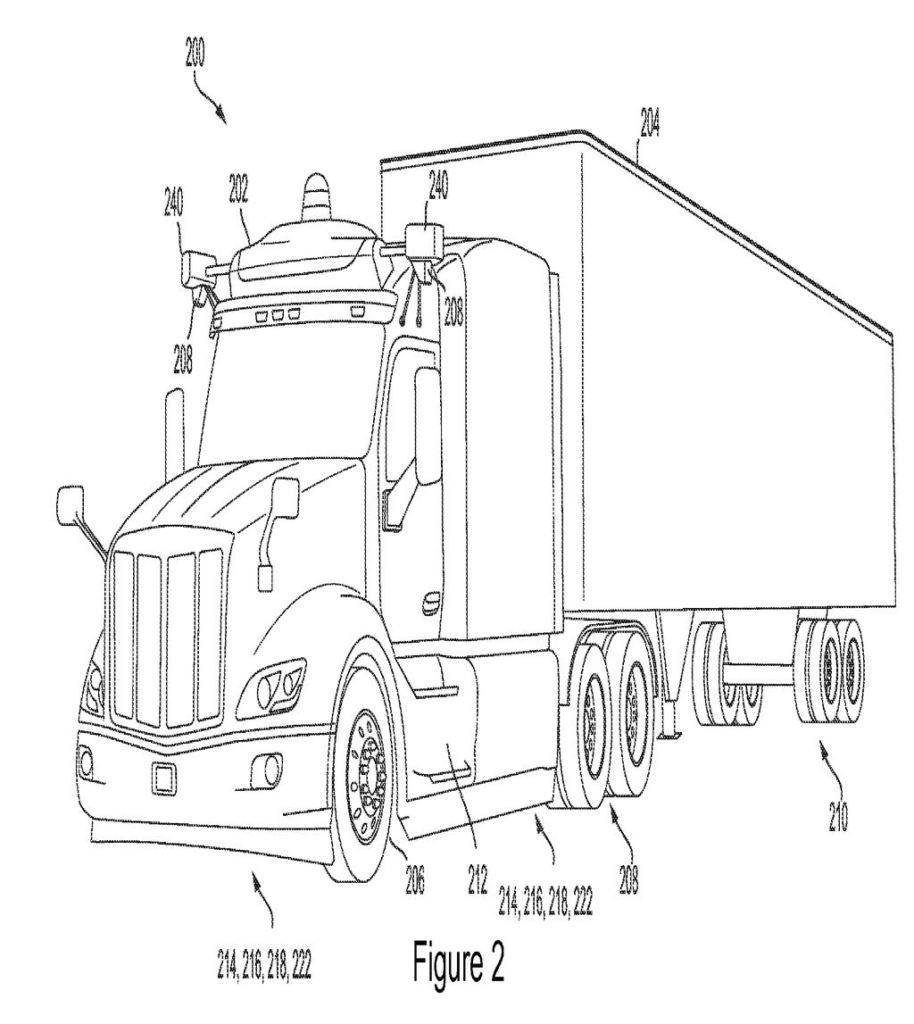
How Waymo's triple brake backup actually works
A self-driving semi-truck rolls down a highway at 65 mph with no one behind the wheel. If its braking system fails, there is no human to pump the pedal. That single fact makes brake reliability far more urgent in autonomous freight than in any ordinary vehicle.
Waymo's patent describes a brake setup with three separate controllers, each capable of stopping the truck on its own. The system is designed so that if you lose power to two of the three brake controllers at once, the brakes automatically apply rather than release. That fail-safe logic means the truck stops itself by default when something goes wrong, rather than coasting until someone intervenes.
The third controller runs in parallel with the second and uses air pressure valves to pick whichever controller is pushing harder. So even if two systems disagree, the truck gets the strongest available braking signal. It's a mechanical argument that always sides with safety.
… upon loss of power to both the first solenoid valve and the second solenoid valve, one or more brakes of the vehicle are applied.
Translation: If the system loses electrical power, the brakes automatically engage for safety.
How the three brake controllers hand off pressure
Most safety-critical vehicles use two independent brake controllers, so if one fails the other takes over. Waymo's patent extends that to three controllers, specifically targeting large trucks where stopping distances are long and the stakes are high.
The first independent claim centers on a clever electrical design: two solenoid valves (electromagnetically controlled switches that route air pressure) are wired as normally closed valves. That means they require active power to stay open. Cut the power to both, and the brakes engage automatically. The vehicle defaults to stopped, not to coasting.
The third controller connects to the system using pneumatic select-high valves, a type of mechanical valve that compares two air pressure signals and passes the higher one downstream. In practice, this means:
- Controller 2 and Controller 3 each send a brake-pressure signal.
- The select-high valve picks whichever signal is stronger.
- The wheels receive the maximum braking force either controller is calling for.
This mechanical arbitration (letting physics pick the winner rather than software) is important because it operates even if one controller's software is unresponsive. There's no voting algorithm that could deadlock; the stronger pressure simply wins.
These valves can be used to perform a mechanical max arbitration between pressure provided by the second controller and the third controller.
Translation: The system physically compares signals from two computer controllers and selects the highest pressure.
What triple-redundant braking means for driverless freight
For autonomous freight, braking isn't a comfort feature, it's the last line of defense between a 40-ton truck and a catastrophic outcome. Adding a third controller changes the failure math significantly: two systems would have to fail simultaneously and the fail-safe wiring would have to be defeated before the truck loses braking entirely. That's a much harder sequence of failures to imagine than a simple dual-system design.
Waymo has been expanding its autonomous trucking program, and the regulatory path for driverless commercial vehicles depends heavily on demonstrating that safety-critical systems can handle multiple simultaneous failures. Filings like this one appear in the broader stream of plain-English patent summaries covering autonomous-vehicle safety architecture, where redundancy engineering is doing as much work as the AI itself.
Google's 48th filing we've tracked since May in the self-driving sensor race builds on work like its blind-spot sharing patent and its street-scene angle patent.
Brake failure in a vehicle with no human driver is about as serious as engineering problems get, and this filing takes that seriously. Adding a third controller with mechanical arbitration (not software arbitration) addresses the specific failure mode where two software-controlled systems could both freeze or receive bad signals simultaneously. The approach matches the size of the problem: physical fail-safe valves that default to braking are a more reliable backstop than any additional layer of code.
There are more where this came from
We read every patent application Big Tech publishes and send you the ones worth knowing. Plain English, free, every week.
The drawings
7 drawing sheets from US 2026/0241907 A1 · click any drawing to enlarge


Want this weekly breakdown for a company we don't cover? Patentlyze Pro →
Be the first to weigh in