Latest cybersecurity patents, Page 25
Fraud detection, encryption, sign-in and privacy controls from Microsoft, Google, IBM, Apple and others. The cybersecurity and privacy patent applications we have broken down from the companies we track, newest first.
- in the Nov 12 release
- 8
- in November so far
- 27
- filings tracked
- 341
- last 90 days
- 143
Recent filings
Newest first · 341 total-
Adobe · Published May 21
Adobe Patents a Password System That Uses Keystroke Timing as a Security Factor
Your password isn't just the characters you type — it could also include *when* you pause between them. Adobe has filed a patent that embeds deliberate timing gaps directly into the password itself.
-
Qualcomm · Published May 21
Qualcomm Patents a System That Lets Video Callers Block Filters on Their Own Face
Imagine joining a video call and discovering the other person's app has quietly swapped your face with a cartoon — without your knowledge. Qualcomm is filing a patent that would let the person being filmed decide whether that's allowed.
-
Qualcomm · Published May 21
Qualcomm Patents a System to Authenticate 5G Network Broadcasts Before Your Device Trusts Them
Your phone trusts a lot of what cell towers tell it — maybe too much. Qualcomm's latest patent proposes a way for devices to cryptographically verify that system-level network broadcasts haven't been faked or tampered with before acting on them.
-
Qualcomm · Published May 21
Qualcomm Patents Session-Key Scrambling for Sensor Data Security
Qualcomm wants to secure sensor data before it ever leaves the sensor — using a session-key scrambling approach that bakes encryption into the transmission pipeline itself, not as an afterthought.
-
Intel · Published May 21
Intel Patents On-Chip Security Channels for Trusted Execution Environments
When security protocols were designed for external PCIe devices, nobody fully accounted for the chips-within-chips world of modern processors. Intel's new patent tries to close that gap by bringing the same cryptographic handshakes used for external hardware to the devices baked directly into the CPU package.
-
Microsoft · Published May 21
Microsoft Patents a System That Auto-Purges Inactive User Credentials from Devices
Every Windows device that someone logged into once — a contractor, a temp, a former employee — quietly stores their credentials. Microsoft's new patent automatically cleans those up before attackers can use them.
-
Microsoft · Published May 21
Microsoft Patents a Cross-Tenant Threat Detection System for Cloud Security
Most cloud security tools are blind to threats that hop between isolated customer environments. Microsoft's new patent describes a way to spot those cross-tenant attacks without breaking the privacy walls between customers.
-
Microsoft · Published May 21
Microsoft Patents a Broker That Routes Workloads to Secure Execution Environments
Microsoft is patenting a system that acts like an air-traffic controller for sensitive computing jobs — automatically routing encrypted workloads to whichever trusted hardware enclave best fits your security policy.
-
Meta · Published May 21
Meta Patents a Face Verification System That Never Sees Your Biometric Data
Meta wants to confirm you are who you say you are — using your face — without your face ever leaving your device. That's a genuinely interesting privacy architecture, and it's worth understanding how.
-
Nvidia · Published May 21
Nvidia Patents a Write-Only Memory System for Cluster Encryption Keys
Nvidia is patenting a way to protect encryption keys in large compute clusters by storing them in memory that literally cannot be read back — even by the system itself. It's a clever architectural trick that removes one of the most common attack surfaces in distributed storage.
-
Amazon · Published May 21
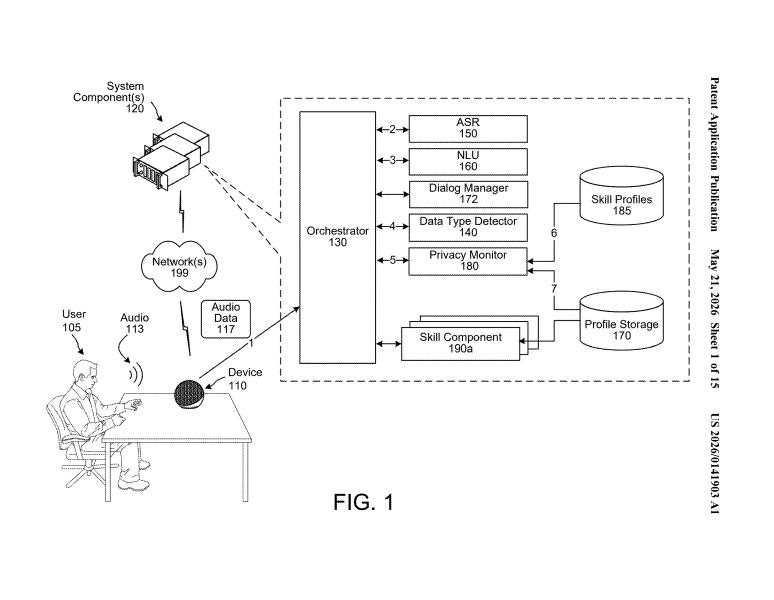
Amazon Patents a Privacy Monitor That Catches Alexa Skills Collecting Sensitive Data
Every time you talk to an Alexa skill, you might accidentally share more than you intended — a phone number, a health detail, a credit card. Amazon's new patent describes a system that intercepts that data before the skill ever sees it.
-
Samsung · Published May 21
Samsung Patents a Blockchain-Backed File Sharing System for Registered Devices
Samsung is exploring a file-sharing method that wraps transfers between your devices in a blockchain ledger — so every encrypted handoff is logged, verifiable, and tied to a registered identity.