Latest cybersecurity patents, Page 24
Fraud detection, encryption, sign-in and privacy controls from Microsoft, Google, IBM, Apple and others. The cybersecurity and privacy patent applications we have broken down from the companies we track, newest first.
- in the Nov 12 release
- 8
- in November so far
- 27
- filings tracked
- 341
- last 90 days
- 143
Recent filings
Newest first · 341 total-
Microsoft · Published May 28
Microsoft Patents a System for Vetting the Documents That Feed Your AI
When you feed an AI a document to answer questions from, how do you know that document hasn't been tampered with? Microsoft is filing patents to solve exactly that problem.
-
Microsoft · Published May 28
Microsoft Patents a Registration-Based System to Lock App Tokens to Specific Instances
What if an authentication token could only ever work inside the exact app instance that requested it — and nowhere else? That's the core idea in Microsoft's latest authentication patent.
-
Microsoft · Published May 28
Microsoft Patents Automatic Runtime Hardening via Static API Call Mapping
What if your build pipeline could automatically figure out exactly which system calls your app is allowed to make — and then enforce that at runtime, no extra developer work required? That's what Microsoft is filing patents around.
-
Microsoft · Published May 28
Microsoft Patents a Detection Engine for Bot-Created Cloud Tenants
Bots don't just spam social media — they spin up fake cloud accounts to abuse free tiers, launder compute, or stage attacks. Microsoft's new patent describes a two-stage detection engine that catches them by looking at the fingerprints tenants leave behind, not just the accounts themselves.
-
Nvidia · Published May 28
Nvidia Patents a Priority-Aware CAN Bus Authentication System for Autonomous Vehicles
Every sensor reading, brake command, and steering input in an autonomous vehicle travels over a CAN bus — a decades-old network protocol with almost no built-in security. Nvidia's new patent wants to fix that without slowing anything down.
-
Microsoft · Published May 28
Microsoft Patents a Capability-Based Gatekeeper for Human Presence Sensors
Modern Windows PCs increasingly ship with sensors that detect whether a human is sitting in front of them — and Microsoft is now patenting a system to make sure only the right apps can query that sensor.
-
Microsoft · Published May 28
Microsoft Patents a File Protection System That Follows Files Across Devices
What if your file's access rules traveled with it — no matter where it ended up? Microsoft is patenting a system that bakes permissions directly into the file itself, so even a copy on someone else's machine knows who's allowed to open it.
-
Amazon · Published May 21
Amazon Patents a Way to Track the Original Identity Behind Assumed AWS Roles
When an AWS user or service assumes a new IAM role, the original identity can get lost in the audit trail. Amazon's new patent wants to make sure it never disappears.
-
Samsung · Published May 21
Samsung Files Patent for a Post-Quantum Signature Verification Test System
As quantum computing threatens traditional cryptography, Samsung is patenting a way to rigorously test whether its memory devices can correctly verify post-quantum digital signatures — before those devices ship.
-
Samsung · Published May 21
Samsung Patents Per-Host Memory Encryption for CXL Devices
As CXL memory pooling lets multiple servers share the same physical RAM, Samsung is filing patents to make sure one host can never read another's data — even if they're neighbors on the same stick.
-
IBM · Published May 21
IBM Patents a Real-Time Privilege Control System for Privileged Containers
Privileged containers are one of the most dangerous attack surfaces in cloud infrastructure — they can do almost anything to the host system if left unchecked. IBM's new patent describes a real-time gate that only lets containers exercise elevated powers when they need them, and yanks those powers the moment something looks wrong.
-
IBM · Published May 21
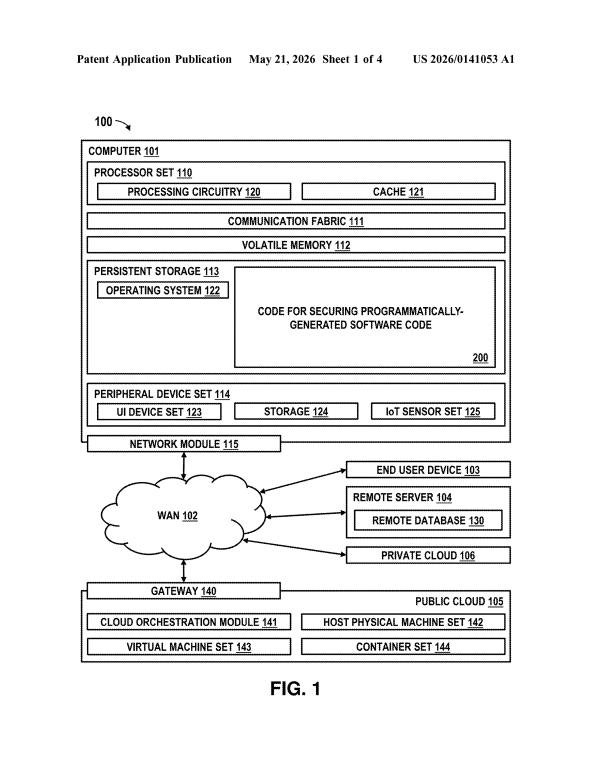
IBM Patents a Safety Net That Catches Destructive AI-Generated Code Before It Runs
AI coding assistants are great at writing code fast — but they can also write code that quietly deletes data or corrupts system state. IBM's new patent tackles that problem by building a sandbox-and-rollback layer directly into the LLM code generation pipeline.