
Waymo · Filed Jul 7, 2026 · Published Oct 29, 2026

Waymo Files Patent to Stop Its Cars From Slamming the Brakes Over Tiny Sensor Glitches

Self-driving cars can overreact when a sensor guess shifts by a fraction of an inch. Waymo's patent describes safety zones the car can ease through slowly, so a harmless pass stops looking like an emergency.
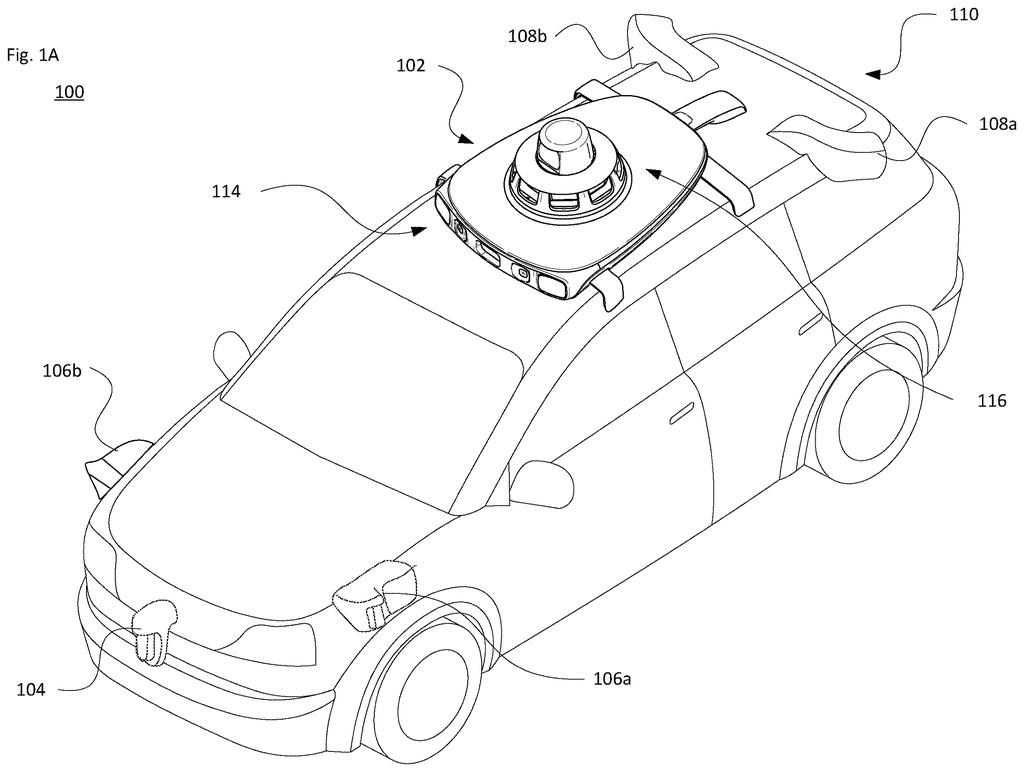
An autonomous car carries rooftop and bumper sensors to spot nearby traffic, pedestrians, and obstacles. Drawing from patent filing US 2026/0336668 A1.
An autonomous car carries rooftop and bumper sensors to spot nearby traffic, pedestrians, and obstacles.
See all 37 drawings from this filing ↓
Publication number US 2026/0336668 A1 US20260336668A1
Applicant WAYMO LLC
Filing date Jul 7, 2026
Publication date Oct 29, 2026
Inventors Jared Stephen Russell, Tobias Kunz, Anup Menon
US classification 701/26
Status when we published Waiting for an examiner (Jul 23, 2026)
Parent application is a Continuation of 18828295 (filed 2024-09-09)
Document 20 claims

What Waymo's permeable speed limits actually do

A self-driving car rolls past a parked van while a cyclist wobbles a short distance away. The car's sensors re-guess the cyclist's position many times a second, and one guess lands a hair closer than the last. Suddenly the car treats a harmless pass as an emergency and brakes hard.

This Waymo patent is about taking the drama out of that moment. Planning rules can work like a light switch: a safety zone is either violated or it isn't. Waymo describes permeable zones instead, which the car may drive through as long as it stays under a speed limit and doesn't linger too long.

The closer the cyclist gets, the stricter the limit becomes, until the zone turns into a hard wall. You would feel it as fewer jolts and no twitchy brake taps, and so would the groceries in the back seat.

From the filing · CLAIM 1
… updating, by the one or more processors, the initial speed plan for the upcoming period of time based on the set of constraints to obtain an updated speed plan, in which the vehicle is able to pass through a permeable one of the set of constraints during the upcoming period of time; …

Translation: The car adjusts its driving plan to ignore minor sensor glitches instead of braking hard.

How the planner lets a car drive through a zone

Many times a second, the car plans its speed for the next 5 to 20 seconds. To do that, it draws each nearby road user as a box on a chart of distance along the route versus time (the patent calls this a distance-time space). The plan must keep the car out of the boxes.

Normally those boxes are hard walls: the car must stay entirely ahead of one or entirely behind it. The patent adds permeable constraints, which the car may drive through if its speed relative to the object stays under a limit. A limit near zero acts like a wall, while a large limit acts like no constraint at all.

The filing and its claims describe several ways to tune this:

  • Soft limits tied to acceleration, braking, or the discomfort of passengers and people outside the car.
  • A cap on how long the car may stay inside the zone, which pushes it away as a neighbor gets closer.
  • Hard constraints kept alongside the permeable ones.
  • A prediction model for what each moving object will do next.

Under the hood, the planner also fills in the space between sampled boxes so the car cannot slip through a gap without the speed limit applying. A smoothing step then treats each zone as hard or permeable.

From the filing · THE ABSTRACT
Noise in sensor data or prediction models may trigger such binary conditions, which in turn may cause the vehicle to alter the speed plan. Aspects of the technology employ permeable speed constraints that enable the vehicle to avoid problems associated with discontinuous constraints.

Translation: Random sensor errors can trick the car into panic braking, so the system uses flexible limits to smooth out the ride.

Why smoother braking matters for robotaxi rides

If you ride in a robotaxi, sudden stops and twitchy braking are the sort of thing you remember. The filing says sensor noise can flip a constraint on and off several times a second, causing brake taps, steering twitches, and rattled cargo such as eggs or fruit. Permeable zones aim to make the car's reaction grow gradually as something gets closer.

The description names three situations: rolling slowly through soft debris like trash or a dust cloud, passing something with little side room, and slowing down for other risks. It covers passenger cars and also trucks, buses, and delivery vehicles. For you, the payoff would be a calmer ride. For Waymo, a planner that reacts in proportion to risk gives engineers a smoother dial to tune.

That makes this Google's 74th filing we've tracked since May in our robotaxi sensing watchlist, following applications on smarter rider drop-off spots and sounds to find your cab.

Editorial take

Jerky braking is a real problem for a taxi with no driver to blame. A robotaxi that slams the brakes for a phantom threat feels unsafe to riders and can bruise a bag of peaches. The description traces the cause to sensor noise flipping a yes-or-no switch several times a second.

The fix matches the size of that problem well. Turning a hard on/off rule into a dial with a speed limit is a small change on paper, and it targets the situations passengers notice most: squeezing past a parked car or a cyclist.

The filing gives no figures on how often this happens or how much it improves rides. Still, ride comfort helps decide whether people trust a car with no driver, so a modest fix to a frequent annoyance earns its place.

Get our take in your Top Stories

Liked this breakdown? Add Patentlyze as a preferred source on Google, and our plain-English take shows up more often in your Top Stories the next time Google patent news breaks.

There are more where this came from

We read every patent application Big Tech publishes and send you the ones worth knowing. Plain English, free, every week.

The drawings

37 drawing sheets from US 2026/0336668 A1 · click any drawing to enlarge

Sensors mounted across an autonomous minivan to track traffic, drawing sheet 1 from US 2026/0336668 A1
Sheet 1 Sensors mounted across an autonomous minivan to track traffic
An autonomous sedan with roof and body sensors, drawing sheet 2 from US 2026/0336668 A1
Sheet 2 An autonomous sedan with roof and body sensors
Self-driving semi-truck fitted with long-range gear, drawing sheet 3 from US 2026/0336668 A1
Sheet 3 Self-driving semi-truck fitted with long-range gear
Computer systems that steer, stop, and route the car, drawing sheet 4 from US 2026/0336668 A1
Sheet 4 Computer systems that steer, stop, and route the car
Electronics running navigation and steering on a driverless cab, drawing sheet 5 from US 2026/0336668 A1
Sheet 5 Electronics running navigation and steering on a driverless cab
Trailer electronics that monitor braking and wheel sensors, drawing sheet 6 from US 2026/0336668 A1
Sheet 6 Trailer electronics that monitor braking and wheel sensors
Planning a left turn across cross-traffic at an intersection, drawing sheet 7 from US 2026/0336668 A1
Sheet 7 Planning a left turn across cross-traffic at an intersection
Maintaining safe distance beside other cars on multi-lane roads, drawing sheet 8 from US 2026/0336668 A1
Sheet 8 Maintaining safe distance beside other cars on multi-lane roads
Show the other 29 sheets
Buffer boxes placed around predicted vehicle positions, drawing sheet 9 from US 2026/0336668 A1
Sheet 9 Buffer boxes placed around predicted vehicle positions
Key corners identified to map out possible paths, drawing sheet 10 from US 2026/0336668 A1
Sheet 10 Key corners identified to map out possible paths
Choosing whether to pass ahead or yield behind, drawing sheet 11 from US 2026/0336668 A1
Sheet 11 Choosing whether to pass ahead or yield behind
Shaded safety zones that allow low driving speeds, drawing sheet 12 from US 2026/0336668 A1
Sheet 12 Shaded safety zones that allow low driving speeds
Accelerating sharply to slip past tight speed limits, drawing sheet 13 from US 2026/0336668 A1
Sheet 13 Accelerating sharply to slip past tight speed limits
Bridging the gaps between moving safety zones, drawing sheet 14 from US 2026/0336668 A1
Sheet 14 Bridging the gaps between moving safety zones
Boundaries that keep cars from slipping between zones, drawing sheet 15 from US 2026/0336668 A1
Sheet 15 Boundaries that keep cars from slipping between zones
Connecting two obstacle positions across time, drawing sheet 16 from US 2026/0336668 A1
Sheet 16 Connecting two obstacle positions across time
Sampling speed limits along a smooth path between obstacles, drawing sheet 17 from US 2026/0336668 A1
Sheet 17 Sampling speed limits along a smooth path between obstacles
Connecting safe buffer zones across shifting sensor readings, drawing sheet 18 from US 2026/0336668 A1
Sheet 18 Connecting safe buffer zones across shifting sensor readings
Mapping speed checkpoints across changing road obstacles, drawing sheet 19 from US 2026/0336668 A1
Sheet 19 Mapping speed checkpoints across changing road obstacles
Calculating a single speed limit across overlapping hazard zones, drawing sheet 20 from US 2026/0336668 A1
Sheet 20 Calculating a single speed limit across overlapping hazard zones
Shifting time forward to find upcoming hazard boundaries, drawing sheet 21 from US 2026/0336668 A1
Sheet 21 Shifting time forward to find upcoming hazard boundaries
Tracking obstacle speed limits as the vehicle advances, drawing sheet 22 from US 2026/0336668 A1
Sheet 22 Tracking obstacle speed limits as the vehicle advances
Merging three time steps to keep speed limits steady, drawing sheet 23 from US 2026/0336668 A1
Sheet 23 Merging three time steps to keep speed limits steady
Moving to the next time window to update speed rules, drawing sheet 24 from US 2026/0336668 A1
Sheet 24 Moving to the next time window to update speed rules
Shifting future obstacle boxes backward in time to sample them, drawing sheet 25 from US 2026/0336668 A1
Sheet 25 Shifting future obstacle boxes backward in time to sample them
Generating obstacle samples continuously across the full time window, drawing sheet 26 from US 2026/0336668 A1
Sheet 26 Generating obstacle samples continuously across the full time window
Accelerating ahead of obstacles instead of stopping, drawing sheet 27 from US 2026/0336668 A1
Sheet 27 Accelerating ahead of obstacles instead of stopping
Slowing down to yield behind nearby road obstacles, drawing sheet 28 from US 2026/0336668 A1
Sheet 28 Slowing down to yield behind nearby road obstacles
Cutting across an obstacle area at a controlled speed, drawing sheet 29 from US 2026/0336668 A1
Sheet 29 Cutting across an obstacle area at a controlled speed
Cruising straight through minor obstacle zones without braking, drawing sheet 30 from US 2026/0336668 A1
Sheet 30 Cruising straight through minor obstacle zones without braking
How the car navigates gently past uncertain road hazards, drawing sheet 31 from US 2026/0336668 A1
Sheet 31 How the car navigates gently past uncertain road hazards
Enforcing a safe speed limit across an obstacle zone, drawing sheet 32 from US 2026/0336668 A1
Sheet 32 Enforcing a safe speed limit across an obstacle zone
Calculating the speed barrier over a given distance, drawing sheet 33 from US 2026/0336668 A1
Sheet 33 Calculating the speed barrier over a given distance
Adjusting speed limits across a grid of points, drawing sheet 34 from US 2026/0336668 A1
Sheet 34 Adjusting speed limits across a grid of points
Safety margins set around an obstacle the car must avoid, drawing sheet 35 from US 2026/0336668 A1
Sheet 35 Safety margins set around an obstacle the car must avoid
How the car glides slowly through minor sensor obstacles, drawing sheet 36 from US 2026/0336668 A1
Sheet 36 How the car glides slowly through minor sensor obstacles
Extra safety zones stop the car from slipping between limits, drawing sheet 37 from US 2026/0336668 A1
Sheet 37 Extra safety zones stop the car from slipping between limits
Browse all the drawings 37 drawing sheets
Patent filing page

Source. Full patent text and figures from the official USPTO publication PDF.
Reader comments

Be the first to weigh in

Start the discussion

Real name or a handle, either is fine. Comments are read by a person before they appear, so allow a little time. Keep it about the filing.