
Meta
Meta · AR / VR · Filed Jul 13, 2026 · USPTO published Nov 12, 2026 · This week's release
Meta Patents a Fix for Washed-Out Blacks in Headset Displays
Meta found a way to stop a headset's own lighting from fogging up the picture: tilt a thin sheet by a few degrees.
- Publication number
- US 2026/0358643 A1(US20260358643A1)
- Applicant
- Meta Platforms Technologies, LLC
- Filed · Published
- Jul 13, 2026 · Nov 12, 2026
- Inventors
- Wanli Chi, Sihui He, Ying Geng, Maxwell Parsons
- Status when we published
- Waiting for an examiner
- Document
- 20 claims
- US classification
- 359/630
- Parent application
- Division of 18/154,038 (filed Jan 12, 2023)(18154038)
What Meta's headset glare fix actually does
A VR headset is showing a night sky, but the black looks more like dark gray. Some of the light meant to light up the tiny screen inside is slipping straight toward your eye instead, and it washes out the darkest parts of the picture.
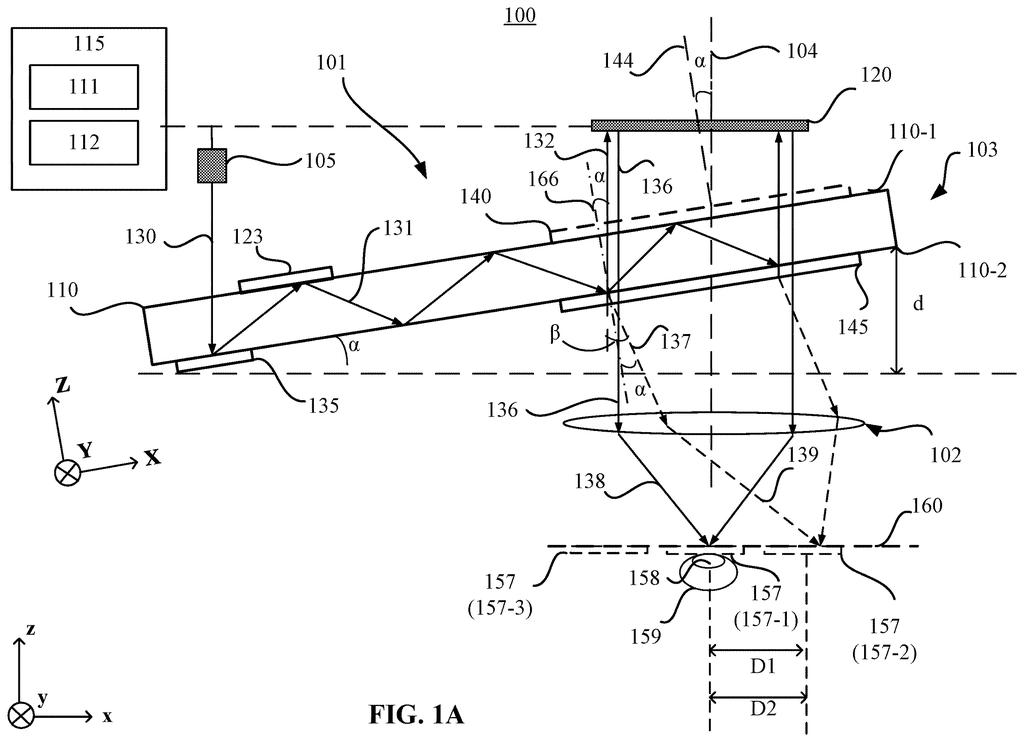
Meta's patent application goes after this with a small geometry trick. Inside the headset, a thin sheet of glass or plastic carries light over to the screen. Meta tilts that sheet by about 5 to 10 degrees. The tilt sends the stray light to a different spot than the picture, so it lands beside your pupil instead of in it.
A thin film on the sheet also helps keep the lighting even across the screen. The goal is deeper blacks and a crisper image.
… a retardation film disposed on a second outer surface of the light guide at a location that is longitudinally between the in-coupling element and the out-coupling element …
Translation: An optical film is placed inside to control light behavior between entry and exit points.
How a few degrees of tilt moves the glare
The screen in the headset is a reflective chip (types like LCOS or DLP) that makes no light of its own. A light source, such as laser diodes, feeds a beam into a light guide, a thin flat sheet that carries light sideways by bouncing it off its own surfaces. An in-coupling element (a pattern that bends light into the sheet) lets it in, and an out-coupling element lets it back out toward the chip.
Some of that light, up to about a tenth of the main beam in some versions, escapes the wrong way, toward your eye. It carries no picture, so it adds a gray veil. The claims add a retardation film (a layer that adjusts the light's polarization, the direction its waves vibrate) on the sheet's opposite face, between the two elements. The description says it helps keep brightness even.
The dependent claims add the tilt:
- The surface holding the out-coupling element is tilted 5° to 10° off the panel's axis.
- The stray beam exits at twice the tilt angle, away from the picture's path.
- The lens focuses the picture onto your pupil and the stray light onto a spot in the eye-box (the zone where your eye can sit) beside it.
In the description's worked example, a 4 mm gap between those two spots and a 20 mm lens focal length call for a tilt of about 5.65°. The filing also describes a deflecting element and an eye-tracking steering mirror as variations.
A normal of a surface of the light guide where the out-coupling element is disposed is tilted by a predetermined angle with respect to an axis of the display panel.
Translation: The surface directing light out is deliberately angled away from the display panel.
What this means for dark scenes in VR and AR
Contrast is what separates a punchy picture from a washed-out one, and it is hard to get in a headset that sits an inch or so from your eye. Gray blacks stand out most in dark scenes, like a space game or a movie in a virtual theater. A fix built on a few degrees of tilt in a part that already exists is appealing because it changes geometry rather than adding hardware.
The filing says the idea could apply beyond VR and AR headsets, including heads-up displays, smartphones, laptops, televisions and vehicles. This one is a divisional, a follow-up to an application first filed in January 2023 that traces back to a February 2022 provisional filing. A patent application says nothing about when, or whether, any of this ships.
Meta's 82nd filing we've tracked since May in the AR glasses race follows work on one-light controller tracking and wider-view cheaper glass.
Source: US 2026/0358643 A1 at the USPTO (PDF). Full patent text and figures are in the official publication.
Get our take in your Top Stories
Liked this breakdown? Add Patentlyze as a preferred source on Google, and our plain-English take shows up more often in your Top Stories the next time Meta patent news breaks.
Add Patentlyze on Google
One click.
There are more where this came from
We read every patent application Big Tech publishes and send you the ones worth knowing. Plain English, free, every week.
The drawings · 11 sheets
11 drawing sheets from US 2026/0358643 A1 · click any drawing to enlarge


Show the other 3 sheets


More from Meta
All 190 Meta patents →
More in AR / VR
All 690 AR / VR patents →
Samsung
Samsung Files Patent to Fix Washed-Out Colors on See-Through AR Glasses
Samsung
Samsung Files Patent for Headset Lenses That Bounce Light to Stay Slim
Samsung
Samsung Files Patent to Make a Headset's Camera View Match Where You Look
Samsung
No comments yet