
Sony
Sony · Display · Filed Jun 12, 2025 · USPTO published Nov 12, 2026 · This week's release
Sony Patents a Ranging System That Borrows Unused Detector Hardware to Measure Longer Distances
Sony found a pile of unused circuitry inside its own depth sensor: when only a small patch of pixels is working, the counters behind the rest sit idle. A new patent application wires them in to help.
- Publication number
- US 2026/0358475 A1(US20260358475A1)
- Applicant
- Sony Semiconductor Solutions Corporation
- Filed · Published
- Jun 12, 2025 · Nov 12, 2026
- Inventors
- Kosuke Shimizu
- Status when we published
- Waiting for an examiner
- Document
- 19 claims
- US classification
- 356/4.01
- Parent application
- National Stage Entry of PCT/JP2024/001924 (filed Jan 23, 2024)(PCTJP2024001924)
What Sony's idle-pixel counter trick does
Today, if you want a light-based depth sensor to see farther, something has to give. The sensor must keep listening for a faint reflection for longer, and that takes more tiny counters to keep the tally. Adding counters makes the chip bigger. Merging pixels so they share counters makes the picture blurrier.
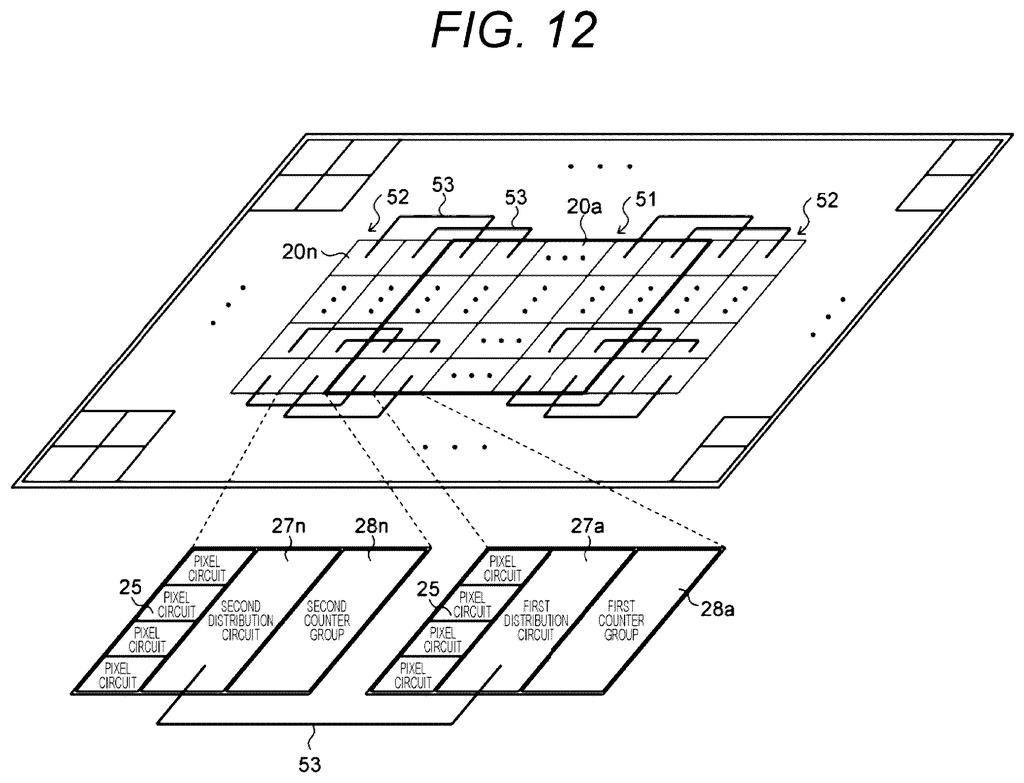
Sony's filing points out that plenty of counters are already sitting around doing nothing. When the sensor only looks at a small patch (for example, because the laser is focused on one distant object), the pixels outside that patch are switched off, and their counters go unused.
The patent describes a switch that wires those idle counters to the pixels that are working. The sharpness stays the same and the chip does not grow, but the measurable range can be at least double.
… counting a number of transitions of an output signal of the first pixel circuit or the first pixel circuit group using the first counter group without using the second counter group and counting the number of transitions using both the first counter group and the second counter group.
Translation: The system toggles between using one set of counters or combining two sets to measure signals.
How the switch links idle counters to active pixels
The sensor in this filing is built from SPADs (single photon avalanche diodes, pixels sensitive enough to react to a single particle of light). A laser fires pulses, and each pixel records when reflected light comes back. Small counters keep a tally for each slice of time after the pulse. Together those tallies form a histogram (a bar chart of how much light arrived at each moment), and the tallest bar reveals the distance to the object.
A longer window of time means more slices, which means more counters, which means a farther reach. The claimed switching circuit chooses between two modes:
- First mode: an active pixel uses only its own counters.
- Second mode: it also borrows the counters of switched-off pixels, and the readings from both sets are combined.
In the second mode the range is at least twice as long, while the resolution stays the same.
The filing also describes using borrowed counters to make each counter hold bigger numbers, so the sensor can repeat its measurement more times. It describes a header attached to the output data that says how many counter groups were linked. In a second embodiment, a telephoto camera narrows both the laser area and the active pixel patch as it zooms in, and the distance reading drives autofocus.
Why longer reach matters for cars and zoom lenses
The practical payoff is longer reach from the same size of chip. Depth sensors like this show up in cars, which the filing names as one application, and in camera systems that need to judge distance for autofocus. The filing's own example is a telephoto lens that zooms in on something far away.
Because this approach adds no pixels, it also avoids the extra power draw and chip size the filing says come with piling on more circuitry. For you, that could mean a distance sensor that fits in a tight space and still spots things farther out. The filing describes the method and does not name a product that would use it.
Sony's 104th filing in our Display patents we've tracked since May adds to a run that includes one cooling a moving camera sensor and one sharpening holographic images.
Source: US 2026/0358475 A1 at the USPTO (PDF). Full patent text and figures are in the official publication.
Get our take in your Top Stories
Liked this breakdown? Add Patentlyze as a preferred source on Google, and our plain-English take shows up more often in your Top Stories the next time Sony patent news breaks.
Add Patentlyze on Google
One click.
There are more where this came from
We read every patent application Big Tech publishes and send you the ones worth knowing. Plain English, free, every week.
The drawings · 21 sheets
21 drawing sheets from US 2026/0358475 A1 · click any drawing to enlarge


Show the other 13 sheets


More from Sony
All 707 Sony patents →
More in Display
All 730 Display patents →
Google
Google Files Patent to Stop Smart Glasses From Waking Up When You Fold Them
Samsung
Samsung Files Patent to Shrink Display Pixels for AR Glasses
Samsung
Samsung Patents an Image Sensor That Splits Focusing and Color Into Separate Pixel Groups
Samsung
No comments yet