

Qualcomm
Qualcomm · AI / ML · Filed Oct 14, 2025 · USPTO published Nov 12, 2026 · This week's release
Qualcomm Files Patent for Shrinking AI Image Generators to Fit on Your Phone
Qualcomm's filing mixes up an AI image generator's numbers on purpose, then undoes the mix, all to make the model small enough to run on a phone.
- Publication number
- US 2026/0359618 A1(US20260359618A1)
- Applicant
- QUALCOMM Incorporated
- Filed · Published
- Oct 14, 2025 · Nov 12, 2026
- Inventors
- Riccardo DEL CHIARO, Marco FEDERICI, Boris VAN BREUGEL, Markus NAGEL
- Status when we published
- Waiting for an examiner
- Document
- 26 claims
- US classification
- 706/15
- Parent application
- Claims priority from a provisional application 63803619 (filed May 10, 2025)
What Qualcomm's image-generator shrink does
A phone sits warm in someone's hand while an AI image app slowly paints a picture. If that someone is you, you already know the cost: a long wait and a battery that drains fast. These generators start with random static and clean it up over many rounds, and each round is a pile of math.
One common fix is to do that math with shorter, rougher numbers, a bit like rounding prices to the nearest dollar. It's much cheaper, but a few oddball values (outliers) throw the rounding off and the pictures get worse. Qualcomm's patent application mixes the numbers up before rounding so the oddballs get spread out, then undoes the mix afterward so the final answer stays on track.
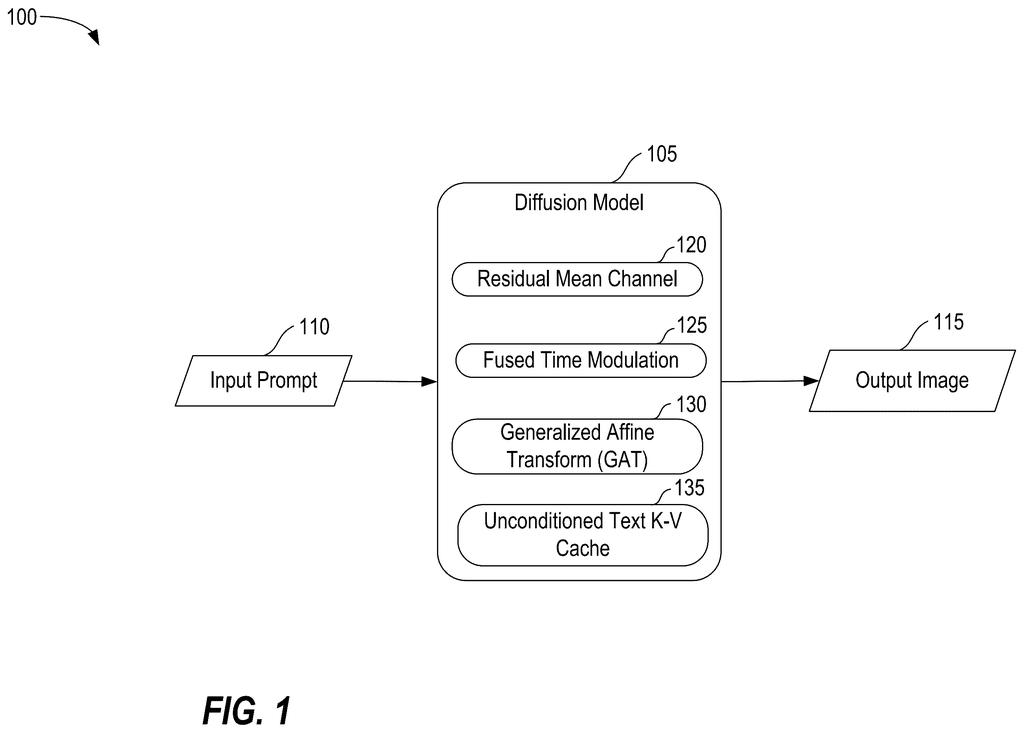
The filing also describes extras, like setting aside a running average and putting it back at the end, and saving a piece of the text prompt that never changes so it isn't recalculated.
apply an affine transform to an input activation matrix for a layer of a diffusion model to generate a transformed input activation matrix, the affine transform comprising a bias matrix, a first invertible matrix having a sequence length dimension, and a second invertible matrix having a feature dimension …
Translation: The system mathematically adjusts the AI's data layers to prepare them for compression.
How the mix-then-undo math keeps images clean
The claims cover one step inside a layer of a diffusion model (an AI that makes images by repeatedly cleaning up noise). Before the layer's numbers are squeezed into low precision (quantized, meaning stored with fewer bits), they go through a generalized affine transform: a shift, a rescale and a rotation. It works along two directions of the data: the sequence (the list of image patches) and the features (the numbers describing each patch).
The key is that the reverse is built in. The undo step for the feature direction is folded into the model's weights ahead of time, so it adds little work while the model runs. The layer then does this:
- Transform the activations (the values flowing through the model), then quantize them.
- Quantize the pre-adjusted weights.
- Multiply the two together.
- Undo the sequence-direction change, then add back the shift's contribution.
The filing names several versions. HadaNorm normalizes each element, then applies a Hadamard rotation (a fixed pattern of adding and subtracting that spreads outliers across many channels). Sequence Hadamard rotates along the sequence direction and suits the attention step, where the model works out which parts of the image relate to each other. The description also covers folding the time-step setting into the weights and caching the blank-prompt data.
… quantizing a fused weight matrix, the fused weight matrix being a first product of a weight matrix and an inverse of the second invertible matrix …
Translation: It shrinks the core neural network weights so the model takes up less memory.
Why this matters for AI image apps on phones
If it works as described, an image generator on your phone could finish faster and use less battery and memory. That can be the difference between a feature you try once and one you keep using. The filing lists smartphones and laptops as the targets, and one claim covers a mobile device carrying this setup.
The hardware section describes a phone-style chip with a dedicated AI processor (an NPU), so the groundwork points toward running generators on the device itself. Keep in mind this is a patent application, not a product, and the filing gives no measured speedups or image-quality scores.
Qualcomm's 30th filing we've tracked since July in our on-device AI privacy work builds on earlier applications for phones learning from your day and a small model speeding up chatbots, adding another step in this run.
Source: US 2026/0359618 A1 at the USPTO (PDF). Full patent text and figures are in the official publication.
Get our take in your Top Stories
Liked this breakdown? Add Patentlyze as a preferred source on Google, and our plain-English take shows up more often in your Top Stories the next time Qualcomm patent news breaks.
Add Patentlyze on Google
One click.
There are more where this came from
We read every patent application Big Tech publishes and send you the ones worth knowing. Plain English, free, every week.
The drawings · 8 sheets
8 drawing sheets from US 2026/0359618 A1 · click any drawing to enlarge


More from Qualcomm
All 624 Qualcomm patents →

More in AI image & video
All 223 AI image & video patents →
Google
Google Patents On-Device AI Image Generation That Skips the Cloud
Adobe
Adobe Patents an AI Image Generator That Draws Fur, Hair and Glass Without a Background
Adobe
Adobe Files Patent for Photo Editing That Changes Lighting and Backdrop From One Sentence
Adobe
No comments yet