
Apple
Apple · Software · Filed Apr 17, 2026 · USPTO published Nov 19, 2026 · This week's release
A New Apple Patent Fixes Your Running Route When GPS Bounces Off Skyscrapers
Apple has filed a patent application aimed at keeping skyscrapers from wrecking the route map of your run. The idea: let your device's motion sensors catch GPS points that jump somewhere you never went.
- Publication number
- US 2026/0367259 A1(US20260367259A1)
- Applicant
- Apple Inc.
- Filed · Published
- Apr 17, 2026 · Nov 19, 2026
- Inventors
- Kenneth M. Pesyna JR., Halil Ibrahim Basturk, Christina Selle, Jun Kyu Lee
- Status when we published
- Waiting for an examiner
- Document
- 20 claims
- US classification
- 342/352
- Parent application
- Claims priority from a provisional application 63808052 (filed May 19, 2025)
What Apple's GPS-plus-motion-sensor fix does
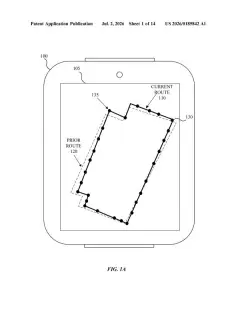
A runner jogs down a canyon of glass office towers while her phone draws her route on a map. The line zigzags into buildings, leaps across the street, and says she ran farther than she did.
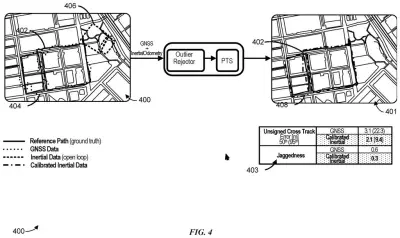
That happens because GPS works by timing signals from satellites, and in a downtown core those signals bounce off buildings before they reach you. Apple's patent application describes a fix. Your device keeps a second, independent record of your movement using its motion sensors, then lines that record up with the GPS track. Wherever GPS makes a wild leap the motion sensors say never happened, the device can ignore that point.
The result is a cleaner route and more believable distance and pace numbers, even among the skyscrapers.
… calibrating the inertial data using the global navigation satellite system (GNSS) data to generate calibrated inertial data.
Translation: It combines satellite signals with motion tracking to create a much more accurate path.
How Apple lines up motion data with GPS
The application covers a method with a few steps. A device receives satellite location data (GNSS, the umbrella term that includes GPS) and motion data from its accelerometers and gyroscopes. It works out what kind of movement it is recording, such as a walk, hike or run, and whether it is in a tricky signal environment, such as a dense city, a tunnel or a canyon. If both are true, it calibrates the motion data using the satellite data.
The motion data comes from inertial odometry (estimating how far you moved by tracking acceleration and rotation). It is accurate over short stretches but drifts over time, and it only knows movement relative to where it started, not where you are on Earth. Calibration fixes that by rotating, shifting and scaling the motion track until it lines up with the satellite track.
Once lined up, the motion track can be used to throw out bad GPS points. The filing says a large jump between GPS fixes, with no matching jump in the motion data, probably means one fix is an outlier. It describes recalibrating as often as every second, then doing a second pass after the workout using only the good GPS points.
The filing describes several ways to spot a tricky environment: a map divided into tiles that carry signal information, GPS signal strength and reflection indicators checked against thresholds, or GPS fixes that jump around too much. It also describes detecting how the device is carried, such as in a hand, a pocket or on a wrist.
What this means for Apple Watch and iPhone runs
If you run or hike with your phone or watch, the practical win is a route map that stays on the road, plus distance and pace numbers you can believe in a downtown core, a tunnel or a canyon. Those are the places where, per the filing, GPS fixes can swing by hundreds of meters from one reading to the next.
The filing names fitness, mapping and device-finding apps as places the cleaned-up data could go, and it lists an iPhone and an Apple Watch among the example devices. It also notes that motion sensors use less power than GPS, so in some versions the device starts satellite tracking only once it detects you moving. Nothing in the text says when, or whether, any of this ships.
That makes this Apple's 745th filing in our Apple coverage since May, adding to a low-power theme seen in the lens-shaping springs and the magnetic trackpad layer.
Source: US 2026/0367259 A1 at the USPTO (PDF). Full patent text and figures are in the official publication.
Get our take in your Top Stories
Liked this breakdown? Add Patentlyze as a preferred source on Google, and our plain-English take shows up more often in your Top Stories the next time Apple patent news breaks.
Add Patentlyze on Google
One click.
There are more where this came from
We read every patent application Big Tech publishes and send you the ones worth knowing. Plain English, free, every week.
The drawings · 15 sheets
15 drawing sheets from US 2026/0367259 A1 · click any drawing to enlarge


Show the other 7 sheets


More from Apple
All 748 Apple patents →
More in Software
All 814 Software patents →
Google
Google Files Patent to Make Lifelike 3D Scenes Run Smoothly on Your Phone
IBM
IBM Patents a System That Automatically Skips Slides When You're Running Out of Time
IBM
IBM Patents a System That Picks the Cheapest Drone Delivery Route in Real Time
Samsung
No comments yet