
Apple
Apple · Software · Filed Jul 27, 2026 · USPTO published Nov 19, 2026 · This week's release
Apple Patents Hand Tracking That Ignores Your Pinch While You Hold a Pen
Grab a pen and your thumb and finger touch, which can look to a camera like a pinch command. A new Apple patent teaches gesture tracking to notice the pen and ignore the false signal.
- Publication number
- US 2026/0367714 A1(US20260367714A1)
- Applicant
- Apple Inc.
- Filed · Published
- Jul 27, 2026 · Nov 19, 2026
- Inventors
- Lailin CHEN, Ashwin Kumar ASOKA KUMAR SHENOI, Daniel J. BREWER, Eslam A. MOSTAFA, Itay BAR YOSEF, Julian K. SHUTZBERG, Leah M. GUM, Martin MELOUN, Minhaeng LEE, Victor BELYAEV
- Status when we published
- Waiting for an examiner
- Document
- 20 claims
- US classification
- 715/863
- Parent application
- Continuation of 18/369,127 (filed Sep 15, 2023)(18369127)
What Apple's hold-a-pen gesture fix does
Every time you pick up a pen, your thumb and finger squeeze together. To a camera watching your hands, that can look a lot like a pinch, the gesture where finger and thumb move toward each other.
Apple's patent describes a fix. The device first spots your hand and whatever is near it, then works out what is going on: are you actually holding the object, or is it just blocking the camera's view? Based on that answer, it changes the rules for how it reads that hand.
The rules can differ from hand to hand. The hand holding the pen can have pinch turned off, while your empty hand can still pinch, and a wave can stay active. The goal is fewer accidental commands while you go about your day.
… selecting, based on the interaction classification, a gesture-recognition parameter set for the first body part from a plurality of gesture-recognition parameter sets …
Translation: The system picks custom hand-tracking rules depending on whether you are holding something.
How the device sorts holding from blocking
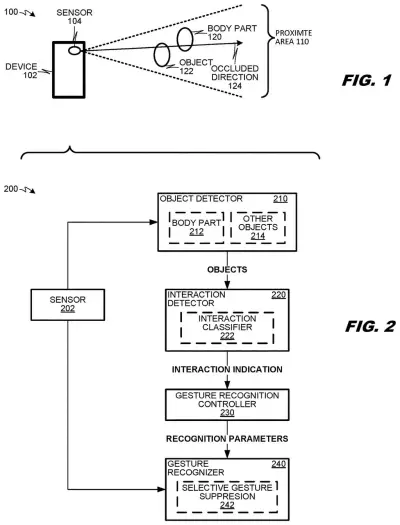
The system starts by scanning the area around you with a sensor, such as a phone or headset camera, a lidar scanner (a depth sensor that measures distance using light), or a motion sensor worn on the hand. One detector finds body parts, and another finds other objects.
Next, an interaction classifier labels what the hand and object are doing. The filing's main examples are holding (a hand gripping a pen) and obscuring (one thing blocking the sensor's view of the other). It can also output a probability, such as how likely it is that the hand is holding the pen.
That label picks a gesture-recognition parameter set, a bundle of settings that tells the recognizer how to treat each gesture. A set can:
- Suppress one gesture while still recognizing others
- Bias recognition toward a gesture, making it easier to trigger
- Bias recognition away from a gesture, making it harder to trigger
- Turn off recognition entirely for that body part
Each hand can get its own set. In the claims, a hand holding a pen has pinch suppressed while a free hand keeps it, and a wave can stay active. The description also gives an example of encouraging a gesture: a request for a drink could be favored when a hand holds an empty cup.
The gesture-recognition parameter sets may selectively suppress, maintain, enable, disable, or bias recognition of particular gestures based on interaction classifications.
Translation: It can turn specific hand gestures on or off depending on what you are holding.
Why fewer phantom pinches matter on headsets
If a touchless control has ever fired when you didn't mean it, this is the problem the filing targets. Its stated aim is better reliability by preventing false positives, which matters most on devices that watch your hands all day, like headsets and phones with cameras.
The approach also lets a device react to what you're holding, since a gesture can be encouraged as well as blocked. The filing's example favors a drink request when your hand holds an empty cup. Nothing here says a product is coming, but the idea reaches beyond pinches to any gesture a held object might confuse.
That makes this Apple's 56th filing we've tracked since May in our eye and hand controls watchlist, building on a floating 3D assistant and fine-tuning pinch placement.
Source: US 2026/0367714 A1 at the USPTO (PDF). Full patent text and figures are in the official publication.
Get our take in your Top Stories
Liked this breakdown? Add Patentlyze as a preferred source on Google, and our plain-English take shows up more often in your Top Stories the next time Apple patent news breaks.
Add Patentlyze on Google
One click.
There are more where this came from
We read every patent application Big Tech publishes and send you the ones worth knowing. Plain English, free, every week.
The drawings · 3 sheets
3 drawing sheets from US 2026/0367714 A1 · click any drawing to enlarge


More from Apple
All 748 Apple patents →
More in Software
All 814 Software patents →
Apple
Apple Files Patent for Clicking With Your Pupils Instead of a Pinch
Apple
Apple Patents Floating Controls for Moving and Resizing Virtual Objects by Looking and Pinching
Apple
Apple Patents a Way to Tell Accidental Pinches from Real Ones in AR
Apple
No comments yet