
GM
GM · Automotive · Filed May 13, 2025 · USPTO published Nov 19, 2026 · This week's release
GM Patents a Pedal Setup That Won't Let You Press Gas and Brake Together
GM has filed a patent application for a physical lock between your gas and brake pedals, so holding one down makes the other impossible to press.
- Publication number
- US 2026/0367661 A1(US20260367661A1)
- Applicant
- GM Global Technology Operations LLC
- Filed · Published
- May 13, 2025 · Nov 19, 2026
- Inventors
- Geehoon Sung, Juwon Kim, Sunggun Kim
- Status when we published
- Examiner raised objections; the company can respond
- Document
- 20 claims
- US classification
- 74/513
- Examiner
- YABUT, DANIEL D (Art Unit 3617)
What GM's gas-and-brake pedal lock actually does
A driver sees brake lights flash ahead and panics. One foot lands on the brake, and the other is hovering over the gas, or pressing it too.
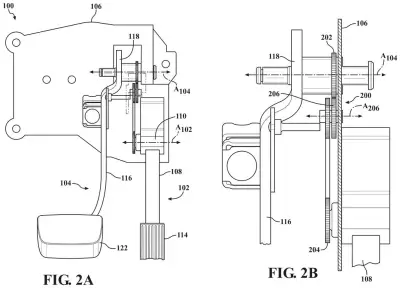
GM's patent application describes a fix that uses no software at all. A small mechanical stopper, connected to both pedals by gears, sits near the gas pedal. Press the brake, and the stopper swings in behind the gas pedal and blocks it. Press the gas, and the force travels back through the gears so the brake pedal can't move.
The filing says drivers sometimes press both pedals out of confusion, panic or inexperience, and that doing so strains the car and can be a hazard. With this design you can use only one pedal at a time, however hard you try. Let go, and the other pedal is free again.
… a stopper pivotable relative to the accelerator pedal and the brake pedal, the stopper configured to: responsive to the brake pedal moving from its first position toward its second position, pivot toward engagement with the accelerator pedal to preclude movement of the accelerator pedal from its first position toward its second position …
Translation: A mechanical barrier swings into place when you hit the brakes so you cannot press the gas pedal at the same time.
How GM's gear train blocks the other pedal
The filing describes a pivoting stopper that sits near the accelerator pedal and moves in response to both pedals. When the brake pedal starts to move, the stopper swings into contact with the back of the accelerator pedal and blocks it. When the accelerator moves first, it pushes against the stopper, and that force travels through the linkage to hold the brake pedal back.
A gear train (a set of meshed gears that pass motion along) connects the three parts:
- A first gear sits on the brake pedal's pivot and turns whenever the brake moves.
- A second gear is joined to the stopper and turns around the accelerator pedal's pivot.
- A third gear reverses the direction of rotation and is tied to the second gear by a chain, belt or cable.
Two other layouts in the filing skip the third gear and use a crossed belt or a rigid rod instead. Both make the first and second gears spin in opposite directions, which is the key to the lock.
Because a driver can press with up to about 668 newtons (roughly 150 pounds), the filing sizes the parts to take it. With a 10 to 1 leverage ratio at the brake, the first gear could see around 6,680 newtons, so the example uses a steel alloy gear about 17 millimeters thick. Letting go of either pedal frees the other.
What a pedal lock means for panicked drivers
If a design like this ever reached a car, you would feel it as a pedal that simply won't go down while the other is held. There are no sensors or code in it, only metal parts that carry your own foot force from one pedal to the other. The filing says this prevents strain on the drive and braking systems, and stops the car from accelerating because of incorrect operation.
The examiner's first review rejected the claims as filed, which is routine at this stage and usually followed by amendments. The filing names no vehicle or model, and a patent application is not a product plan, so it shows an idea GM has explored on paper.
GM's fourth filing we've tracked since November in our GM coverage, following patents on touchscreen menu testing and echo cancellation in calls.
Source: US 2026/0367661 A1 at the USPTO (PDF). Full patent text and figures are in the official publication.
Get our take in your Top Stories
Liked this breakdown? Add Patentlyze as a preferred source on Google, and our plain-English take shows up more often in your Top Stories the next time GM patent news breaks.
Add Patentlyze on Google
One click.
There are more where this came from
We read the new patents from Big Tech, carmakers and more and send you the ones worth knowing. Plain English, free, every week.
The drawings · 6 sheets
6 drawing sheets from US 2026/0367661 A1 · click any drawing to enlarge


More from GM
All 10 GM patents →
More in Automotive
All 432 Automotive patents →
Hyundai & Kia
Kia Patents a Car Software Design Where Swapping a Part Won't Break the Code
Waymo (Google)
Waymo Files Patent for Suggesting Nearby Pickup Spots When Your Pin Won't Work
BMW
BMW Files Patent for Cameras That Spot Fogged Windows and Clear Them Automatically
Hyundai & Kia
No comments yet