
X (Google)
Google · AI / ML · Filed May 15, 2025 · USPTO published Nov 19, 2026 · This week's release
Google Patents an AI Referee That Checks Whether AI-Made Content Fits a Website
When an AI makes content from a company's website, who checks that it actually fits? Google's patent hands that job to a small AI model that can only answer with one of two words.
- Publication number
- US 2026/0368531 A1(US20260368531A1)
- Applicant
- Google LLC
- Filed · Published
- May 15, 2025 · Nov 19, 2026
- Inventors
- Zhaoyi Meng, Yancheng Li, Tian Xia, Hongliang Fei, Francois Walter Michel Belletti, Jieru Mei, Charles Baxter Boyd
- Status when we published
- Waiting for an examiner
- Document
- 20 claims
- US classification
- 706/25
What Google's AI relevance checker actually does
Every time an AI makes an image or a blurb for a business, a person usually has to look at it and decide whether it actually fits. Does this picture look like the bakery it is supposed to represent, or did the AI wander off?
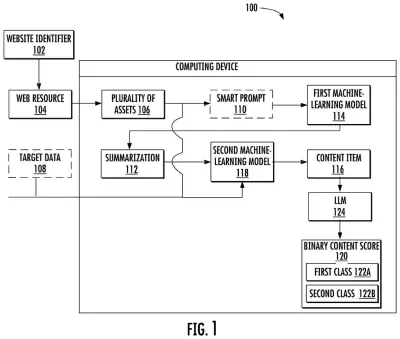
Google's patent describes a way to skip that human step. A first AI reads a company's website (its text, images and logos) and writes a short summary. A second AI makes new content from that summary, such as a picture. Then a third, smaller AI compares the two and gives a one-word verdict: relevant or irrelevant.
The trick is keeping the checker small and fast. Because it must pick between just two answers, it never has to write out a response, which saves a lot of computing when huge numbers of items need checking.
… generating, by a first machine-learning model operating on the computing system, a summarization of the web resource based on the plurality of assets; processing, by a second machine-learning model operating on the computing system, the summarization of the web resource to generate a content item …
Translation: One AI model summarizes the site while a second AI model uses that summary to create new text.
How a two-answer language model stays fast
The system starts with a website address. It pulls out the site's assets: text, menus, product descriptions, logos, images and video. A first machine-learning model turns those into a summary of the business and its tone. The filing also describes a smart prompt (a set of instructions, optionally with a few worked examples) that steers that summary.
A second model, which can be a text-to-image generator, builds a content item from the summary. A language model then compares the item to the summary and outputs a binary content score: relevant or irrelevant.
The speed comes from logit masking. A language model normally scores every possible next word. Here, its output is limited to two permitted tokens (the labels for the two answers), and the system compares just those two scores at the first position. That takes one pass, with no sampling and no long answer. The filing says this can also reduce hallucinations (made-up output).
Training starts with human raters who label examples. The filing then describes fine-tuning with:
- Performance metrics such as the negative rejection rate (how much irrelevant content is correctly filtered out) and the positive acceptance rate
- LoRA, which adjusts only a small subset of the model's settings to save computing
- Early stopping, which ends training before the model memorizes its examples
… processing, by a large language model (LLM) operating on the computing system, the content item to generate a binary content score based on the summarization of the web resource.
Translation: A large language model reviews the generated content and gives it a simple pass or fail score based on the website summary.
Why checking AI-made content cheaply matters
Making images and text for businesses by machine is cheap. Checking them is not. The filing says human review is labor-intensive, costly and hard to scale, and that large models that could do the checking are expensive to train and to run on every single item. A small checker limited to two answers targets exactly that cost.
For you, the effect would be indirect. If a company used this kind of filter, you would be less likely to run into AI-made content that misrepresents the business behind it. The patent doesn't name a product, so where it might show up is open. The filing also describes feeding the scores back to train the content generator, so the checker could improve the generator over time, as well as filter its misses.
That makes this Google's 41st filing we've tracked since May on our AI models working in teams watchlist, after small AI sidekick idea and the AI that splits sound.
Source: US 2026/0368531 A1 at the USPTO (PDF). Full patent text and figures are in the official publication.
Get our take in your Top Stories
Liked this breakdown? Add Patentlyze as a preferred source on Google, and our plain-English take shows up more often in your Top Stories the next time Google patent news breaks.
Add Patentlyze on Google
One click.
There are more where this came from
We read every patent application Big Tech publishes and send you the ones worth knowing. Plain English, free, every week.
The drawings · 3 sheets
3 drawing sheets from US 2026/0368531 A1 · click any drawing to enlarge


More from Google
All 1,127 Google patents →
More in AI / ML
All 2,738 AI / ML patents →
Adobe
Adobe's New Patent Turns a Single Description Into a Finished, Ready-to-Use Page
Adobe
Adobe Wins a Patent for Two AIs That Take Turns Editing and Critiquing Your Video
Microsoft
Microsoft Patents Two Small AIs That Team Up to Operate Your Device
Samsung
No comments yet