
Google
Google · AI / ML · Filed Sep 29, 2025 · USPTO published Nov 19, 2026 · This week's release
Google Patents AI Image Tool That Puts Your Dog in Any Scene From One Photo
Google has filed a patent application for an AI image tool that takes one photo of your dog and drops that exact dog into a scene you describe. It needs no retraining for each new pet or object.
- Publication number
- US 2026/0368967 A1(US20260368967A1)
- Applicant
- Google LLC
- Filed · Published
- Sep 29, 2025 · Nov 19, 2026
- Inventors
- Xuhui Jia, Yang Zhao, Cheuk Kit Kelvin Chan, Yandong Li, Han Zhang, Boqing Gong, Tingbo Hou, Huisheng Wang, Yu-Chuan Su
- Status when we published
- Waiting for an examiner
- Document
- 20 claims
- US classification
- 345/418
- Parent application
- National Stage Entry of PCT/US2024/021958 (filed Mar 28, 2024)(PCTUS2024021958)
What Google's one-photo image patent actually does
Every time you ask an AI image tool for a picture of your dog riding a scooter, you get a dog, just not your dog. The tool knows what dogs look like in general, but it has never met yours.
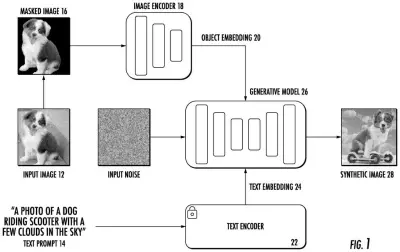
Older workarounds fix this by retraining the AI on several photos of your pet, which is slow and leaves a separate copy of the model for every object. Google's patent application describes a shortcut: show the system one photo, type what you want (the filing's example is 'a dog riding scooter with a few clouds in the sky'), and it paints your actual dog into the scene.
The trick is a photo reader that boils your pet down to a compact description the image generator can use right away, in a single pass, with no extra training for that pet.
obtaining, by a computing system comprising one or more computing devices, an input image that depicts an object and a text prompt that specifies desired content of an output image; processing, by the computing system, the input image with a machine-learned image encoder model to generate an object embedding for the object; …
Translation: The system takes your pet photo and a text description, then analyzes the subject using machine learning.
How the encoder turns your photo into a stand-in
The claims describe a method with two inputs: a photo showing an object, and a text prompt describing the picture you want. An image encoder (a neural network that turns a picture into numbers) converts the object into an object embedding, a compact numeric fingerprint of what it looks like. A text encoder does the same for your prompt.
A generative model then takes both fingerprints and draws a new image that shows the object together with the requested content. The filing says this can be a diffusion model such as Imagen or Stable Diffusion (systems that build a picture by gradually cleaning up random noise), with extra attention layers added so it can consult the object fingerprint while drawing. One claim states the model is not fine-tuned on your photo.
Training is where much of the design work sits:
- Automatic captions: a captioning model writes a description of each training photo.
- Cross-reference swap: sometimes the fingerprint comes from a different photo of the same object, so the model learns the object itself and not one photo's angle or lighting.
- Object dropping: for general photos the fingerprint is replaced with a blank, so the model keeps obeying the words you type.
The filing also describes optionally cutting the object out with a mask first, so the background does not leak into the fingerprint.
… bypasses the lengthy optimization required by previous approaches, which often employ a per-object optimization paradigm. Instead, the proposed framework adopts an encoder to capture high-level identifiable semantics of objects, producing an object-specific embedding with only a single feed-forward pass.
Translation: Instead of slow, complicated training for each individual subject, the new method processes everything in one quick step.
Why skipping per-object retraining matters for Google
If this works as described, you could describe a scene and get your own pet, product or belongings in it from a single photo, without waiting for the AI to be retrained on each one. That makes personalized images practical for ordinary apps rather than a slow, special-purpose job.
The business angle is cost. The filing points out that older methods need a separate trained model for every object, so storage and computing costs climb with each new pet or product. One general model that handles new objects in a single pass is far cheaper to run, and the filing says it can run on a server or directly on a phone, laptop or other device.
That makes this Google's 87th filing we've tracked since May in the AI photo editing race, a group that includes their work on fixing blocky compressed video and relighting faces after shooting.
Source: US 2026/0368967 A1 at the USPTO (PDF). Full patent text and figures are in the official publication.
Get our take in your Top Stories
Liked this breakdown? Add Patentlyze as a preferred source on Google, and our plain-English take shows up more often in your Top Stories the next time Google patent news breaks.
Add Patentlyze on Google
One click.
There are more where this came from
We read every patent application Big Tech publishes and send you the ones worth knowing. Plain English, free, every week.
The drawings · 7 sheets
7 drawing sheets from US 2026/0368967 A1 · click any drawing to enlarge


More from Google
All 1,127 Google patents →
More in AI vision
All 351 AI vision patents →
Nvidia
Nvidia Files Patent to Turn One Ordinary Photo Into a 360-Degree Scene
Qualcomm
Qualcomm Patents a Faster Way for AI to Pick Out Every Object in a Photo
Adobe
Adobe Patents an AI System That Relights Portrait Photos to Match Any Scene
Adobe
No comments yet