
Google
Google · AI / ML · Filed Dec 22, 2025 · USPTO published Nov 12, 2026 · This week's release
Google Patents Photo Editing That Changes the Light on Your Face After the Shot
A background swap usually fails for one reason: your face is still lit by the room you were standing in. Google's patent application describes software that relights you to match the new scene.
- Publication number
- US 2026/0359936 A1(US20260359936A1)
- Applicant
- Google LLC
- Filed · Published
- Dec 22, 2025 · Nov 12, 2026
- Inventors
- Chloe LeGendre, Paul Debevec, Sean Ryan Francesco Fanello, Rohit Kumar Pandey, Sergio Orts Escolano, Christian Haene, Sofien Bouaziz
- Status when we published
- Waiting for an examiner
- Document
- 23 claims
- US classification
- 345/629
- Parent application
- Continuation of 18/554,960 (filed Oct 11, 2023)(18554960)
What Google's photo relighting patent does
You take a portrait in a dim kitchen, then swap in a sunny beach behind you. Your face is still lit like a kitchen, so the result looks pasted on. That mismatch is what gives cheap background swaps away.
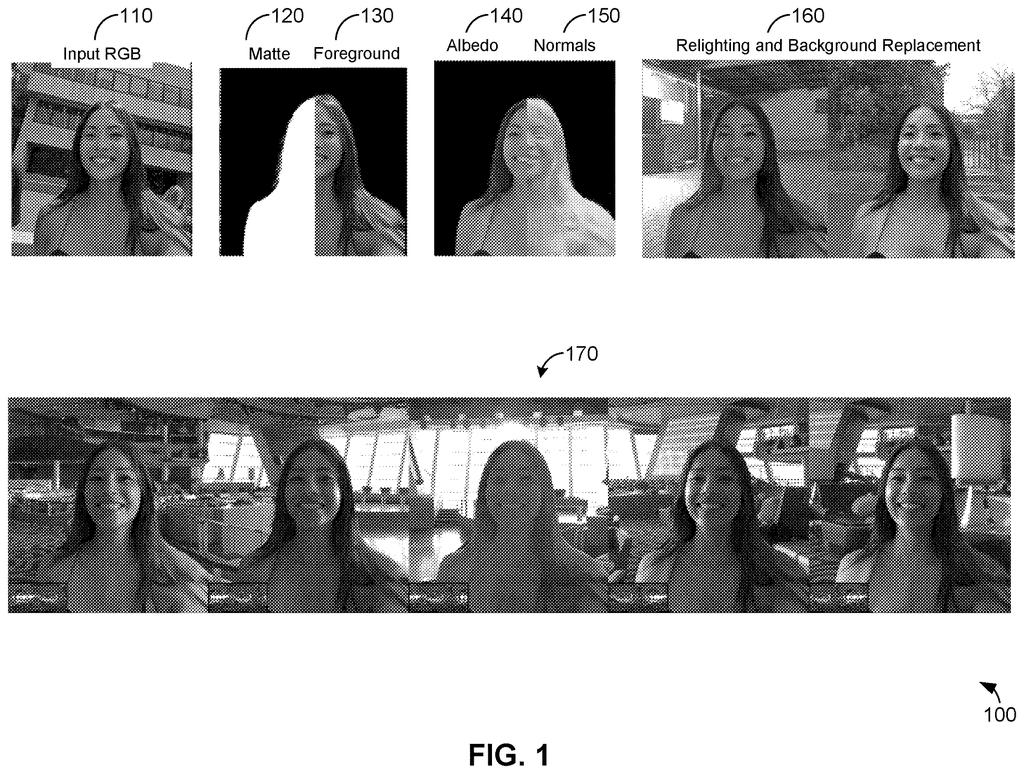
Google's patent application describes software that fixes the lighting on you as well as the backdrop. It works out the shape of your face, then recalculates how light from the new scene would land on it, including glossy highlights and soft shadows. It can also cut you out of the original background cleanly, down to individual hair strands.
The filing says this could run on a phone, and could also touch up photos already in your library, for example by removing a greasy shine after the fact.
predicting, by a specular network, a per-pixel specular material property indicative of a surface roughness of the foreground, and determining a specular lighting component based on the target illumination and the predicted per-pixel specular material property …
Translation: An AI guesses how shiny and rough the person's skin or clothes are to figure out how they should reflect new light.
How the AI works out shine and soft shadows
The core claim covers software that takes a photo of a person plus a target lighting setup (a full 360-degree picture of the light in the new scene), then redraws the person as if they were standing in that light. An AI model (a neural network, meaning software trained on many examples) builds a map of how light should fall on every pixel of the subject.
Two pieces get combined into the final image:
- Diffuse light: the soft, even glow that depends on the shape of the face and the color of skin and clothes.
- Specular light: the glossy highlights, such as shine on a nose or forehead. A separate network predicts how rough or shiny each pixel's surface is, then blends several pre-blurred versions of the lighting to match.
Other claims add a second network that draws self-shadowing (the shadow a nose casts on a cheek), a cutout step that predicts three things at once (a rough outline, a see-through mask, and the person's true colors), and a training check that studies cropped face regions for realistic skin texture.
To teach it, the description says that in one setup the team photographed about 70 people inside a light stage (a dome of 331 programmable lights and 58 cameras), producing roughly 8 million training examples.
… relighting, via a neural network, a foreground of the image to maintain a consistent lighting of the foreground with a target illumination …
Translation: The system uses an artificial intelligence model to change the lighting on the main subject so it matches a new light source.
Why swapped backgrounds could finally look real
If you edit photos on a phone, this targets the gap between a quick background swap and one that looks professionally shot. The filing says studio-quality results normally need controlled lighting and expert knowledge, and that phone users have neither. It describes the method running on a phone, on photos already in your library, or on a remote server.
The filing is open about some limits. It was designed for still images, and video is handled frame by frame with no step to keep frames consistent. The method also assumes it knows the lighting of the new background, which for an ordinary photo has to be estimated. And as a patent application, nothing here says when or whether it would ever ship.
Google's 85th filing we've tracked since May in our AI photo editing efforts follows one on fixing rejected images and one on borrowing faces for group shots.
Source: US 2026/0359936 A1 at the USPTO (PDF). Full patent text and figures are in the official publication.
Get our take in your Top Stories
Liked this breakdown? Add Patentlyze as a preferred source on Google, and our plain-English take shows up more often in your Top Stories the next time Google patent news breaks.
Add Patentlyze on Google
One click.
There are more where this came from
We read every patent application Big Tech publishes and send you the ones worth knowing. Plain English, free, every week.
The drawings · 22 sheets
22 drawing sheets from US 2026/0359936 A1 · click any drawing to enlarge


Show the other 14 sheets


More from Google
All 1,079 Google patents →
More in AI image & video
All 223 AI image & video patents →
Adobe
Adobe Patents an AI That Picks the Right Photo Editing Mode for You
Sony
Sony Files Patent to Let You Change Camera Settings After the Photo Is Taken
Samsung
Samsung Files Patent for Photo Editing That Finishes Cut-Off People You Drag Around
Samsung
No comments yet