
Google
Google · AI / ML · Filed Apr 29, 2025 · USPTO published Nov 12, 2026 · This week's release
Google Files Patent for AI That Edits Rejected Images to Fit the Rules
Google has a plan for the moment a platform rejects your image: instead of making you guess what went wrong, an AI works out the problem and edits the picture for you.
- Publication number
- US 2026/0360030 A1(US20260360030A1)
- Applicant
- Google LLC
- Filed · Published
- Apr 29, 2025 · Nov 12, 2026
- Inventors
- Pradyumna Narayana, Garima Pruthi
- Status when we published
- Waiting for an examiner
- Document
- 20 claims
- US classification
- 382/155
- Examiner
- WINDSOR, COURTNEY J (Art Unit 2661)
- Parent application
- National Stage Entry of PCT/US2024/050205 (filed Oct 7, 2024)(PCTUS2024050205)
What Google's auto-fix for rejected images does
You upload a photo for an online ad, and it bounces back with a vague note that it breaks the rules. So you crop it, tweak it, upload it again, and wait. Rejected again.
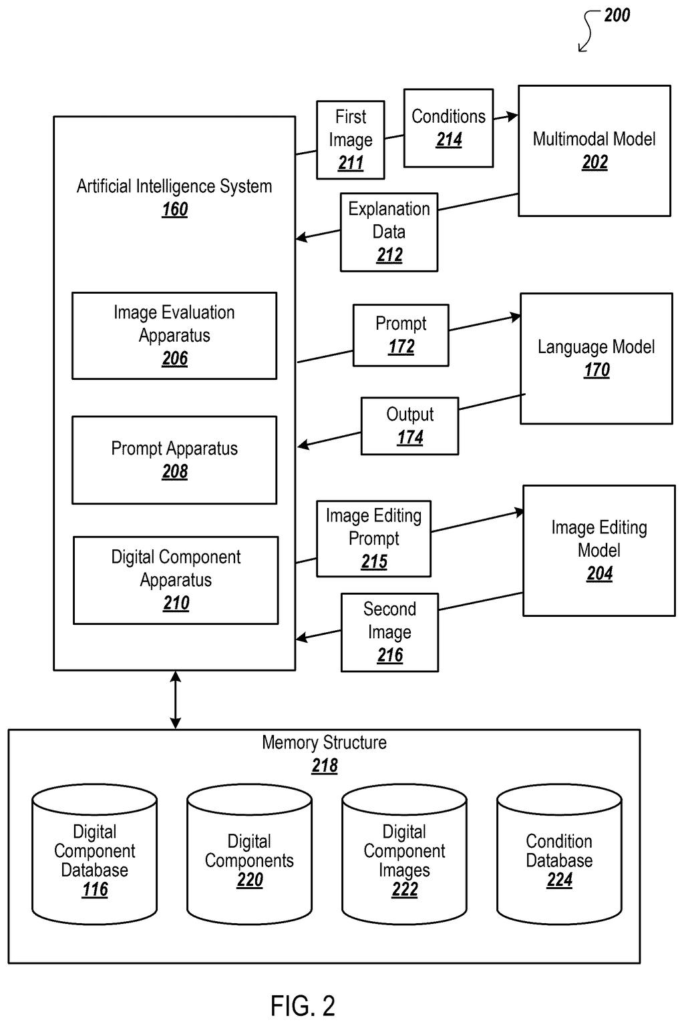
Google's patent application describes a way to skip that loop. When an image fails a content rule, the system works out what is wrong and where in the picture it sits. Then one AI writes plain instructions, like "Erase the adult beverage bottles from the image," and another AI carries them out.
The goal is a corrected picture that stays as close to your original as possible, so you upload once and get back a version that passes. The filing's main example is images used in ads, and the rules can differ by product type or by website, with stricter ones for sites aimed at children.
… generating an image editing prompt that instructs an image editing model to edit the first image to satisfy the one or more conditions …
Translation: The system writes a specific set of instructions to fix the rejected picture.
How the AI finds, describes and fixes the flaw
The system starts when something tells it that a first image has broken one or more rules. Those rules are the policies of whoever distributes the image, and they can vary by product type or by publisher.
Next it builds explanation data: a note on why the image fails and where the problem sits, often as a box drawn around the offending part or as pixel coordinates. The filing describes two ways to get it:
- A multimodal model (an AI that reads both pictures and text) looks at the image and the rules together.
- One AI writes a caption describing the image, and a second AI reads that caption against the rules.
A language model then turns the explanation into an image editing prompt, the written instruction an image editor follows. The patent says this step uses a template tailored to the specific editor (a diffusion model, for instance, which is an image-generating AI), so an off-the-shelf editor needs no retraining.
The editor gets the prompt and the original image, and returns a second image, which goes out to one or more devices. The description adds that the new image can be checked against the rules again, with the prompt adjusted if it still fails.
Why one upload instead of many matters for ads
If you sell things online or run ads, the practical gain is fewer rounds of guesswork. Today a rejection can tell you very little, and blind edits can leave you with a worse picture. This approach aims to hand you a compliant version after a single upload, with the rest of the image left as untouched as possible.
Google's description also points to speed and safety. The filing describes serving images in real time, for example in response to a search query, so a fix has to arrive fast, and splitting the job across specialized models is said to keep errors down. Fewer uploads also means less load on the network, and it gives bad actors fewer chances to probe how the checker works by submitting many versions.
Google's 84th filing we've tracked in the AI photo editing race since May builds on work like borrowing faces for group shots and growing video from one photo.
Source: US 2026/0360030 A1 at the USPTO (PDF). Full patent text and figures are in the official publication.
Get our take in your Top Stories
Liked this breakdown? Add Patentlyze as a preferred source on Google, and our plain-English take shows up more often in your Top Stories the next time Google patent news breaks.
Add Patentlyze on Google
One click.
There are more where this came from
We read every patent application Big Tech publishes and send you the ones worth knowing. Plain English, free, every week.
The drawings · 4 sheets
4 drawing sheets from US 2026/0360030 A1 · click any drawing to enlarge


More from Google
All 1,079 Google patents →
More in AI image & video
All 223 AI image & video patents →
Samsung
Samsung Patents an AI That Grades Its Own Photo Edits to Get Better Over Time
Adobe
Adobe Files Patent for Color Edits That Know a Beach From a Portrait
Sony
Sony Patents an AI System That Edits Video While Keeping Every Frame Consistent
Nvidia
No comments yet