
Google
Google · Security · Filed Jun 23, 2025 · USPTO published Nov 19, 2026 · This week's release
Google Files Patent for Fingerprint Unlocking That Spreads Out the Details It Checks
Fingerprint unlock works by comparing a handful of tiny details in your print, and a new Google patent is about making sure those details aren't bunched together.
- Publication number
- US 2026/0369097 A1(US20260369097A1)
- Applicant
- Google LLC
- Filed · Published
- Jun 23, 2025 · Nov 19, 2026
- Inventors
- Josephine Nordrum, Firas Sammoura
- Status when we published
- Waiting for an examiner
- Document
- 20 claims
- US classification
- 382/125
- Parent application
- National Stage Entry of PCT/US2022/082414 (filed Dec 27, 2022)(PCTUS2022082414)
What Google's fingerprint spot-picking does
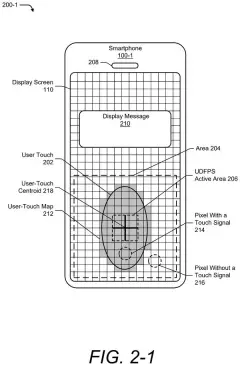
Every time you press your finger to your phone to unlock it, the sensor takes a tiny photo of your fingertip. Software then has to pick out the details that make your print yours, such as the spot where a ridge suddenly ends.
Here's the catch: if the software grabs too many details from one corner of the print, it learns a lot about that corner and very little about the rest. Google's patent describes a simple fix. The software finds the most convincing spot, marks it, then blanks out a small square around it so nothing else can be picked there. Then it repeats.
The result is a set of marked spots spread across the whole fingertip. The filing says that should mean fewer wrong rejections and fewer wrong approvals.
… updating the convolution image by assigning a neutral value to (i) the keypoint pixel and (ii) a plurality of neighboring pixels positioned at predetermined coordinates relative to the keypoint pixel …
Translation: The system blanks out the area around a matched fingerprint feature so it won't trigger the same spot twice.
How the scan blanks out crowded neighbors
The method starts with an image, such as a scan of your fingertip. The software slides a small pattern (called a kernel) across the image and gives every pixel a score for how much its surroundings look like the feature being hunted, such as a ridge end. The grid of scores is called a convolution image.
The kernel has three zones: a center of positive values for the feature itself, a neutral ring for the fuzzy boundary, and an outer ring of negative values for the surroundings. The filing says pixel brightness is first rescaled (for example, from 0 to 255 down to roughly negative 127 to 128) so the surroundings add to the score too, which strengthens the signal.
Then the picking loop runs:
- Take the pixel with the highest score above a cutoff (the filing's example uses 200 out of 255). That pixel is a keypoint, a marked location.
- Set that pixel and its neighbors to a neutral value that can never be picked again. In one example, everything within two pixels, a 5 by 5 square.
- Repeat until nothing eligible is left.
Each keypoint is saved as coordinates plus a compact summary of the small patch around it. For fingerprints, those summaries are compared against ones saved when you enrolled your print, producing a match score that decides whether to unlock. The filing also describes trying eight rotations of a finger-shaped kernel, and running the same steps with inverted values to find valley ends.
The plurality of neighboring pixels defines a minimum spacing between the keypoint pixel and subsequent keypoint pixels detected based on the convolution image as updated.
Translation: This spacing rule forces the scanner to spread out and look at different areas of the finger.
Why spaced-out points could help unlocking
For you, the practical stake is how often your phone gets an unlock wrong. The filing says spreading out the spots means each saved summary carries fresh information instead of repeats, which should reduce both false rejections (your own finger refused) and false approvals (the wrong finger accepted).
The same step shows up in the filing for other jobs, such as finding infrared dots in a light pattern to build a depth image, which it ties to face unlock and robot or vehicle navigation. The claims cover finding features in any image, with fingerprints as one listed use. Nothing in the document says when, or whether, this would reach a product.
That makes this Google's 1088th filing in our Google coverage since May, adding to work like splitting audio into layers and a speaker tied to calendars.
Source: US 2026/0369097 A1 at the USPTO (PDF). Full patent text and figures are in the official publication.
Get our take in your Top Stories
Liked this breakdown? Add Patentlyze as a preferred source on Google, and our plain-English take shows up more often in your Top Stories the next time Google patent news breaks.
Add Patentlyze on Google
One click.
There are more where this came from
We read every patent application Big Tech publishes and send you the ones worth knowing. Plain English, free, every week.
The drawings · 14 sheets
14 drawing sheets from US 2026/0369097 A1 · click any drawing to enlarge


Show the other 6 sheets


More from Google
All 1,127 Google patents →
More in Security
All 353 Security patents →
Samsung
Samsung Files Patent for Fingerprint Unlocking That Still Works on Dry or Scarred Fingers
Samsung
Samsung Files Patent for Using Your Phone's Fingerprint Sensor to Approve Desktop Payments
Qualcomm
Qualcomm Patents a Double-Check System to Stop Hackers From Faking Face and Fingerprint Scans
Qualcomm
No comments yet