
IBM
IBM · Software · Filed Mar 12, 2026 · USPTO published Oct 1, 2026 · Oct 1 release
IBM Patents a System That Builds DNA Family Trees While the Sequencer Is Still Running
DNA sequencers produce data for hours or days, and scientists usually wait until the machine is done before trying to figure out how organisms are related. IBM has filed a patent describing a system that skips that wait entirely.
- Publication number
- US 2026/0301853 A1(US20260301853A1)
- Applicant
- International Business Machines Corporation
- Filed · Published
- Mar 12, 2026 · Oct 1, 2026
- Inventors
- RITESH VIJAY KRISHNA, LAURA-JAYNE GARDINER, VADIM ELISSEEV
- Status when we published
- Waiting for an examiner
- Document
- 20 claims
- US classification
- 702/19
What IBM's real-time gene-mapping system actually does
Imagine a hospital lab running a DNA sequencer on a new virus. Right now, researchers typically have to wait until the machine finishes its entire run, which can take hours, before they can even start figuring out how that virus is related to other known strains. That delay adds up, especially when speed matters.
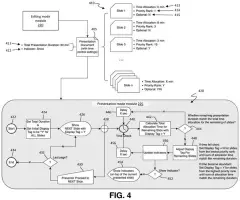
IBM's patent describes a way to do that analysis at the same time the sequencer is working. As the machine produces small chunks of genetic data called "reads," a computer system immediately picks them up, figures out which known genes they match, and slots them into a kind of organized holding area in fast-access memory. By the time the sequencer is done, the family-tree analysis is either finished or very close to it.
The goal is to turn a two-step process into one continuous operation, so that scientists get answers sooner, without changing the sequencing hardware at all.
inferring phylogenetic relationships concurrently with a sequencing operation, wherein the inferring comprises, while sequencing data is in production by a sequencing machine: accessing the sequencing data …
Translation: It builds evolutionary trees while the DNA machine is still running by grabbing the data as it streams out.
How the in-memory database sorts genes as they arrive
The patent covers a method that runs on a distributed computing environment (meaning multiple machines working together) and uses an in-memory database (a database that stores everything in RAM rather than on a slower hard drive, so lookups are extremely fast).
While the sequencing machine is actively producing data, the system does three things in parallel:
- Accesses sequencing data as it streams out of the machine, rather than waiting for a complete output file.
- Maps sequence reads by comparing each small genetic fragment against a reference to find which orthologous genes (genes that are similar across different species because they descend from a common ancestor) each fragment belongs to.
- Places reads into namespaces inside the in-memory database. A namespace here works like a labeled folder: each gene of interest gets its own folder, and relevant reads are dropped into the right one as they arrive.
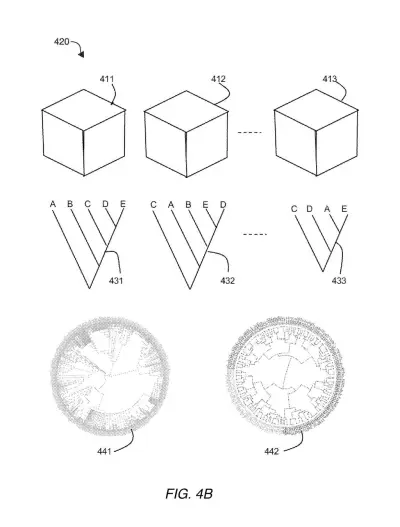
The end goal is phylogenetic inference, which means figuring out the evolutionary relationships among organisms or variants, essentially building a family tree from genetic data. By organizing incoming data into these labeled buckets in real time, the system has everything it needs to run that tree-building calculation without waiting for the sequencer to stop.
… mapping sequence reads from the accessed sequencing data to identify sequence reads corresponding to orthologous genes of interest, and placing the identified sequence reads into respective namespaces for the corresponding orthologous genes in the in-memory database.
Translation: The system sorts the genetic fragments into specific digital folders in fast memory to track matching genes.
What faster phylogenetics means for biology and medicine
For researchers studying fast-moving outbreaks or rapidly mutating pathogens, the time between "sequencer running" and "we know how this is related to other strains" is a meaningful bottleneck. A system that collapses that gap could mean actionable results hours earlier than current workflows allow.
IBM has been filing around bioinformatics and distributed data processing since at least 2024, which gives this patent some context as part of a broader push into scientific computing. For everyday users the effect is indirect: faster genetic analysis supports faster public-health decisions, faster drug development timelines, and quicker identification of novel variants in clinical settings.
IBM's 366th filing in our IBM coverage since May adds to a body that includes work on drug molecule structure and quantum control systems.
Source: US 2026/0301853 A1 at the USPTO (PDF). Full patent text and figures are in the official publication.
Get our take in your Top Stories
Liked this breakdown? Add Patentlyze as a preferred source on Google, and our plain-English take shows up more often in your Top Stories the next time IBM patent news breaks.
Add Patentlyze on Google
One click.
There are more where this came from
We read every patent application Big Tech publishes and send you the ones worth knowing. Plain English, free, every week.
The drawings · 7 sheets
7 drawing sheets from US 2026/0301853 A1 · click any drawing to enlarge


More from IBM
All 470 IBM patents →
More in Software
All 753 Software patents →
Apple
Apple Patents a Home Screen Widget That Shows When Family Members Are Active on Their Devices
Samsung
Samsung Patents an Auto-Schema Health Data Analysis System
Apple
Apple Patents a System That Compares Your Current Route to Your Past Trips in Real Time
Amazon
No comments yet