
Hyundai & Kia
Hyundai & Kia · Automotive · Filed Sep 10, 2025 · USPTO published Nov 19, 2026 · This week's release
Kia Patents a Hydrogen Car That Uses Its Power Generator to Recharge the Battery
A hydrogen car also carries a big battery, and this Kia filing is about when to fire up the fuel cell to refill it. Even a parked car sitting with the A/C on gets its own rule.
- Publication number
- US 2026/0365046 A1(US20260365046A1)
- Applicant
- Kia Corporation
- Filed · Published
- Sep 10, 2025 · Nov 19, 2026
- Inventors
- Soon Oh Kwon, Sang Beom Lee, Young Woo Jung, Jong Bin Kang
- Status when we published
- Waiting for an examiner
- Document
- 20 claims
- US classification
- 180/65.29
What Kia's hydrogen battery top-up actually does
A hydrogen car sits in a parking lot on a hot afternoon, motor off, air conditioning running. The battery is slowly draining, and nobody is going anywhere. Something has to decide what the car does about that.
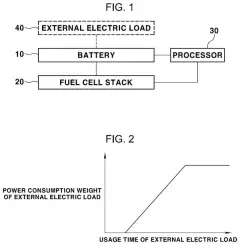
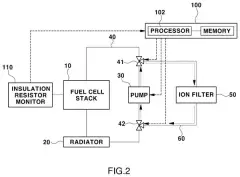
Kia's patent application describes how to make that call. Instead of letting the battery run down, the car can briefly switch on its hydrogen fuel cell (the part that turns hydrogen into electricity) to top the battery back up. Once the battery hits a set level, the fuel cell shuts off again.
The twist is how hard the fuel cell runs. Kia's filing picks the output that uses the least hydrogen for the electricity produced. Only when the battery keeps sinking anyway, say because you are powering appliances from the car, does it push harder and give up some efficiency.
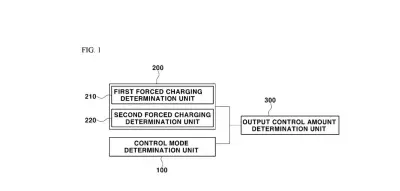
a control mode determination unit configured to monitor a current SoC for required vehicle output in a hybrid driving mode, compare the current SoC with a target SoC, and determine variable stack output of a hydrogen fuel cell for charge control or discharge control …
Translation: The system checks battery levels during hybrid driving and adjusts the fuel cell to charge or drain the battery as needed.
How the fuel cell picks its most efficient output
The filing covers a control system for a hydrogen car that pairs a fuel cell with a high-voltage battery. It tracks the battery's state of charge (SoC, basically how full the battery is) and compares it with a target level. The claims split the job into two situations.
In hybrid mode, the fuel cell is already running. If you need more power than the fuel cell is making, the battery covers the gap (discharge). If you need less, the extra goes into the battery (charge). The system sets fuel cell output along a preset efficiency line, which picks the output that burns the least hydrogen per unit of electricity. It counts both the fuel cell's own efficiency and the energy lost moving power in and out of the battery. In one example, accelerating at 30 kW with the battery at 70% against a 60% target.
In EV mode, the fuel cell is off. When the battery drops past a set condition, a forced charging routine turns the fuel cell on. It checks the gear first:
- Park or Neutral: for example, idling for minutes to hours with the A/C on.
- Drive or Reverse: for example, slow creeping.
The fuel cell runs along the efficient line until the battery reaches a set level (50% in the examples), then shuts off. If the charge keeps falling, such as when you plug in a heavy load, it switches to charging priority, a higher output that gives up some efficiency.
… a forced charging determination unit configured to monitor a current SoC for required vehicle output in an EV driving mode, compare the current SoC with a target SoC, control on/off of the hydrogen fuel cell for forced charging in response to a set driving condition satisfied …
Translation: The system also turns the fuel cell on during electric driving to recharge the battery when specific conditions are met.
What this means for hydrogen car range
For you as a driver, the promise is more miles from the same tank of hydrogen. The filing says the goal is better fuel efficiency and driving range, and that matters most for a car type where refueling stations are scarce. The filing even says the aim is to improve the appeal of hydrogen cars that lack refueling infrastructure.
It also covers a situation drivers rarely think about: the car sitting still. Idling in Park with the A/C on, or powering gear from the car, drains the battery like any other use. A rule that handles those moments efficiently could save hydrogen without you noticing. The filing is control logic for an existing type of drivetrain, so it describes a refinement rather than a new kind of car.
Hyundai's tenth filing since November in our Hyundai coverage follows earlier applications like a hydrogen car timer and a wheel-hidden charging plug.
Source: US 2026/0365046 A1 at the USPTO (PDF). Full patent text and figures are in the official publication.
Get our take in your Top Stories
Liked this breakdown? Add Patentlyze as a preferred source on Google, and our plain-English take shows up more often in your Top Stories the next time Hyundai & Kia patent news breaks.
Add Patentlyze on Google
One click.
There are more where this came from
We read the new patents from Big Tech, carmakers and more and send you the ones worth knowing. Plain English, free, every week.
The drawings · 9 sheets
9 drawing sheets from US 2026/0365046 A1 · click any drawing to enlarge


Show sheet 9

More from Hyundai & Kia
All 15 Hyundai & Kia patents →
More in Automotive
All 432 Automotive patents →
Amazon
Amazon-Owned Zoox Patents Sensors That Vote on Whether the Road Is Clear
Mobileye (Intel)
Mobileye Files Patent for Building Intersection Maps From Other Cars' Drives
Amazon
Amazon's Self-Driving Taxi Unit Patents Fix for Robotaxis Braking at Overpasses
Tesla
No comments yet