
Microsoft
Microsoft · AI / ML · Filed May 30, 2025 · USPTO published Nov 19, 2026 · This week's release
Microsoft Patents an AI Writer That Builds Documents One Section at a Time
Ask an AI to write a 40-page document in one go and the back half tends to drift into filler. Microsoft's patent breaks the job into an outline and writes each section separately, then fact-checks every piece against your source material.
- Publication number
- US 2026/0368416 A1(US20260368416A1)
- Applicant
- Microsoft Technology Licensing, LLC
- Filed · Published
- May 30, 2025 · Nov 19, 2026
- Inventors
- Sara MALVAR MAUÁ, Ranveer CHANDRA, Jessica Kristan WOLK, Bruno SILVA, Eduardo Rocha RODRIGUES, Rafael Soares PADILHA, Maria Angels DE LUIS BALAGUER, Leonardo DE OLIVEIRA NUNES, Roberto DE MOURA ESTEVÃO FILHO, Alexander Steven CROWN, Renato Luiz DE FREITAS CUNHA, Khushboo AGGARWAL
- Status when we published
- Waiting for an examiner
- Document
- 20 claims
- US classification
- 715/255
- Parent application
- Claims priority from a provisional application 63807221 (filed May 16, 2025)
What Microsoft's section-by-section writer does
A paralegal opens last year's contract, deletes every name and number, and starts typing the new deal into the same layout. Software teams and researchers do the same thing with manuals and papers. It is slow, and it is exactly the job Microsoft's new patent hands to AI.
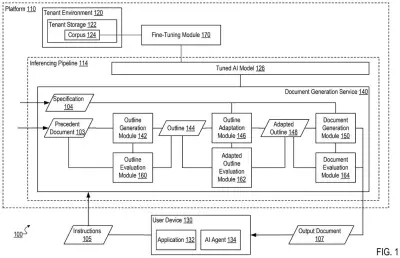
You point the system at an old document you like (the filing calls it a precedent) and at the facts for the new one, such as a term sheet or source code. The AI first copies the old document's outline, then edits it to fit your facts: dropping a results section if you have no results, adding an intellectual property section if your term sheet mentions it. Then it writes one section at a time instead of the whole thing in one go, so it stays on topic.
Each section gets checked against your facts. If the AI keeps failing, it leaves a placeholder asking a human to step in, instead of inventing something.
… generating an adapted outline by modifying one or more sections of the plurality of sections based on content of the one or more specifications …
Translation: The system updates the document outline based on your specific requirements.
How the outline gets adapted and checked
The system starts with three inputs: your instructions, a precedent document (an old file or template that supplies the structure, tone and level of detail), and one or more specifications (the facts for the new document, such as source code, a slide deck or a term sheet). It can also pick the precedent itself by scoring how similar your stored documents are to the specifications.
- Pull an outline of sections and subsections out of the precedent, saved in a nested format like JSON (a tidy list-within-a-list that software can read).
- Adapt that outline to the specifications by adding, removing or describing sections.
- Ask the AI to write each section in its own separate request, handing it only the facts that belong to that section.
- Stack the finished sections in outline order.
The AI is a base language model that has been fine-tuned (retrained) on a company's own documents, so it picks up house terminology and style. The filing says a company could keep separate tuned models for different document types, such as legal versus software documentation.
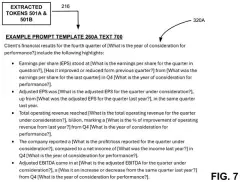
Quality checks run at every stage. The outline, the adapted outline and each section get scored, and weak ones are regenerated. One check pulls out names, dates and values and confirms the specifications mention them, which catches invented facts. After a set number of failed tries, a placeholder goes in for a human to fill.
… generating, through a plurality of individual inferencing operations using a tuned artificial intelligence (AI) model, a plurality of content segments each corresponding to a distinct section of the adapted outline …
Translation: The AI writes each section of the document one piece at a time.
What this means for office document software
If you write the same kinds of documents again and again, such as contracts, manuals or reports, this describes an assistant that starts from your own best example instead of a blank page. The draft should sound like your company's own files, and long drafts are less likely to wander off topic, repeat terms inconsistently, or go generic near the end.
The filing describes a word processing application talking to a cloud platform that keeps each customer's data in its own private partition. The placeholder step matters most for trust: when the AI cannot back a statement with your source material, it says so and leaves the gap for you, instead of filling it with a confident guess.
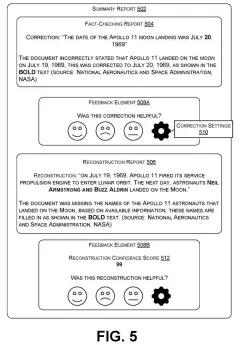
That makes this Microsoft's 86th filing we've tracked under Language AI since May, joining earlier work on a shortcut for matching searches and fact-checking AI summaries.
Source: US 2026/0368416 A1 at the USPTO (PDF). Full patent text and figures are in the official publication.
Get our take in your Top Stories
Liked this breakdown? Add Patentlyze as a preferred source on Google, and our plain-English take shows up more often in your Top Stories the next time Microsoft patent news breaks.
Add Patentlyze on Google
One click.
There are more where this came from
We read every patent application Big Tech publishes and send you the ones worth knowing. Plain English, free, every week.
The drawings · 11 sheets
11 drawing sheets from US 2026/0368416 A1 · click any drawing to enlarge


Show the other 3 sheets


More from Microsoft
All 681 Microsoft patents →
More in AI / ML
All 2,738 AI / ML patents →
IBM
IBM Patents an ML System That Writes Requirements Documents Automatically
Google
Google Patents an AI Document Writer That Knows When to Ask You a Question
IBM
IBM's New Patent Targets Inaccurate AI Answers When Reading Technical Documents
IBM
No comments yet