
Microsoft
Microsoft · AI / ML · Filed Jul 27, 2026 · USPTO published Nov 19, 2026 · This week's release
Microsoft Patents a Shortcut for Matching New Searches to Millions of Possible Results
When you type a search the system has never seen, Microsoft's patent describes a way to skip most of the possible answers. It finds a short list of likely matches first and checks only those.
- Publication number
- US 2026/0368493 A1(US20260368493A1)
- Applicant
- Microsoft Technology Licensing, LLC
- Filed · Published
- Jul 27, 2026 · Nov 19, 2026
- Inventors
- Kushal DAVE, Deepak SAINI, Amav Kumar JAIN, Jian JIAO, Amit Kumar Rambachan SINGH, Ruofei ZHONG, Manik VARMA
- Status when we published
- Waiting for an examiner
- Document
- 20 claims
- US classification
- 706/15
- Parent application
- Continuation of 18/278,361 (filed Aug 22, 2023)(18278361)
What Microsoft's million-label matching system does
Here's the squeeze behind online recommendations: to give you a good answer, a system has to pick from a huge pool of possible results, sometimes more than a million webpages, ads, products or movies. Check them all one by one and the wait gets too long. Keep the pool small and the best match may not even be in it.
Microsoft's patent describes a way to keep the giant pool but skip most of the checking. It builds a big web of connections from past activity, such as which results followed which searches. When something brand new comes in, a query the system has never seen, it finds the closest matches already in that web.
Those close matches point to a short list of likely answers. Only those get a full check, so you get results drawn from a million-plus options without waiting on all of them.
… identifying, using an Approximate Nearest Neighbor Search over existing nodes in the joint graph, a set of closest nodes to the received document; determining, based on the identified set of closest nodes, a subset of the plurality of classifiers for evaluating the received document …
Translation: It quickly finds the closest matches in a massive map to narrow down which tests to run.
How the system shortlists answers for new queries
This patent covers a way to recommend labels for something new in a field called extreme classification, which means choosing the best answers from more than a million possible ones. In the filing's terms, an input is a 'document' (a search query, a product, a movie title) and an output is a 'label' (a webpage, an ad, another product or title).
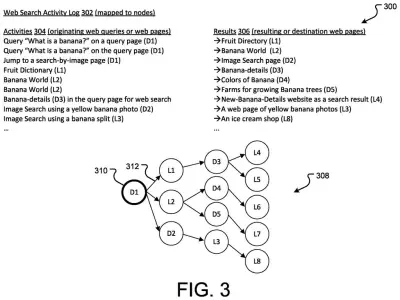
The system keeps a joint graph: a web of dots (nodes) where each dot is a document or a label, and arrows (edges) link them, often built from activity logs of what people searched and which results followed. The claims focus on the case where a new document is not in that graph yet:
- Run an Approximate Nearest Neighbor Search (a fast method that finds close matches without comparing against everything) over the existing nodes.
- Use those closest nodes to pick a shortlist of classifiers (one small model per label), so fewer than all of them are used.
- Run only the shortlisted classifiers to produce candidate labels.
- Send the candidates back as the response.
Closeness comes from graph convolution (blending a node's information with its neighbors' into a list of numbers), averaged across one, two and three steps out. During training, a label attention step (a weighting that decides which information to lean on) gives labels with few connections a wider look. The filing also describes learning from these links rather than reading each page's words, and adding the new document to the graph afterward.
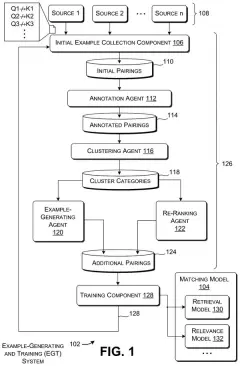
Systems and methods are provided for learning classifiers for annotating a document with predicted labels under extreme classification where there are over a million labels.
Translation: This technology tags a single document by sorting through a choice of over a million possible labels.
Why faster matching matters for search and ads
If you have ever waited on search results, scrolled past sponsored ads, or been shown 'you might also like' products, a system like this could sit behind the scenes. The filing names exactly those uses: web search, sponsored search, product recommendations and content recommendations. Faster matching could let a service keep a pool of millions of options without slowing down.
The payoff would show up as quick results even for queries the system has never seen. New queries and new products appear constantly, and the filing's claims treat that case as the main one. The patent does not say whether any Microsoft service uses this approach.
That makes this Microsoft's 85th filing in language AI work we've tracked since May, joining earlier applications on checking summaries against source docs and fixing washed-out text on streams.
Source: US 2026/0368493 A1 at the USPTO (PDF). Full patent text and figures are in the official publication.
Get our take in your Top Stories
Liked this breakdown? Add Patentlyze as a preferred source on Google, and our plain-English take shows up more often in your Top Stories the next time Microsoft patent news breaks.
Add Patentlyze on Google
One click.
There are more where this came from
We read every patent application Big Tech publishes and send you the ones worth knowing. Plain English, free, every week.
The drawings · 9 sheets
9 drawing sheets from US 2026/0368493 A1 · click any drawing to enlarge


Show the other 1 sheets

More from Microsoft
All 681 Microsoft patents →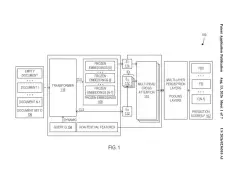
More in AI / ML
All 2,738 AI / ML patents →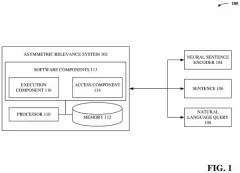
IBM
IBM Patents a Fix for Search Results That Match the Words but Miss the Answer
Adobe
Adobe Files Patent for Teaching Its AI With Made-Up User Requests
IBM
IBM Files Patent for Turning Finished Documents Into Question Lists for AI
Adobe
No comments yet