
Microsoft
Microsoft · AI / ML · Filed Jun 24, 2025 · USPTO published Nov 19, 2026 · This week's release
Microsoft Files Patent for Fact-Checking AI Summaries Against the Original Documents
AI summaries of long documents get built in layers, and every layer can add a mistake. Microsoft's patent application describes a checker that walks back through those layers and shows you the exact sentence behind each claim.
- Publication number
- US 2026/0368567 A1(US20260368567A1)
- Applicant
- Microsoft Technology Licensing, LLC
- Filed · Published
- Jun 24, 2025 · Nov 19, 2026
- Inventors
- Dasha METROPOLITANSKY
- Status when we published
- Waiting for an examiner
- Document
- 20 claims
- US classification
- 706/12
- Parent application
- Claims priority from a provisional application 63806533 (filed May 15, 2025)
What Microsoft's AI fact-check trail does
Ever asked an AI to summarize a long report and then wondered whether any single line was actually in there? With very long material, the AI often works in layers: it summarizes chunks, then summarizes those summaries, then summarizes again. Each layer is another chance for a mistake to slip in.
Microsoft's patent application describes a checker that takes the final summary, breaks it into individual statements, and hunts for the evidence behind each one. It walks backward through the layers until it lands on the exact sentence in the original text, or finds the layer where things went off the rails.
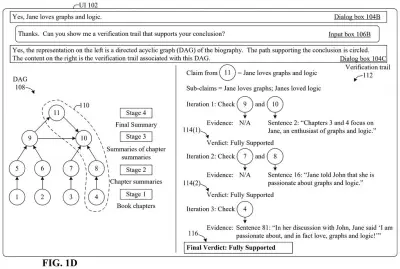
The filing's example is a chatbot asked whether a biography shows a character loving graphs and logic. You can ask for a trail and see that one supporting line was actually a joke: "Just kidding. My true passion is graphs." The claim gets flagged as not fully supported.
modeling a multi-stage generative pipeline based upon original source documents as a Directed Acyclic Graph (DAG) …
Translation: The system maps out how an AI creates text by turning source documents into a connected web of steps.
How the checker walks back through summaries
The patent models a multi-step AI process as a directed acyclic graph (DAG), which is a map of boxes and arrows where the arrows only point one way and never loop back. The original documents are the starting boxes (called root nodes, meaning boxes with no arrows coming in). Every AI-written summary or answer is another box, and the final answer is the last box, called the terminal node.
The checker splits that final box into individual claims, meaning single statements that can be verified. For each claim it repeats three steps:
- Gather evidence: text from the boxes feeding the final answer is cut into chunks, and every sentence gets a unique ID. The AI picks the IDs of sentences that strongly support or contradict the claim. Those IDs are checked against the real ones, so a made-up sentence gets thrown out.
- Give a verdict: the AI reads short summaries of that evidence and answers "fully supported," "not fully supported," or "inconclusive."
- Backtrack: if the claim holds up, the process steps one layer down to the boxes that fed the ones with evidence, then repeats until it reaches the original text.
Each claim ends with verdicts and an evidence trail: the exact sentences, which box each came from, and the summaries made along the way. If a claim fails, the in-between verdicts point to the layer where the unsupported content likely appeared. The filing says only boxes that contributed evidence get checked further, which cuts the workload. A chat-style screen can show the graph with the supporting path circled next to the trail.
… attempting to identify a provenance trace from an individual claim through individual intermediate nodes to an individual root node …
Translation: It checks if an AI statement is true by tracing it backward through every step of the drafting process to the source material.
Why summaries of long documents need receipts
If you use AI to summarize long documents, the practical question is always whether you can trust a given line. A trail that leads to the exact sentence turns "take my word for it" into something you can click and check. The filing lists a doctor reading medical literature, a lawyer summarizing past cases and a customer service agent working from policy documents as places where this matters.
It also helps the people building these tools. The filing says that when a claim fails, you can see which layer added the unsupported content, which tells builders where to fix things. It describes the checker running on a phone, a tablet or a cloud server, and mentions Microsoft's own GraphRAG as one layered process it could check. The filing also reports that it beat the other checking methods the authors tested on book summaries and news questions.
That makes this Microsoft's 31st filing we've tracked since July in the AI safety guardrails race, adding to one catching filtered images and one screening AI assistant traffic.
Source: US 2026/0368567 A1 at the USPTO (PDF). Full patent text and figures are in the official publication.
Get our take in your Top Stories
Liked this breakdown? Add Patentlyze as a preferred source on Google, and our plain-English take shows up more often in your Top Stories the next time Microsoft patent news breaks.
Add Patentlyze on Google
One click.
There are more where this came from
We read every patent application Big Tech publishes and send you the ones worth knowing. Plain English, free, every week.
The drawings · 11 sheets
11 drawing sheets from US 2026/0368567 A1 · click any drawing to enlarge


Show the other 3 sheets


More from Microsoft
All 681 Microsoft patents →
More in AI / ML
All 2,738 AI / ML patents →
IBM
IBM's New Patent Targets Inaccurate AI Answers When Reading Technical Documents
IBM
IBM Patents a Two-Layer System for Tracing Where AI-Generated Text Came From
Adobe
Adobe Files Patent for AI That Highlights Where in Your Document an Answer Came From
Adobe
No comments yet