
Qualcomm
Qualcomm · Chip · Filed May 9, 2025 · USPTO published Nov 12, 2026 · This week's release
Qualcomm Files Patent for Letting Devices Sleep Through Minor Background Tasks
Every time a sleeping gadget wakes up, it burns battery. Qualcomm's filing has the chip hold minor wake-ups in a line and handle them all at once.
- Publication number
- US 2026/0358873 A1(US20260358873A1)
- Applicant
- QUALCOMM Incorporated
- Filed · Published
- May 9, 2025 · Nov 12, 2026
- Inventors
- Ujjwal LNU, Srikanth RAPOLU
- Status when we published
- Company responded; back with the examiner
- Document
- 20 claims
- US classification
- 713/323
- Examiner
- PATEL, HETUL B (Art Unit 3992)
What Qualcomm's wake-up batching actually does
Ever had a phone or gadget that seems to wake up for no good reason, over and over? Behind the screen, small background chores, like checking location or running a self-test, can each pull a sleeping device back to life.
Qualcomm's filing describes a chip that sorts these wake-ups into two piles. Routine ones go into a waiting line instead of acting right away. The chip runs the whole batch at once when a timer runs out, when the line gets long enough, or when something urgent shows up, like you touching the screen or a message arriving from the network.
One wake-up for a whole batch costs less battery than many separate ones. And you still get an instant response when it counts.
queue one or more wake requests associated with a first category, in a monitoring interval; and execute the queued one or more wake requests based on one of: an expiry of the monitoring interval …
Translation: The chip holds off on minor background tasks until a set time period finally runs out.
How the chip decides when to run the queue
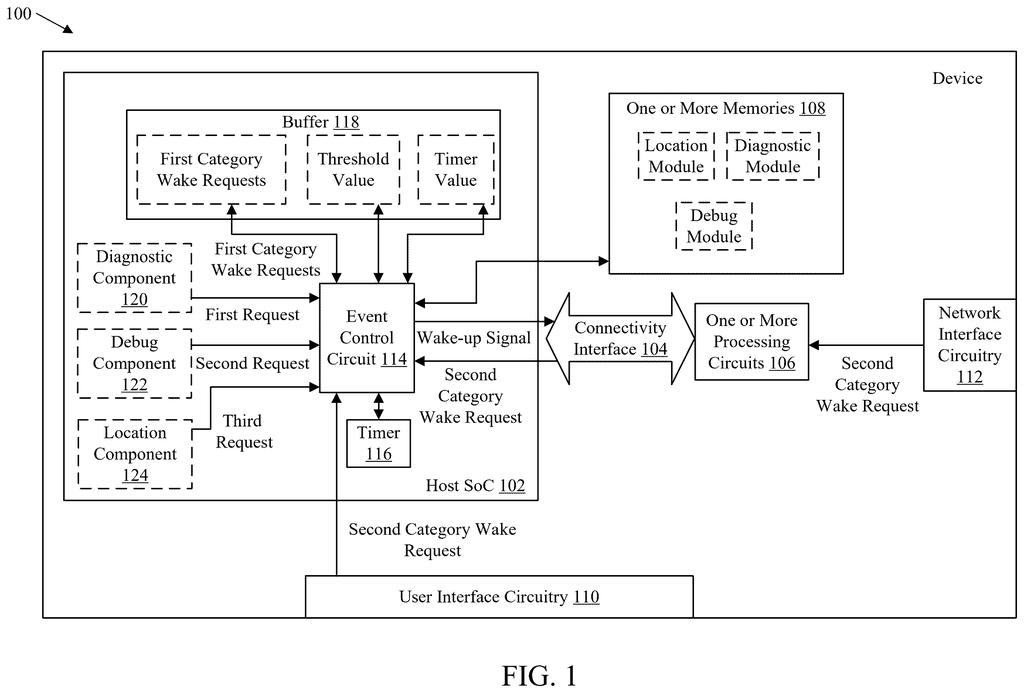
The filing is about a system-on-chip (SoC, the main chip that runs a phone, sensor or car module). Inside it sits an event control circuit, a small manager that decides when a sleeping device should wake up.
Wake requests come in two flavors. Low-priority ones come from inside the chip, such as a location check, a self-diagnosis or a debugging routine. High-priority ones come from outside: a touch, a keypress, or data arriving from a network. Low-priority requests go into a buffer (a temporary holding area) while a timer, started by the first request, counts through a 'monitoring interval.' The chip runs the whole batch when any one of three things happens first:
- The interval ends;
- The queue grows past a threshold (the example uses three);
- A high-priority request arrives, which runs along with the queue.
The settings can adapt. The filing describes a remote device with a long interval (20 hours or 2 days) and a high threshold (100 or 500). A device in a busy area or doing emergency work gets a short interval (20 minutes) and a low threshold (3 or 5). The timer can count in even steps or in doubling steps (1, 2, 4, 8 minutes). Batching also means the high-speed link between the main chip and other parts, such as the modem, is set up once per batch instead of for every wake-up.
… generate low priority wake requests in a low power state of the device and queue the generated wake requests, in a monitoring interval.
Translation: While resting, the device saves up unimportant tasks instead of waking up immediately.
Why fewer wake-ups could stretch battery life
Anything that spends most of its life asleep, such as a remote sensor, a tracker or a laptop in standby, loses charge each time it wakes. The filing describes a way to cut those wake-ups, and says fewer link setups could also make the device more stable. It points to devices in remote areas where long battery life matters, and lists phones, wearables, cars and smart-home gear as places the chip could go.
The application is still early. The examiner's first review rejected the claims as filed, which is routine at this stage and usually followed by amendments, so the final wording could change. The filing names no specific product.
Qualcomm's 72nd filing in our chip patent coverage since May adds to a run that includes loading data mid-work and reshuffling data during loads, two ideas we've tracked closely.
Source: US 2026/0358873 A1 at the USPTO (PDF). Full patent text and figures are in the official publication.
Get our take in your Top Stories
Liked this breakdown? Add Patentlyze as a preferred source on Google, and our plain-English take shows up more often in your Top Stories the next time Qualcomm patent news breaks.
Add Patentlyze on Google
One click.
There are more where this came from
We read every patent application Big Tech publishes and send you the ones worth knowing. Plain English, free, every week.
The drawings · 8 sheets
8 drawing sheets from US 2026/0358873 A1 · click any drawing to enlarge


More from Qualcomm
All 624 Qualcomm patents →

More in Chip
All 645 Chip patents →
Nvidia
Nvidia Files Patent for Letting Two Chip Types Share Self-Driving Camera Work
Sony
Sony Files Patent for a Two-Layer Camera Chip That Is Easier to Make
Google
Google Files Patent for Devices That Predict Their Own Overheating
Wing (Google)
No comments yet