
Samsung
Samsung · Networking · Filed Feb 26, 2026 · USPTO published Nov 19, 2026 · This week's release
Samsung Patents a Phone That Switches Its Tap-to-Pay Setup by Country
A phone bought in Korea can fail at Japan's transit gates because its tap-to-pay settings are fixed to the country where it was sold. Samsung's filing describes a phone that changes those settings based on where you are.
- Publication number
- US 2026/0371051 A1(US20260371051A1)
- Applicant
- Samsung Electronics Co., Ltd.
- Filed · Published
- Feb 26, 2026 · Nov 19, 2026
- Inventors
- Myeonghwan NAM, Ingwon HONG, Byounghak JIN, Jaehyung SEO, Moonseok KANG
- Status when we published
- Waiting for an examiner
- Document
- 20 claims
- US classification
- 455/41.1
- Parent application
- Continuation of PCT/KR2026/002943 (filed Feb 23, 2026)(PCTKR2026002943)
What Samsung's country-aware tap-to-pay does
Ever flown abroad and found your phone's tap-to-pay refused to work at the subway gate? It can happen because phones ship with settings tuned to the country where they were sold. A phone bought in Korea, for example, talks the way Korean readers expect, which is not how Japanese or French transit gates talk.
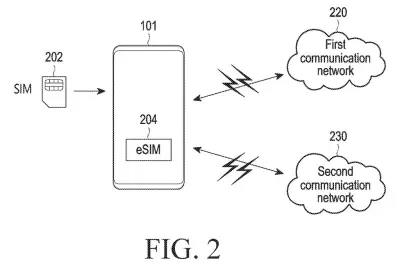
Samsung's patent application describes a phone that works out where you are, using cell signals, GPS or Wi-Fi, and swaps in the right settings for that place. It then checks whether the SIM card in your phone can handle them. Some SIMs only understand one of the three tap-to-pay dialects that readers around the world use.
If your SIM can't cope, the phone switches to a different secure chip built into the phone itself, so your transit card or payment can still go through.
… determine whether the first NFC configuration is supported by a subscriber identification module (SIM) included in the electronic device, and based on identifying whether the first NFC configuration is supported by the SIM, control the NFC circuit to perform NFC operations using the first NFC configuration or a second NFC configuration …
Translation: The phone checks if your SIM card supports the local payment setup, and switches if it does not.
How the phone checks your SIM before paying
The phone keeps a library of NFC configurations (NFC, or near-field communication, is the short-range radio behind tap-to-pay and transit cards). Each configuration is a bundle of settings for one area. The filing's example splits the world into five: the U.S. and neighbors, Japan, Korea, China and neighbors, and Europe and neighbors.
Each bundle says which protocol type to listen for (A, B or F, three standards that different readers use), whether the SIM can act as the secure chip, and a default route, meaning which secure chip receives commands from a reader. That chip is called an NFC execution environment, or NFCEE.
When something triggers a check, the phone runs three steps:
- Pick a configuration: the country from cell signals, GPS or Wi-Fi, the factory default country if location is unknown, or the one a wallet app asks for.
- Test it against the SIM: does the area match, and can the SIM handle the protocol types?
- If the SIM can't, use a non-SIM secure chip instead, such as an embedded secure element.
Triggers include powering on, toggling airplane mode or NFC, or swapping SIM cards. In the filing's example, a Korean phone with a SIM that only handles type A travels to Taiwan, where the transit card needs the embedded chip, so the phone switches.
… based on identifying that the first NFC configuration is not supported by the SIM, obtain a second NFC configuration supporting NFC execution environments (NFCEE) of a non-SIM type and control the NFC circuit to perform NFC operations using the second NFC configuration.
Translation: If the SIM card cannot handle the local standard, the phone switches to a non-SIM payment method.
Why your phone could stop failing abroad
The practical win is for anyone who travels with a phone bought somewhere else. The filing's own examples are a Korean phone that can't ride transit in Japan, and one that can't connect to France's readers. Your phone would sort out the right setup as you cross a border, with no menu digging.
It also helps when you swap in a local SIM, since the phone no longer depends on whatever that SIM can do. The filing says the same logic could run a paired smart watch or smart ring, so a wearable could handle a transit gate abroad too.
This is the 1630th Samsung filing we've tracked in our Samsung coverage since May, adding to work like the leg-assist wearable and the altitude misread fix.
Source: US 2026/0371051 A1 at the USPTO (PDF). Full patent text and figures are in the official publication.
Get our take in your Top Stories
Liked this breakdown? Add Patentlyze as a preferred source on Google, and our plain-English take shows up more often in your Top Stories the next time Samsung patent news breaks.
Add Patentlyze on Google
One click.
There are more where this came from
We read every patent application Big Tech publishes and send you the ones worth knowing. Plain English, free, every week.
The drawings · 15 sheets
15 drawing sheets from US 2026/0371051 A1 · click any drawing to enlarge


Show the other 7 sheets


More from Samsung
All 1,662 Samsung patents →
More in Networking
All 516 Networking patents →
Apple
Apple Files Patent to Simplify Cellular Setup on a Brand-New Phone
Intel
Intel Patents Automatic Wi-Fi Setup for Connected Home and Industrial Devices
Apple
Apple Files Patent for Borrowing Your Phone's Camera on a Shared TV
Apple
No comments yet