
Samsung
Samsung · AI / ML · Filed Feb 4, 2026 · USPTO published Nov 19, 2026 · This week's release
A New Samsung Patent Shrinks AI Models by Rounding Off Angles Instead of Numbers
Squeezing an AI model onto a phone means rounding off its numbers, and rounding too bluntly costs accuracy. Samsung's twist is to round the angle hiding behind each number instead.
- Publication number
- US 2026/0368475 A1(US20260368475A1)
- Applicant
- Samsung Electronics Co., Ltd.
- Filed · Published
- Feb 4, 2026 · Nov 19, 2026
- Inventors
- Hyunsoo KIM
- Status when we published
- Waiting for an examiner
- Document
- 20 claims
- US classification
- 706/15
- Parent application
- Continuation of 17/483,110 (filed Sep 23, 2021)(17483110)
What Samsung's angle-rounding patent actually does
Ever squeezed a big photo down to send it, only to find the colors went muddy? AI models have a version of that problem. To run on a phone, a model has to round off its stored numbers to shorter versions, and rounding too bluntly costs accuracy.
Samsung's filing targets models that deal with things that rotate, like 3D positions or the red, green and blue values of a pixel. Instead of rounding each stored number directly, the method first turns it into an angle, rounds the angle in even steps, and turns it back into a number. Those numbers were describing rotations all along, so rounding the angles spreads the error out more evenly.
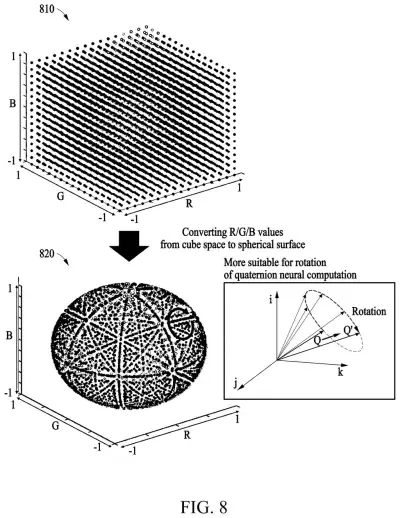
The filing also describes squashing each pixel's color values onto the surface of a sphere before an image goes in, so the whole pipeline works in the same rotation-friendly terms.
converting, by applying an angle function to each of parameter elements comprised in a multidimensional parameter vector of a multidimensional vector neural network, each of the parameter elements into a Euler angle …
Translation: It translates standard neural network numbers into geometric angles instead.
How a number becomes an angle and back again
The patent covers a way to build a quantized neural network. That means a version of a trained AI model whose numbers are stored in a low-precision format (the filing mentions 8-bit or 4-bit, down from 32-bit floating point) so it runs faster and uses less power on phones, wearables and similar devices.
It is aimed at multidimensional vector networks, such as quaternion networks. A quaternion is a four-part number (one real part and three imaginary parts) that can hold something like x, y, z coordinates or a pixel's red, green and blue values together. The steps are:
- Convert each element of a weight vector (the stored values that tell the model how strongly to connect its nodes) into a Euler angle, an angle describing how a rotation axis tilts against the x, y and z axes.
- Divide the range of angles into equal sections and round each angle to the middle of its section.
- Convert the rounded angles back into the low-precision values the model will actually use.
The filing argues that rounding the raw values at equal intervals makes the error in the angles uneven, which damages the rotation information. Rounding the angles evenly keeps that information at a similar quality everywhere.
The same trick can be applied to the inputs of each layer. For images, pixel colors are divided by the square root of the sum of their squares so they sit on a sphere of radius 1. The shrunken model then runs its usual math (multiply-and-add, normalization, pooling, activation) to produce an inference, meaning an answer.
… performing quantization on the Euler angles; and determining each of quantized parameter elements based on the quantized Euler angles.
Translation: It then shrinks those angles down and uses them to rebuild a smaller version of the network.
What this means for AI running on your phone
The practical payoff is AI features that run on the device in your hand, using less battery and memory. The filing names smartphones, wearables, TVs, home appliances, cars and AR devices as places a shrunken model could live, and image recognition is its main worked example.
The catch is scope. The method is built for models that use quaternion-style numbers, which are a small corner of the field next to the models most apps use today. It is most relevant if Samsung or its partners build on that style of network. The filing gives no accuracy results, so the size of the benefit is not shown here.
That makes this Samsung's 30th filing we've tracked in AI training and infrastructure since May, a count that includes one on sharpening blurry photos and one on metering compute power.
Source: US 2026/0368475 A1 at the USPTO (PDF). Full patent text and figures are in the official publication.
Get our take in your Top Stories
Liked this breakdown? Add Patentlyze as a preferred source on Google, and our plain-English take shows up more often in your Top Stories the next time Samsung patent news breaks.
Add Patentlyze on Google
One click.
There are more where this came from
We read every patent application Big Tech publishes and send you the ones worth knowing. Plain English, free, every week.
The drawings · 9 sheets
9 drawing sheets from US 2026/0368475 A1 · click any drawing to enlarge


Show the other 1 sheets

More from Samsung
All 1,662 Samsung patents →
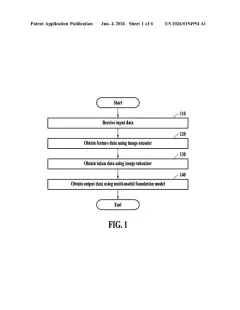
More in AI training & infrastructure
All 323 AI training & infrastructure patents →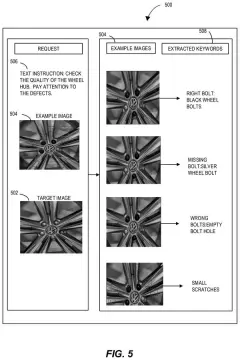
IBM
IBM Patents Photo Inspection You Set Up With One Example and a Sentence
Qualcomm
Qualcomm Files Patent for Shrinking AI Models So They Fit on Your Phone
Microsoft
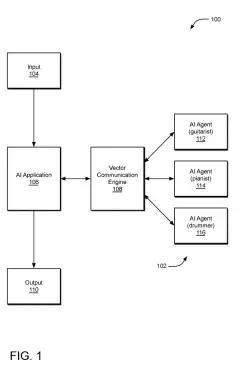
Microsoft Files Patent for AI Programs That Skip English and Talk in Numbers
Google
No comments yet